Monterey Peninsula: Sandbar and Grill

This is Kirk’s wonderful food blog, mmm-yoso!!! Every once in a while, he lets Cathy or me (ed from Yuma) do a post. Today, I want to write about eating like a tourist in Monterey.

One of us first meals that I can remember eating after I moved to Monterey many years ago was at a restaurant on Fishermen’s Wharf. Believe it or not, I never ate another dinner at the Wharf, one of Monterey’s major tourist attractions, for the rest of the time that I lived in the city. Why? Because no self-respecting local eats at Fishermen’s Wharf. All the locals know that the food in the Fishermen’s Wharf area is not especially innovative and will usually cost 25 to 50% more than the same meal purchased elsewhere.

However, as a regular on Chowhound, I have learned that not every person is as intrepid as Kirk, who we all know would happily ride public transportation in a strange city for an hour and a half just to sample an especially authentic version of papaya salad with salted blue crab. Many visitors to Monterey aren’t looking for the very best restaurant, if eating at that restaurant involves following complicated directions and driving through strange towns. Also, many visitors to the Monterey Peninsula are spending $250 a night for a motel room, just so that they can look at the beautiful bay instead of the cornfields or industrial landscape they live in and work in regularly. Therefore, they want to eat at one of the tourist restaurants with a nice view.

This past summer, as a public service, I decided it was my duty to try the two reportedly best restaurants in the Fishermen’s Wharf area. The first place that Steve, Helen, and I sampled is actually located on the commercial wharf, the far less touristy wharf located about 100 yards eastward from Fishermen’s Wharf Img_0084

When we arrived at the restaurant, it looked like the restaurant had vanished, leaving just its sign:

Img_0085

In fact, this restaurant is slung down below the level of the wharf, providing diners with a unique sea level perspective on the yacht harbor, full of various boats bobbing and rocking from wind and waves. A few years ago, my friend Chris and I had stopped here for an afternoon cocktail, and we were very impressed with the view. Unfortunately, on this visit, the sun was shining brightly through the windows, so the restaurant lowered its blinds and whatever view we might have had through the slats was obscured by the glare (which is why there is no beautiful picture from inside the restaurant of the yacht harbor boats at anchor).

As soon as we were seated, the extremely friendly (perhaps even overly friendly), jocular, and down-home waitperson brought us menus, the wine list, and bread and butter:Img_0087

While far from the best bread I was served on this visit, the sliced sourdough from Palermo bakery would provide a visitor with a nice introduction to Monterey sourdough, the slightly tangy crumb being surrounded by a decent, if not overly crunchy, crust. For locals, the bread was nothing special, but if I were visiting from Iowa, I would have been very impressed.

The next item that arrived at our table was a bottle of Esprit de Beaucastel ($36.50), one of my favorite California white Rhône style wines:

Img_0088

Although Steve was quick to note that the wine list had no vintage dates on it, I thought it was generally a good and inclusive list for a tourist restaurant. For example, a bottle of Vermentino was listed for only $24. While the wine list is not nearly as extensive nor as well priced as the one at Passionfish, prices were fair enough, and there were enough choices that I had trouble making up my mind.

That evening, the Sandbar and Grill had signs up advertising the availability of Dungeness crab. It seems that the harvest last summer had been poor, and the restaurant claimed to be one of the few places in town serving fresh crab at this time. As someone who grew up eating Dungeness crab, I had to start my meal with the crab cocktail ($11.50):Img_0089
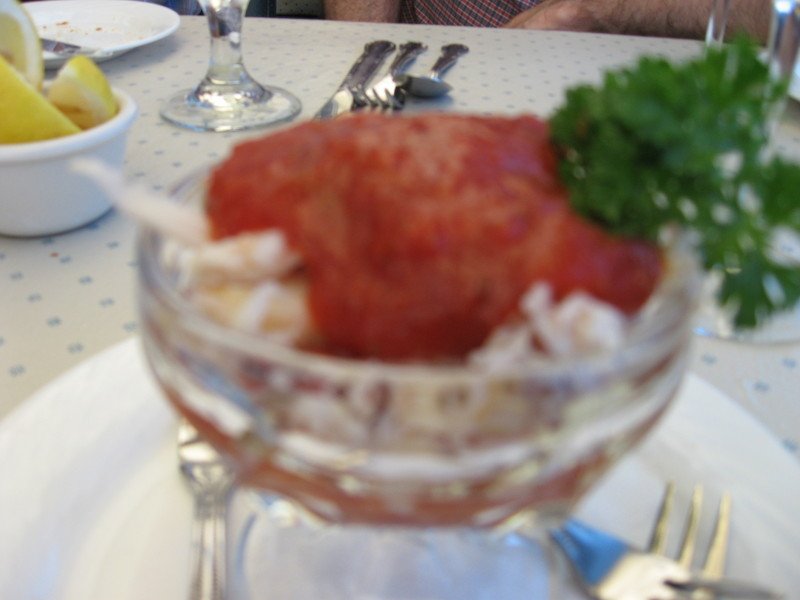
Even though that was a lot of money for an appetizer, I was not disappointed with the quality and quantity of the crab:

Img_0090

There were several large leg and claw chunks like this one in the cocktail. The crab meat was sweet and succulent. My only complaint, and it is a minor one, is that the cocktail sauce was pretty ordinary; I’m sure I could make a better one at home. If I were to order this dish again, I would request the sauce on the side.

The appetizer was followed by a cup of clam chowder ($4.95) and a Caesar salad ($4.95):

Img_0091_3 Img_0092_2 

The salad was, in my mind, pretty sorry. While it was sprinkled with grated cheese, there was very little creamy dressing for the fresh romaine leaves. The chowder, on the other hand, was tasty — a much better chowder than the standard pasty glue pots full of salty clam base that are often called clam chowder and served in tourist restaurants. Clams, celery, and potatoes added textual variation to the flavorful and creamy broth. The use of bay leaves added an herbal dimension to the flavor. I was also extremely impressed by the coarse, spicy, and flavorful fresh black pepper our waitperson ground onto the surface of the soup. It seems strange to me to comment about the quality of the black pepper, but to be honest, this pepper was extraordinarily tasty and made a major contribution to the chowder.

Our main courses showed up next. Helen opted for the crab Louie ($18.95), and her salad was a beautiful thing, topped with a flavorful mass of impeccably fresh Dungeness:

Img_0093

Steve ordered the ahi salad ($16.95):

Img_0095

Both salads were accompanied by wedges of hard-boiled eggs and rather ordinary supermarket tomatoes. I was impressed, however, with the mixture of greens used. The base for both salads was chopped romaine, which provides body and crunch. But both salads also contained delicate Salinas Valley greens, which provide taste and color variations. Helen’s Louie dressing was a creamy version of this classic, with decided spice and tomato flavors. While Steve pronounced himself happy with the lightly dressed ahi salad and quickly gobbled it up, I thought the ahi itself was not as fresh and pristine as I would’ve liked. Not bad, mind you, but certainly not sushi quality fish.

For my entrée, I ordered a favorite specialty of the Monterey Bay area, sand dabs ($18.95):

Img_0096

Sand dabs are a tiny species of sole (or perhaps flounder) unique to the central and northern California coast. The version that the Sandbar and Grill was good if not outstanding. The seven or eight little filets were very fresh and had a light and sweet flavor. The light breading on them was okay, but not crunchy. Rather than being sauced, the dabs were served with a lemon wedge and an excellent homemade tartar sauce, its creamy mayonnaise smoothness studded with tangy capers and bits of chopped onion. The side dish, linguine with vegetables and a little touch of olive oil, was nothing special although it matched well with the fish.

I really wasn’t sure what I would find when I decided to go eat with the tourists. I have to admit that my experience at the Sandbar and Grill was better than I expected. Even without the view, and even with a couple of items that were not as good as they should have been, my overall experience was positive. This is certainly not the finest dining on the Monterey Peninsula, but the food was good and the service was attentive if a bit obtrusive. I guess it is somehow fitting for me to try a couple of tourist restaurants since, hard as it is for me to admit, ed from Yuma is now a tourist, not a local anymore, in Monterey.

Monterey Peninsula: Whaling Station

While Kirk and Cathy are no doubt eating well and will soon share their experiences with you, this is ed from Yuma again. This time I am writing about a scrumptious meal I had while on vacation in Monterey.

We all know (or have heard of) someone who is a fanatic about his/her barbecue. It has to be beef (or pork), it has to be ribs (or brisket), you have to use oak (or hickory or applewood), it has to be smoked  for 8 hours (or 12), the dry rub has to be composed of the following spices (what ever) , the sauce must be based on tomato or molasses or mustard, and it has to be sour or sweet or spicy hot or etc. etc. Well, I like barbecue in general, but don’t care that much about how it is prepared, as long as it tastes good. On the other hand, I am a fanatic about prime rib because there really is only one right way to prepare it. And today, almost all restaurant "prime rib" is crap.

First, prime rib needs to be made with prime or higher grade beef. That’s what the term prime rib originally meant. However, these days, a restaurateur may legally call any standing rib roast a "prime rib." Calling it that does not make it really prime rib, no matter what the law says. Second, a serving of prime rib needs to be cut off an actual roast in an oven. Today, the vast majority of restaurant prime rib is roasted to very rare and then pulled out of the oven and left to cool. When a customer orders prime rib, the waitperson will ask, "how do you want that done?" As soon as you hear those words, you should get up and run out of the restaurant as fast as you can. What those words mean is that they will cut your slab of beef off a cooled roast and then reheat it to the degree of doneness that you specify. Sorry folks, that is not prime rib; that is LEFTOVERS! Reheating a piece of prime rib ruins it for human consumption (or at least, my consumption). It muddies the taste and destroys the texture of the meat. It becomes chewy, not silken tender. Third, a prime rib needs to be very slowly roasted at a low temperature. As most barbecue fanatics are aware, long cooking at low temperatures causes the fat cells to melt into the flesh and makes all of the meat very tender. This is what real prime rib should look like:Img_0104

Because I am such a fanatic about prime rib, I have largely given up ordering it when I go out to eat. My life has been full of enough disappointments without more lousy prime rib. So why were Steve and I walking into the Whaling Station, John Pisto’s flagship restaurant in the Cannery Row area of New Monterey, looking for prime rib? There are two simple answers. First, Helen had had an early dinner because she had to work the next morning, so Steve and I were free to go out, be manly, and gorge ourselves on meat. More importantly, the previous year as I was walking around reading menus (doesn’t everyone walk around and read menus?), a sign next to the Whaling Station’s menu proclaimed that each night the restaurant had one slowly roasted prime rib roast, and when that roast was consumed there was no more prime rib that evening. As I read that, my heart skipped a beat (I’m sure it had nothing to do with the projected cholesterol). It sounded like the prime rib at the Whaling Station was worth a try.

After we sat down, we made sure the prime rib was available, and then I asked the question, "how is the prime rib done this evening?" The waiter responded that the roast had already been cooked 12 hours and that it would be rare to medium rare at this time. Exactly what I wanted to hear. We placed our orders, and it was all I could do to keep from drooling onto the table in anticipation.

Soon a small basket of good bread and the bottle of 2002 St Supery Cabernet Sauvignon ($39) that we had ordered showed up at the table:Img_0099_2 Img_0100

While not as good as the bread at Passionfish, this was excellent Monterey Peninsula bread. We actually ate very little of the bread because our first courses showed up soon afterwards.

Steve had ordered a bowl of clam chowder ($6.95):

Img_0101

Like prime rib, I have been eating clam chowder virtually all of my life, and I know how it should taste. As soon as I took this picture, I quickly dipped a spoon in and savored the soup. The broth was rich with clam flavor and smooth and creamy to the tongue. No gloppy, floury paste here. Most clam chowders get their texture from potatoes and/or celery. In this chowder, while potatoes were present, the main textural elements were the numerous pieces of chewy clam. This was certainly one of the clammiest chowders I can remember eating – or, rather, tasting, as Steve inhaled the bowl so fast that I couldn’t slide another spoon into it.

I ordered a wedge salad with blue cheese dressing ($7.95):

Img_0102

In general, I eat iceberg lettuce rarely as it has very little flavor and provides only crunch in a salad. However, its nearly flavorless crunch is a perfect foil for an excellent blue cheese dressing, which this was. The wedge of crispy fresh lettuce was totally covered in dressing, which also pooled around the lettuce on the bottom of the plate. Served with a steak knife, the salad seemed to expand as I cut into it, pieces of lettuce and chunks of cheese tumbling down onto the plate. It was rich and heavenly. Like prime rib and clam chowder, blue cheese dressing is another childhood favorite. My mother cooked in and managed a basic blue collar American food restaurant when I was growing up, but she used to brag that her blue cheese dressing was better than that served at the country club in town. This dressing would’ve made my mother proud. It had a a creamy richness, great flavor, and numerous chunks of blue cheese.

There was more to the salad than just the lettuce and dressing as you can see in the picture. Radish slices, cucumber slices, thin ribbons of carrot, and chopped green onion provided nice color contrasts. The accompanying garlic bread was equally outstanding – crunchy, buttery, and full of garlic flavor.

Nonetheless, no matter how good the soup, salad, and wine, they were merely the opening act at this culinary concert. The headliner arrived next:

Img_0104_2

As high as my expectations were, this piece of rare prime rib exceeded them. Since Steve and I had ordered the smaller prime ribs ($29.95), I was pleasantly surprised to see an attached rib bone. The beef was fork tender, richly flavored, and wonderfully juicy. As I write this, I am starting to drool again as the memory of the meal comes back to me.

While the prime rib was the star of the show, the rest of the plate made a contribution to the wonderful meal as well:

Img_0105

The spinach was just barely wilted and full of green spinach flavors. The few bits of bacon in the spinach were overwhelmed by the leafy goodness of the vegetable, but the chef’s careful touch showed off in the freshness and intensity of the spinach taste. In my picture, it is hard to see the rich and creamy mashed potatoes, bursting with buttery goodness, because they are hidden under thin shards of deep-fried potato. Those shards added a nice textural contrast with their thin strips of crunch to the creamy goodness underneath. In the background, there is a ramekin of beefy and slightly salty au jus, just in case the prime rib was not rich enough in flavor, and another ramekin with two preparations of horseradish, if one wanted a spicy touch to the meal. While I tried both horseradishes and the au jus, the prime rib was good enough by itself.

For dessert, Steve wanted chocolate decadence ($7):Img_0106a

The triangle of super chocolatey cake was decadent indeed, and the presentation was very pretty, but I found it the least impressive part of the entire meal. I am not saying that this was a bad dessert, but it is a desert that I have had equally well prepared in several other places. Of course, it is just slightly possible that I was so stuffed and satiated and delighted and satisfied and happy with the savory courses that no dessert could have made me feel any better.

Although this post has been focused on prime rib, I should point out that The Whaling Station also serves a large variety of prime steaks and seafood dishes. The tuxedoed service was attentive and inobtrusive. While definitely not an inexpensive dining option (though not as expensive as the neighboring Sardine Factory), I suspect that anyone looking for an upscale meal in the Cannery Row area would do well at The Whaling Station.

After looking at an early draft of this post, Kirk called me "a prime rib Nazi." Maybe he’s right. Nonetheless, most of the time that I mention prime rib to my friends who care about food, they often ask why I waste my time on such a meal. What has happened to these people (I think) is that they have gone their entire lives without ever once having had real prime rib. After eating lousy "prime rib" a few times, most people with functioning taste buds stop ordering it – and for good reason. But I think that if you experience the sinful goodness of outstanding real prime rib, you might well become a prime rib Nazi too.

Whaling Station, 763 Wave St, Monterey CA 93940, (831) 373-2460.

Cantonese Feast at Yummy Yummy in Yuma

Hi everyone – this is ed from Yuma again.  mmm-yoso!!! is Kirk’s wonderful blog, and he is kind enough (or lazy enough?) to let Cathy and I post here occasionally. I felt like sharing with you a meal that I recently shared with some of my friends in Yuma. Unfortunately for you, they got to taste the dishes, you just get to read about them. Sorry about that!

Img_0230

I can still remember a conversation that took place about seven years ago. I was waiting for some take-out from this nearby Cantonese restaurant, and I asked Mary, the proprietor, if they could make greens with foo-yee sauce.

"You like foo-yee?" she asked with a raised eyebrow and a quizzical look on her face.

"I love it," I lied. I had never tried it. However, I had just read at Chowhound that Jim Leff initially judges a Cantonese restaurant by ordering greens in foo yee sauce. If they could not make it, the restaurant was not authentic. If they could not make it well, the restaurant was not likely to make anything else very well either. Img_0585

A week later, I opened my first carry out box full of greens in foo yee sauce. The pungent aroma of fermented tofu heavily laced with garlic rose to my nostrils in a scented steamy cloud. The greens were in a light colored sauce full of garlic chunks and smears of fragrant tofu. What a funky wonderful way to eat a vegetable. As it turned out, this was the true beginning of my relationship with Yummy Yummy restaurant and of my education about Cantonese cuisine.

Over the years, Mary has taught me about various Chinese greens and other vegetables, and her restaurant has served me hundreds of generally satisfying dinners and lunches.

Anyway, this last week I hosted a veggie dinner at Yummy Yummy for nine of my friends, most of whom have treated me to dinners and parties at their homes. This was my way of partially repaying them for their gracious hospitality without having to clean my apartment. Since I had just returned from San Diego (and the Ranch 99 market), I made sure that Mary had a range of interesting vegetables to prepare.

After we had opened numerous bottles of wine that we brought, and after steamed rice, fried rice, and a vegetable chow mein hit the table, the first real entree to arrive was fried tofu and pineapple in a sweet and sour sauce:Img_0199

As usual at Yummy Yummy, the tofu was perfectly fried, putting a nice skin over the moist and tender interior. To balance the sweetness of this dish, the bitter melon in black bean sauce was served next (photo is a bit fuzzy):Img_0201

While some of my friends are not very fond of bitter melon, I love this dish, and Mary has taught me how to select melons that are more or (as in this case) less bitter. The deep flavors of black beans provide a perfect foil to the smooth bitterness.

Two orders of vegetable egg foo yung soon followed. While not earth-shatteringly good, Yummy Yummy’s egg foo yung has a straight-forward, mild flavor. I had never ordered it until some of us got together for a similar feast last year, and one individual asked for egg foo yung, and I was reintroduced to a dish I only remembered from childhood:Img_0202

In order to show off Yummy Yummy’s Mexicali style kung pao, I asked Mary to prepare kung pao squash.This restaurant’s kung pao is done with celery, baby corn chunks, and water chestnuts instead of peanuts to add crunch. While I usually have the dish with chicken, the squash was a good substitute that added to the various textures (sorry about the blurry picture):Img_0203

Everyone thought this was a very tasty and spicy dish.

The next two dishes were two versions of yu choi (Ranch 99 was out of on choi and their long beans looked long on age). One of them was prepared with foo yee sauce, and the other with a ginger and garlic sauce (pictured):

Img_0205

Although both preps were good and showed off the fresh green flavors of the yu-choi, the greens with the foo yee sauce were the favorite of my friends. Considering that no one at the table had ever eaten foo yee sauce before we started dining at Yummy Yummy, it amazes me to hear someone say "wow, I love that foo yee sauce!" with a rich Texas accent.

Two plates of my favorite dish from the meal, tofu with fresh shiitake mushrooms, then followed:

Img_0207

The intense umami of the mushrooms is a perfect complement to the neutral tofu. In addition to the soft chewy ‘shrooms, the slightly bite resistent tofu skin, and the soft creamy interior of the tofu, thin strips of onion and celery added to the contrasts in textures and to the overall mouthfeel of this succulent and savory dish.

Tiny baby bok choi arrived next, their light sauce full of ginger slices and chunks of garlic. Again the cooking emphasized the freshness of the veggies, leaving plenty of cruch to match up with the softer green parts of the leaves:

Img_0209

The same wonderful baby vegetable then arrived paired with fried tofu:

Img_0211

For a bit of a change of pace, the spicy tofu was served with steamed tofu. Normally this dish would have had different vegetables, but I think Mary felt that she needed to use up the whole bag of shiitakes that I brought back from San Diego:

Img_0213

Amazingly, most of the spicy dishes at Yummy Yummy are created using a single dried chili pod from a type of chili that I cannot recall ever seeing elsewhere in a restaurant or a store (the pic is from another meal). Img_0179 Yet that single chili is perfectly capable of spicing up and flavoring an entire plate of food.

The final dish, egg plant in oyster sauce, was a fitting conclusion to the meal and tasted much better than it looked. The rich flavor and soft texture of the vegetable gave all of us pleasure:

Img_0215

I should note that most of these dishes are not regularly available at the restaurant. The menu simply notes "Chinese Vegetable" ($6.99), and normally only one or two Chinese vegetable choices are available at any time. But as you can tell, this restaurant is very willing to work with a customer (particularly a customer possessing a Chinese vegetable or two) to create wonderful meals.

I should also point out that this is not fancy food, by any means. Instead, Yummy Yummy prepares straight-forward, ingredient-centered dishes. Nonetheless, the 9 omnivores and the one mostly vegetarian person all left feeling like they had enjoyed a true gourmet experience.

I hope you readers and friends of mmm-yoso have enjoyed looking at and hearing about this meal almost as much as my friends and I enjoyed eating it. Unfortunately, I don’t think that’s possible.

Yummy Yummy Chinese Restaurant, 2241 S. Ave A, #23 in Palm Plaza, Yuma AZ 85364, (928) 376-0419.

Monterey Peninsula: Passionfish Part 3

I am sure that Kirk and Cathy are eating well and will soon share the details with the rest of us. Today, though, this is ed from Yuma focusing on the entrees at Passionfish on the Monterey Peninsula. Next time I post, I promise it will be about someplace different.

As most of you are able to tell by now, I am a fan of Passionfish in Pacific Grove. Not all of my meals of Passionfish have been outstanding; in particular, I can remember one clunker of a meal about five years ago. On some visits, a dish may not satisfy me as much as most dishes at Passionfish have. Nonetheless, three things remain constant at Passionfish. First, the dishes will be creative and often innovative. Second, the wine choices will be numerous and the wine will be priced close to retail. Third, the meal will represent an excellent dining value, particularly in comparison with the other restaurant choices in Carmel and on the Monterey Peninsula.

A major reason that this restaurant continues to lure me back again and again is that this is a restaurant with a vision. The couple that owns the restaurant, Ted and Cindy Walter, each has an important role in Passionfish’s success. He is the head chef, and she manages the dining rooms. The restaurant represents their personal passion and their individual dedication to the art and science of running a restaurant. Unlike so many restaurants that begin well and then go into a long declining phase, Passionfish has continually improved over the years. The dining rooms have been redecorated to make them more appealing. The chef is constantly working on new flavor combinations and keeping what he is most satisfied with and tweaking dishes that need improvement. In my third and final post about Passionfish, I want to share with you the most interesting and best tasting entrées I’ve eaten (or at least gotten a taste of) over the last couple of years.

While the emphasis at the restaurant is on sustainable seafood, the needs of carnivores are not neglected. My favorite entrée from the land has to be the duck confit ($17 last year, $19 this year):

Img_0306

It seems that ever since the restaurant opened, there has been a version of this dish on the menu. Last year, a moist, rich, and tender hind quarter of a duck was paired with succulent braised fennel and spicy chili potatoes. It is hard to believe that this duck has first been cooked in fat and then grilled because it is not at all greasy or oily. The meat literally falls from the bones. Braised fennel may be my all time favorite vegetable – tender, lightly flavored, and rich. The chili gratin potatoes add a nice contrast in terms of tastes and textures, while the Carmel Valley honey reduction provides a note of sweetness that helps bring all the flavors together.

Seafood, however, provides most of the entrées on the menu. I am continually impressed that the kitchen serves only fish and shellfish from sustainable fisheries; yet, at the same time, the menu will always has a wide range of seafood dishes to choose from. This year, for example, Steve ordered Alaskan sablefish crusted with pepper and accompanied by wasabi slaw and baby bok choy ($20):

Img_0071

The tender, perfectly cooked sablefish was moist and tasty, it’s mild flavor shown off by the intense black pepper crust. The accompanying items offered a wonderful contrast to each other. The julienned red apple slices in the wasabi slaw added spicy and fruity notes to the dish. On the other hand, warm sautéed baby bok choy contributed notes of fresh vegetable greenery. For added flavor, the fish was accompanied by a ginger vinaigrette, adding a touch of contrast with its sour spicy tang.

Another long time favorite at the restaurant is the barbecued shrimp with a spicy Vietnamese sauce:

Img_0367

Last year (as pictured) we had the dish as an entrée ($20); this year it was an appetizer ($10). The main difference is in the number of shrimp (eight or four) and the number of cabbage rice fritters (two or one). The shrimp are always perfectly cooked: moist and juicy inside and slightly charred on the outside. The fritters similarly showed the chef’s sure hand, the crunchy exterior completely covering the soft and moist interior. For contrast, the slaw here has strong lemongrass and chili flavors, hot and sour notes. The Vietnamese style sauce that literally underlies the shrimp also has spicy and tangy elements, but it’s more dominated by its touch of sweetness and garlic, with perhaps just a hint of fish sauce. This is a fusion dish that works extremely well.

On the same visit that Steve ordered that wonderful shrimp entrée, I had Gulf of Maine scallops ($23 last year, $24 this year):

Img_0365

To be honest, I have few memories of the broccoli rabe which was underneath the thyme risotto custard. And no memory of the risotto custard at all. But I hope I never forget those scallops as long as I live. That night, I got lucky – I hit the jackpot. Never in my life have I tasted scallops so perfectly prepared. How the chef was able to put a crunchy top and bottom on each scallop while leaving the center of each one perfectly rare and moist is beyond me. Frankly, I doubt if any chef could prepare scallops that perfect on a consistent basis. Each scallop tasted outstandingly fresh and was incredibly tender. I’m sure that the tomato truffle butter went well with the scallops, but again my only memory of that meal are those scallops because they were that good.

During my most recent dinner at Passionfish, I got to sample two very fine entrées. The first was tilapia with thyme mashed potatoes and garlic-balsamic vinegar butter ($18):

Img_0161

The picture here does not do justice to the dish. The tilapia was tender and mildly flavored. The mashed potatoes were soft and rich. The vinegar butter was an ideal accompaniment to bring together the potatoes and the fish. This sweet and slightly sour gravy perfectly accented the flavor of the tilapia and simultaneously cut through some of the richness of the potatoes. To balance the soft textures and complementary flavors of the fish and potatoes, the perfectly cooked (meaning still very crunchy) and extremely fresh sugar snap peas added a major contrast in flavor, texture, and color.

The other outstanding entrée that evening was wild Monterey salmon topped with coriander aioli over a cucumber, dill, and medjool date salad ($22):

Img_0162

Nothing I have eaten in my life really prepared me for the look and the taste of this entrée. The salmon was, of course, perfectly grilled – with a slight touch of char and a wonderful moist and flaky interior. The fish itself was extremely fresh and well flavored. I have learned to expect this at Passionfish. What amazed me that evening and still amazes me is the accompaniment to the fish. While the plate and the fish were both hot, the chunks of cucumber were cool as well as crunchy. The contrasts in taste, temperature, and texture were outstanding. The medjool dates provided a hint of sweetness and the dill added a background spice note, but both were secondary flavors. I assume the beautiful green color resulted from puréed cucumber skin (because I could detect no other flavors), and the resulting two-tone color scheme of the entrée made it almost as attractive to my eyes as it was attractive in my mouth. The aioli was truly a case of gilding the lily as its flavors of coriander and roasted garlic were certainly not needed to make the dish a tasty success. The salmon was rich and flavorful enough on its own, but I was not tempted to scrape the rich aioli off the fish. This was certainly one of the best and most original salmon dishes I can remember.

The only way I can properly end this look at some of my favorite entrées from Passionfish is with one of my favorite desserts there. This simple combination of good vanilla ice cream and unbelievably fresh and flavorful raspberries in a Cabernet syrup makes for a refreshing conclusion to any of the wonderful meals at Passionfish ($6):

Img_0308

Monterey Peninsula: Passionfish Part 2

Kirk and Cathy are no doubt doing interesting things and eating wonderful food, but just don’t feel like posting about it. So this is ed from Yuma filling in the gap with pictures and words about the salads and appetizers at Passionfish on the Monterey Peninsula.

Many people feel that the best items on the Passionfish menu are their salads and appetizers. These days, the menu contains three separate pre-entrée categories: Teasers, First Courses, and Salads, but for purposes of this post, our focus will be on first, salads and then, other appetizers.

Often the restaurant will have some version of a roasted beet salad. Last year, the roasted beets were served with greens, goat cheese, and very thin onion rings ($8). We liked it so much that we ordered it on both of our visits last year:

Merged_salads

Your eyes are not lying. Once the salad was made with roasted red beets, and once with yellow. In both cases the sweet earthiness of the roasted beet played off against the tang of the goat cheese. The deep-fried oniony flavor of the battered rings complemented the nutty arugula flavors. The varied textures also played across the tongue: the crunch of onion, the fleshy mouth feel of the beet, the chew of the greens, and the creaminess of the cheese.

This year we tried two other new salads. The baked Gorgonzola with curried greens, candied pecans, and golden chutney ($8) was an amazing tastefest:

Img_0067

This amazing salad combined tastes that I never would have imagined putting together. Of course, if you’re going to use a curried dressing on a salad (a thought that never occurred to me, I must admit) , it does make some sense to pair that salad with the complex sweet and fruit notes of a mango and currant chutney. But candied pecans? Yet the nuts added a different type of sweetness and certainly a distinctive crunchy texture to the salad. Most amazing in this context is the hot packet of crispy dough lying atop the salad. When cut open, the packet yields creamy melted Gorgonzola, the molten cheese adding salty and funky flavors that offer a total taste and textural contrast to the rest of the salad.

Another winner was the goat cheese salad with apples and toasted pecans ($8) (Steve and Helen split this salad – at no additional charge – so this picture is of a half portion):Img_0159

Again, the chef has sought to balance cheese flavors and textures with nuts, fruit, and greens. Steve and Helen wolfed down this salad so fast that I am unable to comment further as to how it tasted.

Last year, I enjoyed perhaps my favorite salad from all of my years of visiting Passionfish. Strangely enough, it was listed not with the salads, but as a first course: smoked sturgeon with celery and dates ($6):

Img_0300

The pristine Salinas Valley mixed greens were topped with four slices of succulent smoked sturgeon (as you can see, I ate half of one of the pieces before I remembered to take this picture). The firm flesh of the sturgeon had a distinct smoky flavor but was equally fresh and moist. It would not have been out of place on nigiri sushi rice. As the chef often likes to balance flavors, the savory fish was matched with sweet and sugary mashed medjool dates – as seen at the top and bottom of the plate. On each side of the plate were slices of crunchy celery in a celery puree. Once again, when I looked at the dish described on the menu, I had trouble imagining why these ingredients were together. Once I started putting them into my mouth, the chef’s skill came through clearly. Celery and dates go together well, and both of them seem to bring out smoky and slightly fishy taste of the sturgeon. And all the other textures in the salad stood out from the firm cool fish flesh.

One of the oddest appetizers I have ever eaten at Passionfish was on the menu this year. It was modestly called oysters with a cucumber relish ($8). If Melanie Wong hadn’t expressed her enthusiasm about the dish, it never would have occurred to me to order this rather peculiar looking appetizer:

Img_0160

For me, this little appetizer was much like two appetizers in one. When I took the first bite of one of the long flatworm-like objects tangled together around the middle of the plate, I was happy with the flavor but also puzzled, because I had forgotten some of the details of Melanie’s discussion of this dish. My mouth was crunching on something with a very familiar flavor, but the input from my eyes and the input from my mouth didn’t agree. I couldn’t figure out what I was eating. Luckily our very friendly and competent waitperson was in the area and I asked her what those things where. When she told me that they were shaved fennel slices with seaweed, suddenly my culinary confusion was gone. When I put the next long slice in my mouth, I first could taste the light licorice flavor of the fennel, which I had not noticed on the first bite. Then I recognized the dominant flavor, which was the seaweed, even though visually the seaweed is a small element in the appetizer. Overall, the center of this appetizer tasted like a lightly fennel flavored and very crunchy seaweed salad. Really amazing.

Around the edge of the seaweed/fennel combo were four plump briny oysters swimming in a sea of cucumber purée. The oysters were clearly the star of this part of the dish and the cucumber relish showed off their flavor very well. Nonetheless, unlike Melanie, I felt that the two halves of this appetizer never truly went together. When I tried to eat fennel slices and oyster simultaneously, I loved the textual contrasts but found that to my mouth the tastes jarred against each other. Your results might differ.

No discussion of appetizers at Passionfish would be complete without a look at what is many people’s favorite, Dungeness crab cake with a lime relish ($8 last year, $11 this year):

Img_0163

This is an outstanding crab cake. While the lime and tomato elements in the relish add a nice contrast in flavors and colors to the plate, here the Dungeness is king (please excuse the crab joke):

Img_0164

They say that a picture is worth a thousand words. In this case I will spare you those thousand words because that picture makes the best conclusion possible for a look at the salads and appetizers at Passionfish. Yum.

Monterey Peninsula: Passionfish Introduction

Who knows what Kirk and Cathy are up to right now, but this is ed from Yuma – just back from two weeks in Monterey – and I want to share my experiences at one of my very favorite restaurants. This post is part one. If Kirk lets me go on, I will discuss salads and appetizers in part 2 and entrees in part 3.

Kirk’s recent post about his rotation made me realize that one restaurant, Passionfish on the Monterey Peninsula, 600 miles away from where I live, is definitely on my rotation. Passionfish

Some background: before I became ed from Yuma, I was once ed from Monterey, where I lived for a dozen years. These days, Monterey is my favorite vacation spot, and I still have friends in the area, including a very nice couple – obviously tolerant of eccentricity – who let me stay in the spare bedroom at their condo. For the last several years, I have enjoyed a couple of weeks escaping the searing summer weather in Yuma and savoring the beautiful scenery, the cool ocean breezes, and the wonderful restaurants in the Monterey area. While I do some cooking in their kitchen and sometimes Steve and Helen prepare meals as well, Monterey and its adjacent communities (Carmel, Pacific Grove, Seaside, Marina, among others) have numerous tempting restaurants that cater both to locals and to the innumerable tourists who flock like seagulls every summer to this beautiful part of the central California coast. Never much good at resisting temptation (which partly explains my lack of marital success), I willingly succumb to these alluring eateries and usually have 7 – 10 restaurant dinners at various spots during my stay. While I like to try new places as often as I can, every year I must have at least two dinners at Passionfish, at the corner of Congress and Lighthouse in Pacific Grove. Let me try to explain why.

One main reason is evident in this photograph:

Img_0158

At first glance, this picture of a glass and a bottle of wine look pretty ordinary. Of course, the stemware is fine quality crystal (fairly common in good restaurants in the area), but it is the label on the bottle that is of most interest. The grape variety, Arneis, is a relatively rare grape in the Piedmont region of northern Italy where it is originally from. Even rarer, this version comes from a California vineyard, and to be honest, I had no idea that anyone had planted this grape anywhere in California. By my standards, this is an unusual wine ($30), but such unusual wines are common on the broad and well-chosen wine list at the restaurant. As someone who grew tired of Chardonnay many years ago and someone who loves infinite variety (which also partly explains my lack of marital success), the list at Passionfish, with its pages and pages of excellent and unusual white and red wine choices, is, for me, as much fun to read as the latest issue of "Funny Times."

What makes the wine list even more special is that Passionfish sells these wines at retail prices, the same price that one would pay for the identical bottle in a wine shop, if one frequented a wine shop good enough to have such an unusual wine. Img_0361 For example, this bottle of Marilyn Remark 2004 Marsanne (another rare grape varietal, especially in California) is on the wine list priced at $30. I saw an identical bottle at a local specialty grocery priced at $31. Another great tasting and unusual white wine is this estate bottled Gruener Veltliner from Schloss Gobelsburg in Austria, another $30 value. The only real problem with the wine list is selecting which one or two bottles to drink.

Img_0065

The last two pictures also illustrate another strength of the restaurant. Soon after being seated, diners are served several warmed pieces of the very best bread that I have eaten in years – if not ever. Accompanied by whipped unsalted butter, each slice is a sheer delight. The warm bread is so fresh that it has that just baked taste and smell. Although not a sourdough, the bread has a thick and supremely crunchy crust that crackles when bitten and contrasts with the soft bready interior, which has a slightly moist, dense fine crumb. The bread’s quality can be seen in the evenness of the tiny air pockets in the bread, no empty bubbles of air in any piece. In my opinion, the San Francisco Bay area and the Monterey Bay area produce the best bread in the entire United States. Nonetheless, the bread at Passionfish stands head and shoulders above any other that I remember. My waking thought the morning after my first meal at Passionfish this year was not about the incredible entrée or the outstanding salad or even the unusual bottle of wine I had consumed the night before. No, I woke up reliving the taste and textures of this wonderful bread.

This next photo, an appetizer of seared ahi accompanied by wasabi slaw ($9), illustrates other reasons for my passion about Passionfish:

Img_0363

My friend Steve has long loved seared ahi and has often ordered this dish at Passionfish. Every time I have had a taste of his nearly raw tuna, I have been impressed by the freshness and quality of the fish. In addition, this dish illustrates how the chef utilizes culinary fusion – often very effectively. In this dish, for example, we have a Japanese influence in the nearly raw tuna, the use of wasabi, and the topping of seaweed salad. But the word "slaw" with its Dutch roots reminds us that various cold salads are part of the American and western European traditions as is the use of tart green apple. Similarly, the menu bristles with terms like ravioli, spaetzle, charmoula, goat cheese, lemongrass, tostadita, medjool, risotto, Kurobuta etc. The kitchen clearly enjoys playing with various flavors and culinary traditions and recognizes no boundaries or borders. Of course, such cooking is risky, but it is also intriguing and challenging.

What is equally impressive about this dish (like many others on the menu) is that it has evolved over the years. If memory serves, the first two or three times that Steve ordered the dish, the tuna was crusted with black pepper and the slaw was julienned jicama lightly coated with a wasabi flavored coleslaw dressing and topped with pea shoots. In last year’s version (as seen in the photo), the ahi was crusted with a fennel seed rub, and the jicama and pea shoots were replaced by julienned green apple topped with seaweed salad. This year, the appetizer was absent from the menu altogether. In other words, the chef is constantly experimenting. He refuses to rest on his laurels, and his menu is constantly morphing. The menu not only changes over the years, but many items change week to week, and most days additional specials are available. One of my local friends suggests that the chef must go home every night thinking about ways to change and improve the food.

The wide range of ingredients and constantly changing dishes also make this restaurant a magnet for those of us who are fascinated with and passionate about food. On my first visit this summer, my meal began with a fried oyster salad with citrus-soy dressed arugula ($8):

Img_0069

This wonderful salad combines the nutty flavor of arugula, the tang of the dressing, and the succulent flavors of cooked oysters, while it contrasts the textures of the greens with the crunchy exterior and the soft, moist, and tender interior of the oysters. As I was taking this photo, a woman seated at the next table asked why I was taking pictures, and I gave my usual answer that I put the pics on my computer, which allows me to savor the meal again and again. She then asked if I was a Chowhound and mentioned that she went to the site often. I confessed I was, and after chatting with her for a minute or two, I went back to enjoying the salad.

Then my entree, sturgeon with Nueske bacon, sweet corn, banana potatoes, & tomato vinaigrette ($20), arrived at the table:

Img_0072

While this dish may look like a busy mess, the balancing of flavors is incredible. Nueske bacon is heavily smoked with applewood, so the equivalent of one or two slices gives the whole plate a smoky flavor which balances perfectly with the sweetness of the corn which itself is balanced with the tang of the tomato vinaigrette, all the flavors centered by the firm waxiness of the banana potato slices and the mildly fishy flavor of the sturgeon. As  I was savoring this wonderful concoction, the same woman from the next table leaned over and told me that there was another Chowhound at the next table over who was taking pictures of her food as well. When I went over and introduced myself, it turned out to be tokyoastrogirl (her blog is called Tuna Toast) who had ordered exactly the same meal as I did. Small world – but more evidence of the sort of restaurant Passionfish is.

While this culinary creativity sometimes works so well that it can leave a diner almost breathless with admiration; sometimes it can lead to mistakes (read the various comments, particularly Melanie’s, at this Chowhound post for evidence). Similarly, since the menu is constantly changing, a customer looking for an old favorite may well come away frustrated. I still remember a halibut dish that came with broth containing vegetables and little gnocchi. It was tasty and unusual, and I would like to try it again, but I have never seen it repeated on the menu.

The restaurant has two other failings in my mind. Sometimes, particularly on weekend evenings, Passionfish gets uncomfortably loud. There seems to be little effort at noise abatement as most of the walls and ceilings are hard surfaces. In addition, eating an excellent meal and drinking bottles of very reasonably priced wine certainly fuels conversation. And once the noise level reaches a certain threshold, everyone has to TALK VERY LOUDLY in order to be heard across the table. At this point, all the conversations in the restaurant have to rise to a higher sonic level, and the din becomes deafening.

The second major shortcoming of the restaurant is its view. Many people come to the Monterey Peninsula for the incredible natural beauty of the area, but outside of the beautiful food (and perhaps your attractive companion(s) at the table), a diner’s views at Passionfish are restricted to an office plaza or a Shell station. So I suggest one go walk in the afternoon at Point Lobos for the scenery – and eat that night at Passionfish for the food.

Passionfish, 701 Lighthouse Ave, Pacific Grove CA 93950, (831) 655-3311.

Road Trip: Green Village Restaurant SGV

Yes, this is a road trip, but  not Kirk's;  instead it's ed from Yuma who just had to get out of the 115 degree desert and into some good food.

The last time  I spent an evening looking for a restaurant in the San Gabriel Valley, I was like a little kid who was told he could only pick one from a gigantic box of mysterious chocolates. Complete choice overload. Which one? Which is the best? How can I choose? Smoke must have been pouring out of my ears from total systemic breakdown before I settled on the path of least resistance and had a mediocre meal at a Korean barbecue. Knowing that I would be spending another evening in the valley on my way up to Monterey, I vowed not to let that happen again, so I did what any wise individual,  faced with such daunting culinary  choices, should do – I asked Kirk to recommend a couple of places and mentioned that maybe a Shanghai style place would be interesting.

"You could try Green Village," he suggested, linking me to a Jonathan Gold article from 2002 and explaining that he himself had not eaten at the restaurant since it relocated many many years ago. "Oh, yeh, then you could also write a post on it for the blog." Now I understood his thinking -  I'd feel obligated to write it up in return for the advice, and he'd get another post out of me. OK, that seemed like a fair deal, and it did save me from a serious brain cramp.

When I stopped by to look the place over in the afternoon,  Picture_001 I learned that one thing had changed since Gold's review : there was now a young waitperson who could speak English, and in fact, he seemed pleased and amazed that some old pony-tailed white guy would be interested in a meal there. Talking with him made me feel welcome, and looking the menu over made me  salivate. Nonetheless there were pages of choices, most of them sounding delicious or at least weird and intriguing.

Being as food obsessed as I am, I spent the rest of the afternoon, after I left the place, pondering my choices (kid with candy box syndrome again). My first thought was to duplicate a couple of Gold's favorites, braised fish tail and the yellow croaker with liver moss (as Gold notes in his later review of Green Village, this second item is now listed in two places on the menu – once under its original name and once as yellow fish with seaweed – somebody must have showed them Gold's original article). But just ordering what Gold had already discussed would be too easy. And what could I say then? "Gold was right," or, "Gold was wrong." If I write the former, I have contributed nothing; if I write the latter, who is going to believe ME?

Therefore, I decided on two different items. First I ordered wine chicken ($5.50):Picture_002

Serving the chicken in a little cup in this fashion was perfect. It insured that each piece of the chicken was in contact with the complex flavor notes of the marinade. Notice also that the meatiest breast pieces lay across the top of the pile of chicken, while the bonier bits lurked underneath.Picture_003   What outstanding chicken it was. At first taste, the essence of cooked chicken flesh was intense. So often, we mask the flavors of chicken, drenching it in rich or spicy sauces or covering it with spiced breading and frying it. In this dish, on the contrary, the chicken flavor sang out like a rooster at dawn.

I am not implying that the wine sauce with its notes of ginger and hint of salt contributed nothing. In fact, the sauce was the perfect foil to show off the deep chicken flavors. As fast as the chopsticks brought the pieces to my mouth, I devoured them. Left with only the pile of bones, I looked through them, searching (the way one might search for a lost hiker in a forest) for missing slivers of flesh that had evaded my teeth at first. I wanted to taste every molecule I could.

For my main course, I went with the young server's recommendation of a whole fish dish. This fish was not listed on the menu and even the check contained the name only in Chinese characters with no translation, so I will call it Inside-out Fish, for reasons that will become apparent ($18.99). When it arrived at the table, it was truly a thing of culinary beauty and made me smile:Picture_004

On the other hand, my dining companion  for the night, Mr Fish, did not look quite as happy about his situation:Picture_005

Those of you familiar with Shanghai cuisine may consider a fish prepared in this fashion pretty standard, but I had never seen anything like it. Prior to being deep fried, the fish had been deboned, the fleshy side of each fillet had been deeply scored with a crosshatch pattern, and the fish had been dusted with flour. In the deep fryer, the scored flesh had expanded while the skin did not, and then the fish had been arranged, inside out, with the meat on the outside and the skin hidden within:Picture_006

Upon first tasting, I was delighted. The frying had added crunch throughout the fillets, but I could still taste the  fish. The sauce was beautiful to look at and contained fresh little shrimp, peas, and cubed carrots. Coupled with the complexity of the fish preparation, it was almost a taste bud overload. The flavor of the sauce reminded me of an excellent sweet and sour sauce, making me think that this would be a whole fish dish that might get even Aunt Sadie to like whole fish – no bones, nice crunch, and a pleasant sweet sauce reminiscent of so much of the Chinese food a lot us Anglos (particularly those of us who grew up far away from places like the SGV) considered typical Chinese food.

Nonetheless, I have to admit that Mr Fish was not a perfect dish. As I was eating away, I noticed that occasionally there would be a hint of dusty flour, which I attributed to the fact some of the flour on the skin side of the fish had not been cooked:Picture_007

Also, as I began the second fillet, the sweetness of the sauce began to cloy. I like candy as much as the next person, but I was approaching sugar overload. I found myself picking at the cheeks and tail of the fish to take a break from the unrelenting sweetness of the dish.  Of course, the real problem was not with Mr Fish and his accompanying sauce; it was that I was eating this dish by myself. Had I been feasting with friends, and sharing braised pork, braised fish tail, stir-fried veggies, and yellow croaker with liver moss, the bites of this tasty fish would have provided a nice contrast to the other dishes. As it was, that contrast was lacking.

Overall, however, I liked the restaurant very much. Even though I was the only non-Asian of the 29 diners that evening (and probably the only one not speaking Mandarin), I was treated with respect and friendliness. The menu was full of dishes I wanted to try. I kept wishing that I could instantly clone myself half a dozen times (like in a bad B grade Sci-Fi flick) and create enough other diners for a proper feast; however, with 7 of me sitting around a table, I wouldn't have been able to get a word in edgewise, so maybe that's not such a good idea. Instead,  it would be better to come back to Green Village with a group of friends and really explore what the kitchen can accomplish.

Green Village, 250 W. Valley Blvd (second floor), San Gabriel CA, (626) 576-2228.

Los Manjares de Pepe – Yuma

It’s just ed from Yuma again – this time writing a real long post about probably the best restaurant in town. Just in case you might someday be stuck in Yuma at mealtime, this is one place to remember.

Los Manjares de Pepe is widely recognized among the culinary cognoscenti of Yuma (well, at least among my friends and me) as the best Mexican restaurant in town – and that’s saying something considering how many good Mexican restaurants our town boasts of. It doesn’t get this acclaim because of its wonderful signage:

Img_0603

Or because of a beautiful building:

Img_0602

No, people love Pepe’s for several reasons, all of them connected with the great food served. First, Monday through Friday, the restaurant features incredible specials, all at $4.99.  On Mondays, you can get a caldo de albondigas. Img_0060_2 Like all meals here, the soup comes with good chips and spicy (if somewhat thin) salsa. You also get rice, beans, and your choice of tortillas. This great bowl of soup contains a nice rich stock, filled with 4 or 5 large and flavorful meatballs and an assortment of vegetables – celery, onion, carrot, and potato. Like the other specials, this a great deal.

On Wednesday, the special is peurco en salsa chipotle. This dish may be the tastiest thing I have ever eaten in Yuma, anywhere. Img_0600 Chipotle is not a common flavor used in most of Yuma’s Mexican restaurants, but Pepe achieves something fantastic in this dish. The large chunks of rich and slightly fatty pork are bathed in a intensely smoky and moderately picante sauce. The balance of flavors achieved is excellent. The chipotle flavor is strong and rich enough to please the palate without drowning out the meaty flavors of the pork chunks.

Friday’s special is truly special as well. I have always liked pozole since I first had a taste of this wonderful concoction of pork, hominy, and chile flavors years ago. The version at Los Manjares is, nonetheless, far and away the best I have ever eaten: Img_0673 Pozole broth with its meaty richness and deep red chile flavors is basically a great taste. Plus, Pepe doesn’t short change customers in any way with this dish. This stock is as powerfully rich and as densely flavored as it looks. The bowl is full of hominy kernals and huge chunks of pork. Img_0674 In addition to the chips, salsa, beans, rice and tortillas, the customer also gets a selection of add-ons (the picture is of the extras for two). Each bowl is served with chopped onions, lime wedges, chopped cabbage, and a generous helping of cilantro. These can be dumped into the soup to add flavors and crunchy textures. Other people add these extras onto the tacos or burritos made with the pork and tortillas. Either way, they provide a nice addition and add to the taste and mouthfeel of the dish.Img_0671

For those of you who are sure that your cholesterol has gone up twenty points just looking at the last set of pictures, I need to add that another reason why I think that Los Manjares is so outstanding is its chicken. We all have experienced lousy Mexican restaurant chicken. Take a chicken, boil it until tasteless, shred it, and then dump these wet flavorless shards of fowl into a flour or corn tortilla. But there is no boiled chicken at Pepe’s. For example, take a look at an order of Pollo Deshuesado (boneless chicken)($7.99):Img_0613_2

Each of these chunks of chicken is a delight to the mouth – tender, well-spiced, and full of chicken flavor. But Pepe uses his flavorful grilled chicken in his whole range of chicken dishes. I recently ordered the chicken enchiladas (senior size with 2 enchiladas, $4.99) and was served this wonderfully flavoful plate: Img_0677

As much as I love posting at Kirk’s wonderful blog because I can show all of you folks pictures of these wonderful things I have eaten, this picture does not do justice to this savory and succulent meal. The enchilada sauce, although it looks like most other enchilada sauces, has double the intensity of deep red chile flavor. And inside each of these rolled cylinders of tasty corn tortilla hides spicy and tasty morsels of Pepe’s flavorful grilled chicken.

A picture does begin to convey the quality of the world’s greatest chicken taco salad (no shell, $5.50):

Img_0642

It is hard for me to write about this salad without sprinkling superlatives over my sentences the way some of us sprinkle black pepper on scrambled eggs. On top of a smear of creamy frijoles, a mound of iceberg is surrounded by shredded pollo asado and topped with diced tomato, dollops of crema, rich fresh guacamole, shredded queso, pickled red onion slices, and chopped cilantro. Is it by chance that the colors across the top reflect the colors of la bandera – the flag of Mexico?  Anyway, as beautiful as this looks, the looks don’t come close to the flavors. Each shred of chicken is full of spice and is chewy tasty. The neutral background of crunchy lettuce brings together each biteful of salad. Overall, my mouth is full of multiple contrasts of temperatures, textures, and tastes (particularly after I drizzle salsa over the whole thing).

One of my favorite meals at Los Manjares – and years ago at El Zarape when Pepe cooked there – is the pollo al carbon, bone-in, well marinated chicken grilled outside over charcoal. Sometimes, after smelling the aromas of the chicken cooking outside, it is impossible not to order it for lunch (with beans & rice – 2 pieces $4.99, 4 pieces $6.99), so I have probably eaten this meal 20 times at least.  I knew I had to have a photo for this post, so on a recent dinner visit, I order the 4 piece dinner:

Img_0667 Sad to say, this was the sorriest version of the pollo al carbon I’d ever eaten. First, the 4 pieces were 2 legs and 2 thighs. And the pieces look bigger in the pic than they were in real life. Second, the chicken had either been overcooked on the grill or had been sitting around under heat for too long so that the crunchy exterior almost extended to the bone. In any case, this was a disappointing meal. Still, though, the chicken had an excellent flavor, and the overly crunchy meat was OK in tacos. I just missed the usual moist and chickeny interior that I have come to expect from this dish. It also reminded me that sometimes even the best places don’t always get everything right.

In addition to the daily specials and the (usually) great chicken dishes, Los Manjares also serves a wide range of wonderfully prepared Mexican restaurant standards. Since I had decided to do this post, I have been trying a few dishes that I could not remember eating before at Pepe’s. So recently, I ordered a carnitas torta ($3.99):

Img_0001I was astounded by the size of the sandwich; it filled up an entire plate. I know now that I had never ordered this dish before because it was a truly memorable torta, and not just because it was so large. The bottom layer of filling was a smooth beany smear of frijoles. On top of that was a layer of porky and crunchy carnitas. The carnitas was covered with chopped lettuce. The upper half of the bolillo was spread with Pepe’s flavorful fresh guacamole, chopped cilantro, and pico de gallo, that flavorful fresh salsa of diced tomato, onion, and jalapeno. I never for a moment considered trying to pick this sandwich up with my hands and eating it. Doing that would have spilled goodies all over my shirt, and goodies this good need to be in my mouth, not on my wardrobe. So I attacked the torta with knife and fork and began devouring. Nonetheless, as good as it tasted, I could not completely finish it. Wow!

Los Manjares also prepares a number of dishes in a rich and tomatoey ranchero sauce:

Img_0665 This is a plate of Camerones Rancheros ($10.99), one of the most expensive dishes on the menu. The shrimp were tender and tasty, their mild flavors enhanced by the subtle ranchero sauce. Equally good is the Steak Ranchero and the Lengua, which is also served in this sauce. Unlike the deep red chile or chipotle flavors of some sauces, the ranchero with its tomato and bell pepper accent stays in the background and compliments the flavors of the shrimp or meat.

I want to end this long post by looking at one last dish done very well by Pepe, Al Pastor:

Img_0610   Believe it or not, this gigantic order of tender dry rubbed pork slices sells for $7.50. No, that is not a misprint. There is so much food here (and don’t forget the chips, salsa, and tortillas) that I only order this if I am really hungry, and I still often bring enough pork home for a midnight snack. I doubt if there is a vertical spit in Pepe’s kitchen, but this dish does not suffer from that in every way. The spices rubbed onto the meat before cooking add flavor to the meat. What’s more, the pieces of pork are often tastily charred:

Img_0614 As this picture also illustrates, my favorite way to eat the Al Pastor is folded into a taco with the pico de gallo (and sometimes the pickled onions) from the plate added to the taco. Moments after this photo was snapped, I ladled a couple of teaspoons of salsa on this homemade taco and chowed down. Chewy, spicy, meaty, tender, crunchy and corny all at once. Yum!

I do have one fear about writing this post for Kirk. I can imagine some big city restaurateur reading this blog and suddenly deciding that he could make a fortune selling Mexican food this good in New York City. Then virtually overnight, Pepe would be pulling down six figures, living in a Manhatten condo, and charging willing diners, who had lined up outside the restaurant 2 hours before it opened, $50 for a plate of Al Pastor. If that should happen, New York, as well as Pepe and the restaurateur, would be the richer, but poor old Yuma would be left with a huge culinary hole. So if you are a New York restaurant owner, just let me say, "Nah, it’d never work."

Los Manjares de Pepe, 2187 West 8th St., Yuma AZ. (928) 782-2366 

High Way 95 Cafe – Yuma

Yeh, it's ed from Yuma again. Today I decided to write about one of Yuma's Asian restaurants. Yes, you read that right – Yuma has Asian restaurants.

March 2011 update: Since this post was published, Hwy 95 opened a fancier location called Palagor, which closed after a few months. More recently, they have taken over the old Fortune Cookie locationat B and 16th, so they now have two restaurants.

This small restaurant perched at the edge of town on Hwy 95 is overall the best Asian restaurant in Yuma.

Img_0653

You don't know how hard it is for me to write that last sentence. First off, I am automatically suspicious of any restaurant that claims to serve "Mandarin, Thai, and Asian Cuisine." In addition, some of my first visits to the restaurant were unpleasant: The "pan-fried" dumplings were deep fried. An "Indian" noodle dish was a nasty disaster. On one of my first visits to the place with friends, they forgot one person's order – and that person was (at that time) my girlfriend (now my latest ex-girlfriend). I also have developed a long relationship with another Chinese restaurant in town that is still a personal favorite. So it has been hard for me to concede primacy to Highway 95 Cafe, but as a whole, this is the best in town in terms of quality and especially variety.

One thing I love about the place are the varieties of soup noodles. This is the Roast Pork with Wonton Noodles Soup (5.95)

Img_0622

A very nice-looking and generous bowl of soup. Though hard to tell from the photo, the roast pork is in chunks, not thin slices, and has a good porky flavor. It includes plenty of perfectly done noodles with some pull to them, a few leaves of napa cabbage, and several broccoli florets. On the other hand, the two wontons are pretty flavorless and filled with just a little ground mystery meat. Img_0623 Similarly, the broth lacks a deep savory richness, its main flavor note being a background hint of soy sauce. Nonetheless, I would gladly order this hearty soup again.

Surprisingly (considering that the owners and chefs at the restaurant are Mandarin speaking Chinese), some of the best noodle soups on the menu are versions of Thai soups. The Tom Yum soup (without noodles $4.95, with noodles $5.95) caught my attention the very first time I slurped up a spoonful of its sour and spicy broth. While the underlying stock may be as lightly flavored as in the pork noodle soup, here the Thai spices, lemon grass, and sour tang provide a depth of taste that the other soup lacked:

Img_0635

Yes, that soup is as spicy hot as it looks. Another Thai style noodle soup is the Coconut Curry Noodles Soup (5.95).

Img_0657

Here the spicy hot broth is matched by Thai red curry flavors and the creamy mouthfeel of coconut milk. I also love the array of veggies here. Img_0660 In addition to the red onions, cilantro, eggplant strips, and shrimp visible in the large photo, there are chunks of chicken, sizable pieces of green bean, slices of tofu, and two or three baby okras. While this may not seem amazing to those of you who live in large cities, such a range of unusual veggies is hard to find in most restaurants in Yuma, much less all put together in one soupbowl. For some reason, I had never tried this soup before I started visiting the Highway 95 Cafe to take pictures for this post. What a discovery!

Another of my favorite dishes here is the Pad Thai:

Img_0615   

I know some of you are probably thinking, how ordinary. And yes, this classic dish, which has introduced many newbies to the wonders of Thai cuisine, is often perfunctorily bland and clumsily prepared even at good Thai restaurants. Highway 95's version, however, is as good as I'veImg_0616 ever had – anywhere (of course, I have never been to Bangkok). The rice noodles are perfectly cooked and then stirfried with a whole scrambled egg, 5 or 6 small fresh-tasting shrimp, several chunks of chicken, a few strips of tofu, green onions, and bean sprouts. The combination provides various textures and multiple flavor notes. The Pad Thai is also supremely well-balanced. I order it extra spicy, so I get two small dried red chilies, and this background heat matches up nicely with the tang of the lime wedge, the hints of tamarind, and a touch of sweetness. I'm sitting here at my computer salivating at the thought of it.

I don't mean to imply that everything is outstanding at the cafe. In my mind, it is too difficult to do such a wide range of cuisines with uniform success. Recently, I tried the Chow Kueh Teow, Img_0685 a Malaysian seafood and noodle stirfry($6.95). Although I generally liked most of the mixture of seafood (shrimp, mussels, and tender squid slices), krab was the predominent element. Also, unlike the Pad Thai, this dish lacked much interplay between its various elements as soy sauce provided the primary flavor, making the end result monochromatic in taste and in looks.

Another dish that left something to be desired was the Seafood Chow Fun with Lobster Sauce ($8.95). I don't mean to imply that this item was a total failure. The three large shrimp were pristine and quite tasty. On the other hand, the rest of the seafood Img_0636consisted of one small clam and a few pieces of krab. Moreover, when I look at my photo, I'm not sure if it's a bit blurry or if that's how this noodle dish actually looked in real life. Yes friends, just as it appears, this was a bowl of either gloppy goop or goopy glop – I'm not sure which. To make it worse, both the chow fun and the little bit of cabbage and carrot were overcooked, so the mouthfeel was as uninteresting texturely as this picture is boring visually.  Like the photo, the flavors were monotone and understated as well.

Nonetheless, it really wouldn't be fair to end a look at Yuma's best Asian restaurant on such a down note, so I'd like to finish with two of their best items. The Kong Pao Chicken (Sm $4.25, Lg $7.25) is a good version of that classic dish:Img_0652

Served with plenty of steamed rice, this is the small size portion of the Kong Pao Chicken, and it is full of flavor. The first tastes hit the mouth with both the hot spiciness of the chilies and a distinct peanut flavor. The textures contribute excellent contrasts as all the crunchy ingredients – peanuts, celery and finely diced water chestnuts (and something else I couldn't identify) – balance against the extremely tender chicken pieces. In fact, I have only two minor complaints about this fine lunch: 1) the chicken is almost too tender and lacks chickeny flavor (maybe too much parboiling?), and 2) there is a background sweet flavor that is unfortunately common in much Chinese food prepared for Americans.

Another excellent item is Homestyle Bean Curd ($6.25):

Img_0638

What's not to like? The tofu is perfectly cooked with a chewy skin and moist and tender interior. The tofu plays off against the crunch of the cabbage and broccoli. The chile flavor is also excellent. It is hard to see from this photo, but that chile in the foreground is not your standard Chinese restaurant chile. If you look carefully, this chile still has a dark green cap on it. According to my good friend and eating buddy, Chip, the proprietors actually grow some of their own chilies for use in special dishes at the restaurant. And this is a special dish.

Because of the good flavors, wide range of dishes, and excellent prices, Highway 95 Cafe has been voted the best Asian restaurant in Yuma by readers of the local paper. I know that these sorts of polls often select eateries about as well as American voters choose politicians, but in this case, I must admit, they got it right. Let's just hope the voters do as well in 2008.

High Way 95 Asian Cuisine, 2585 E. 16th St. , Yuma AZ, (928) 329-8882.

Borders Cafe – Yuma

No, Kirk has not moved to Yuma. This is just Ed from Yuma doing another post for mmm-yoso!!! Hope you all don’t mind.

Just a brief update – I dropped into Border’s last week (Jan 21, 2008) and didn’t recognize anybody there. Tried to order a couple of my favorites (fish ball soup and sting ray soup) and were told that they no longer made those. Found out that a new family was running the place. I did have a bowl of rightous, beefy albondigas de res,  but this post is no longer a useful guide to the place. R.I.P.

I feel a little strange writing another post about Yuma for Kirk’s marvelous blog that generally centers on San Diego dining. I guess my justification is that in my mind Yuma is just a distant suburb of San Diego – it is thinking like this that keeps me sane when it’s 115° here.  In this post, I’d like to focus on a small, family run Mexican restaurant in which the chef, the grandmother of the family, has around 30 years of experience of cooking in Cabo. The place is called Borders and located on Yuma’s main drag 4th ave.

Img_0649

Many of the items available here are fairly standard dishes found in many Mexican restaurants, although always done very effectively at Borders. For example, the chiles rellenos here are long and beautiful to look at:

Img_0654

Img_0655Although the chilies themselves are not especially picante, they have a good flavor and the rellenos are not lost in a thick layer of breading, a soup of sauce, or a mound of cheese. Even the cheese stuffing is fairly thin so that the overall effect is a balanced flavor.

Another standard dish done very well here is the taco salad with carne asada:

Borders_005

The flavorful slices of steak were not just the topping of the salad but extended all the way through. Yum. The fish tacos are another treat:

Borders_007

Each taco contains two small crunchy fish fillets. These are as good as you would get in Yuma. While lengua is found in many Mexican restaurants in town, Borders serves it as lengua estofada – or lengua stew.

Borders_006

My friend Betsy raved about this molé after she had it, so I had to order it also and I agree with everything that she said. It is easily the best in town. Most moles are too sweet, and sometimes plain boiled chicken is just topped with sauce. In this case the mole sauce is nicely balanced, slightly spicy, and full flavored. The chicken is fall apart tender.

Borders_002

Borders also offers some interesting dishes that cannot be found in another Mexican restaurant in Yuma.

Img_0645

Caguamanta, or stingray soup, has been heretofore available only at Deliciosos del Mar, a taco truck. Borders’ version is rich and deeply flavorful, if a touch too salty for my taste.

Img_0648It is full of small chunks of the stingray and various vegetables, such as Img_0647potatoes, carrots, onions, tomatoes, green peppers, and olives. Another amazing dish here is albondigas de pescado. The deeply flavorful and chili infused broth is full of pale and mildly fishy meatballs along with some veggies. Unlike fishballs in Chinese cuisine, these balls have a texture more like meatballs and a taste that is enhanced by the wonderfully rich and tasty stock:

Img_0620

My only concern about this restaurant is that it contains only about 10 tables, and it seems like every time I come there it is busier than it was the last time. I guess that’s good for the restaurant, but I always worry that I may have to stand and wait if the customer base continues to grow and if winter visitors find out about it. Prices are very reasonable. Most medium soups (lunch size) are 4.99. I believe all the entrees are under $8. While there is minimal atmosphere, the service is efficient and caring. Another reason to visit Yuma, the great metropolis of Southwest Arizona.

OK, the only metropolis of Southwest Arizona.