Peperonata

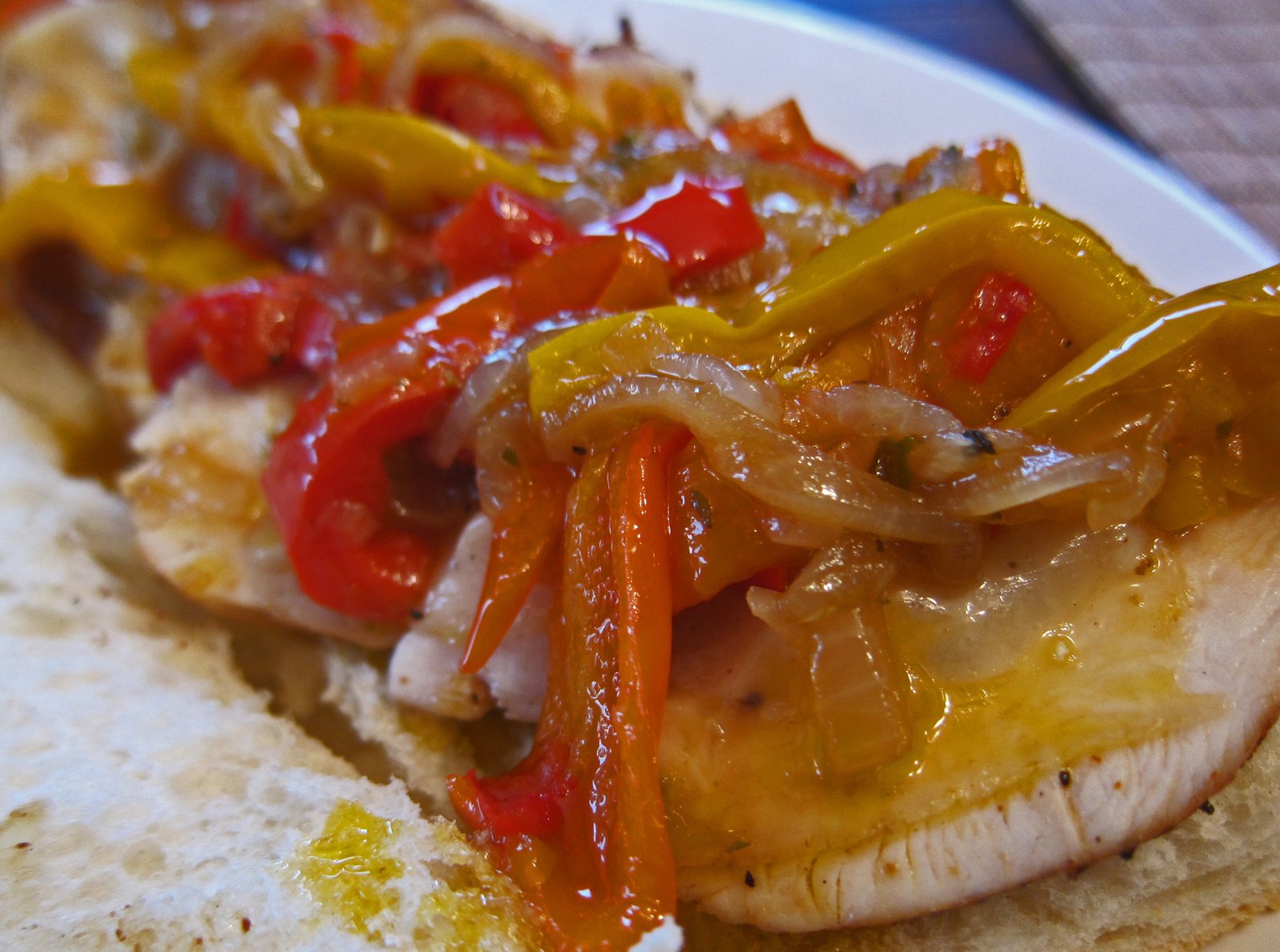
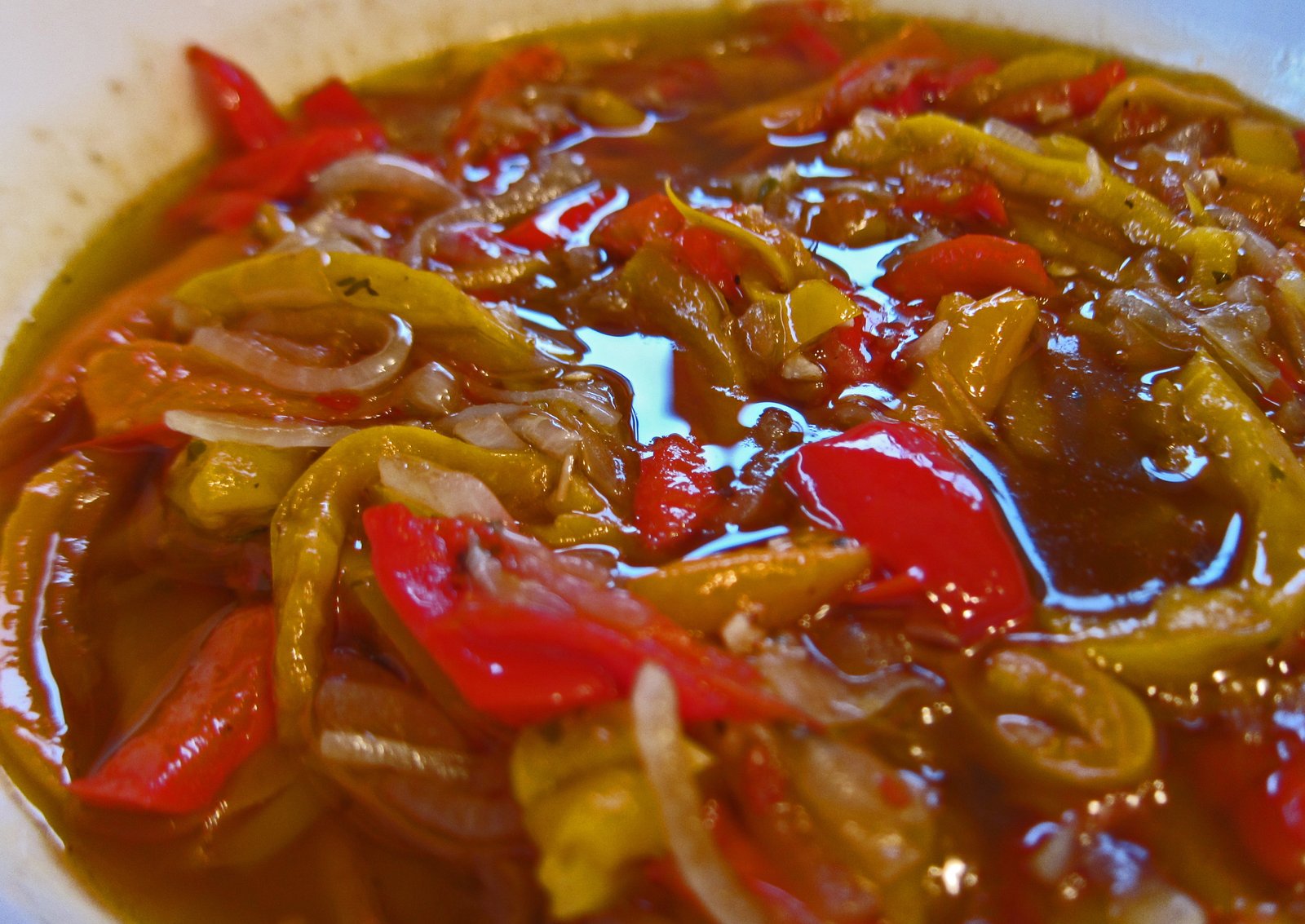
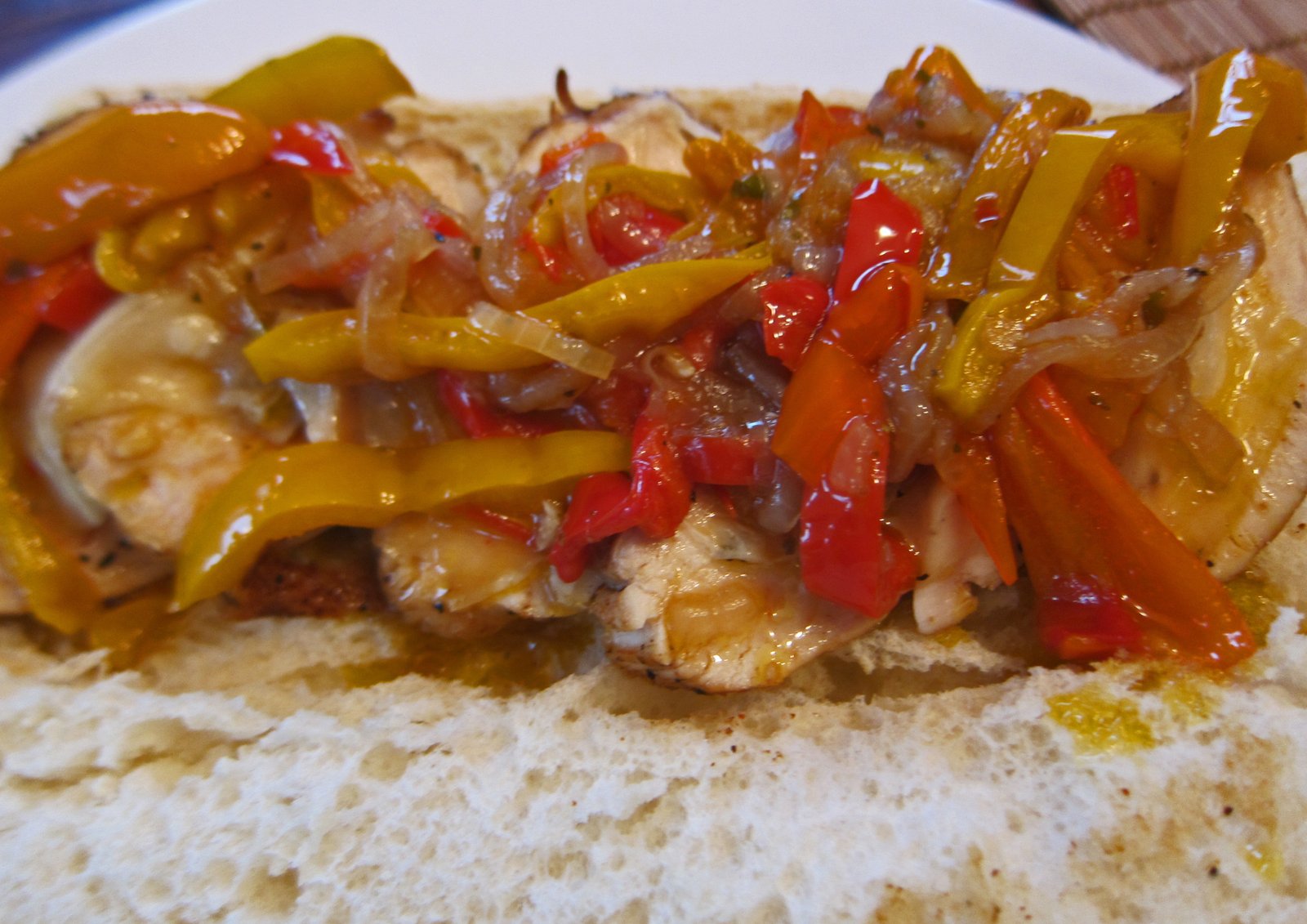
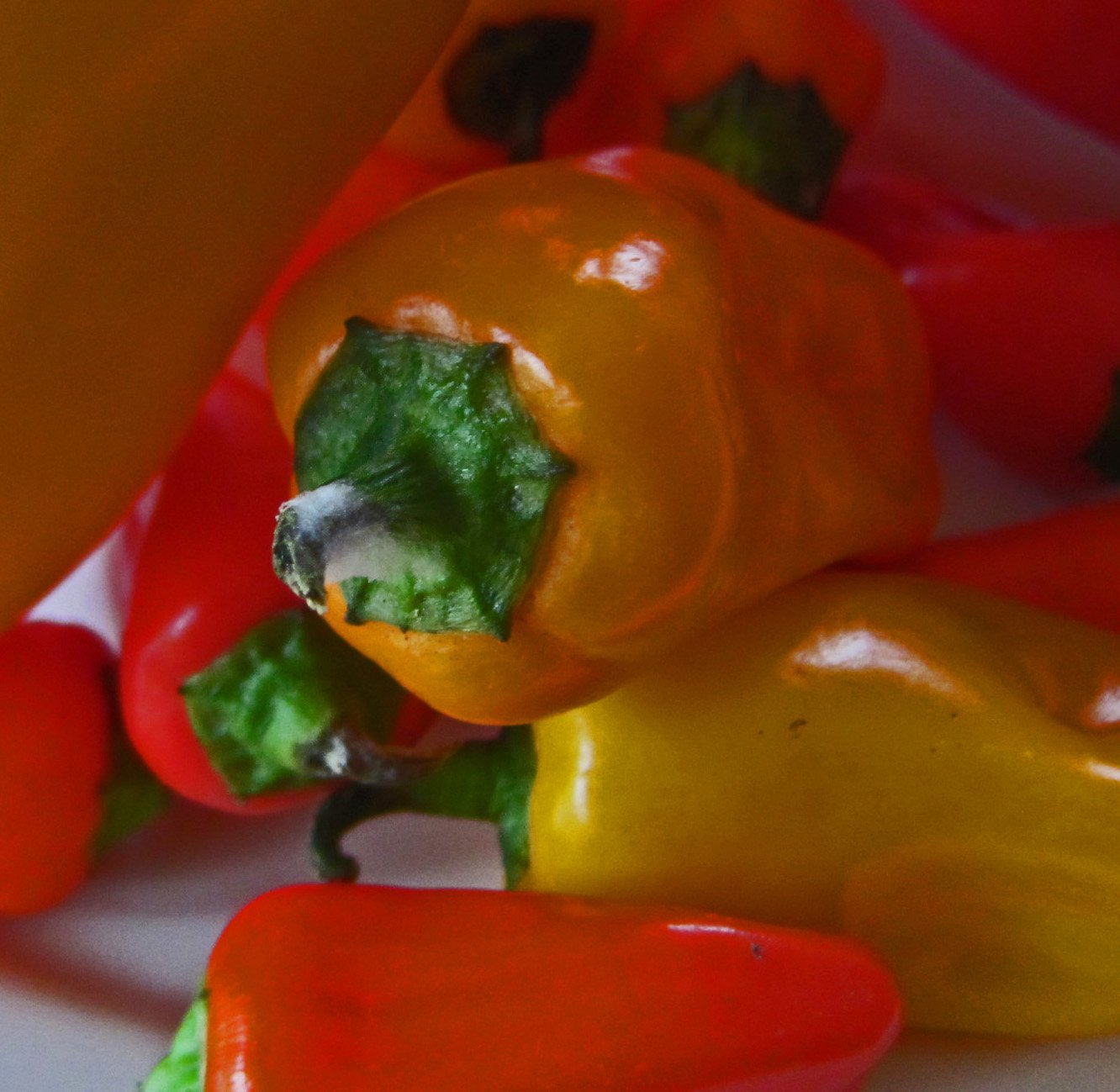
Peperonata 02I don't recall seeing peppers priced quite as cheap as in the last few weeks. The abundance of peppers gave me a chance to make another recipe from Molly Stevens All About Braising. Unlike the Lamb Shanks Braised with Lentils and Curry, this one is quite easy. Peperonata is an Italian stewed pepper dish that tastes great on bruschetta or as an antipasto. While we ate most of it on toasted baguette, the only photos I took were as a relish for a simple pan sauteed chicken breast.

 Peperonata 03

As always I did ad a couple of things to the recipe, in this case some garlic and dried oregano. Since the amount of peppers I had was closer to the three pound mark, I ended up using 1/2 of olive oil. The anchovies in the recipe add a deep savory and salty background flavor and I loved the addition of balsamic vinegar instead of the usual white wine or red wine vinegar.

Anyway……here's what I did.

Pepperonata:

Peperonata 01

1/2 Cup Extra Virgin Olive Oil
3 pounds various sweet peppers (do not use green bell peppers) cut into 1/3" strips
1 large onion also cut into strips
2 coves of garlic minced
4 anchovies minced
1/4 tsp red pepper flakes
1/2 tsp dry oregano crushed
2 tb balsamic vinegar
salt and pepper to taste

– Heat the olive oil in a heavy bottomed saucepan or Dutch oven over medium heat and add red epper flakes.
– Add onions and garlic, stir ocasionally until softened. About five minutes or so.Peperonata 04
– Stir in the anchovies, oregano, black pepper and a large pinch of salt.
– Add the peppers and combine. Lower the heat to low and braise.
– Check and stir every 10 – 15 minutes. Lower the heat if the peppers are sticking or getting mushy.
– The peppers should be tender after about 45 minutes or so.
– Remove from heat, add balsamic vinegar and taste. Adjust salt and pepper.
– Let cool to room temperature before serving.

Easy huh?

I'm thinking that you could find numerous uses for this. Add some fresh herbs to serve with antipasto, use it with meats…….

Lamb Shanks Braised with Lentils and Curry

Recently, the Missus made an interesting observation; telling me that I really hadn't "cooked" in a while. I was kind of flabbergasted, I'd catered a friends Sukiyaki dinner for twenty that swelled to thirty, even made a huge pot full of Oxtail Soup for my friends. I'd been making a lot of stuff at home. But the Missus quickly noted that much of it was "on the fly" or just stuff I'd made before. And She was right. So I made it a point to, well, really make something, spend some time in the kitchen, and fall in love with the process all over again. I had the perfect muse for my goal; we had just gotten a 9quart French Oven from Le Creuset. I'd coveted one for years, but dreaded spending the money, or to be more frank, asking to spend the money for one. So I did the smart thing, I just waited until the day the Missus said, "you know we need something good to braise in, like a Dutch oven." Man, I got on the Internet and ordered it so fast smoke was coming from my keyboard! I also ordered Molly Stevens James Beard Foundation award winning book, All About Braising: The Art of Uncomplicated Cooking. Even though I've done my share of braising, I love cookbooks, as they give me inspiration, and I really wanted to see what this one had to offer.

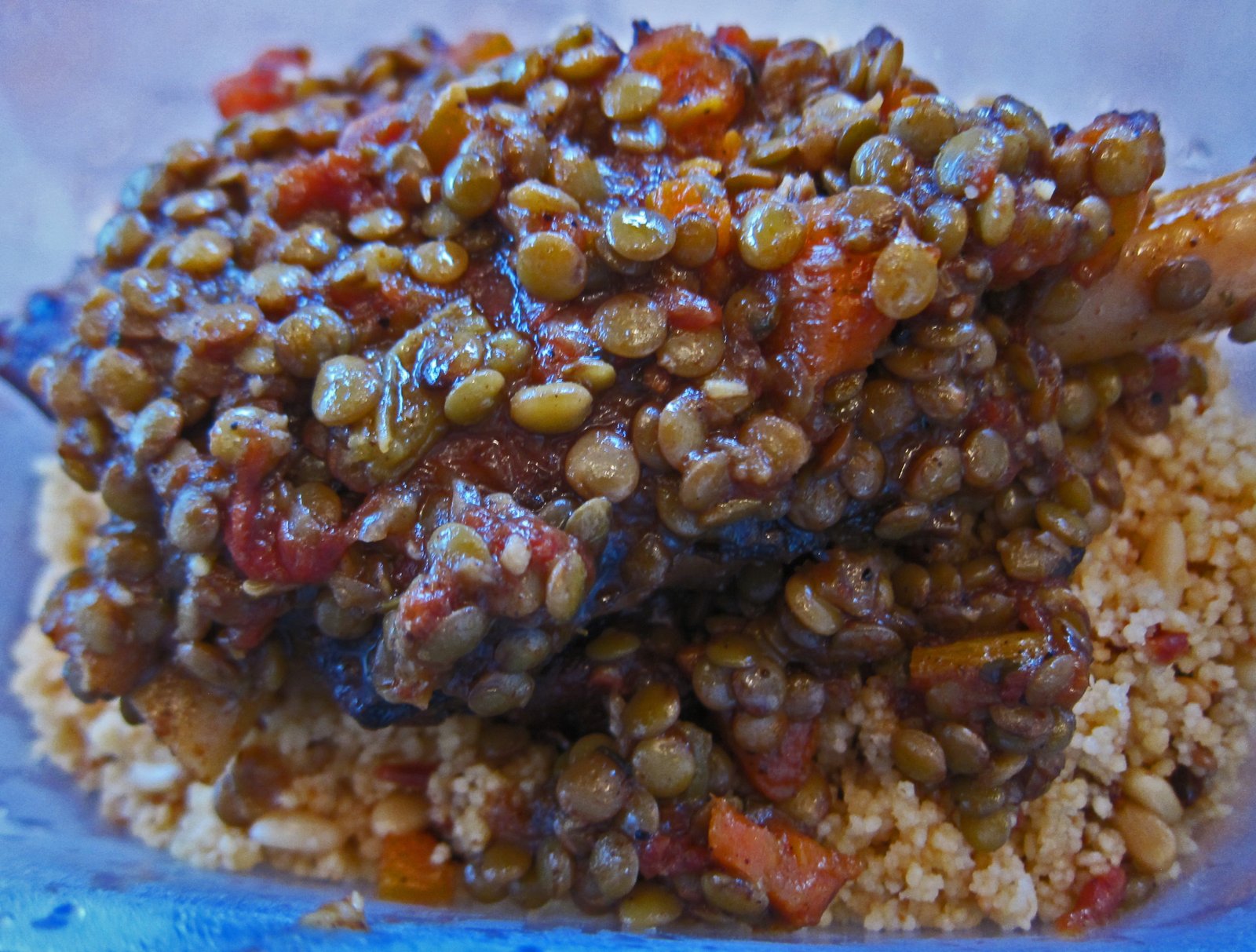
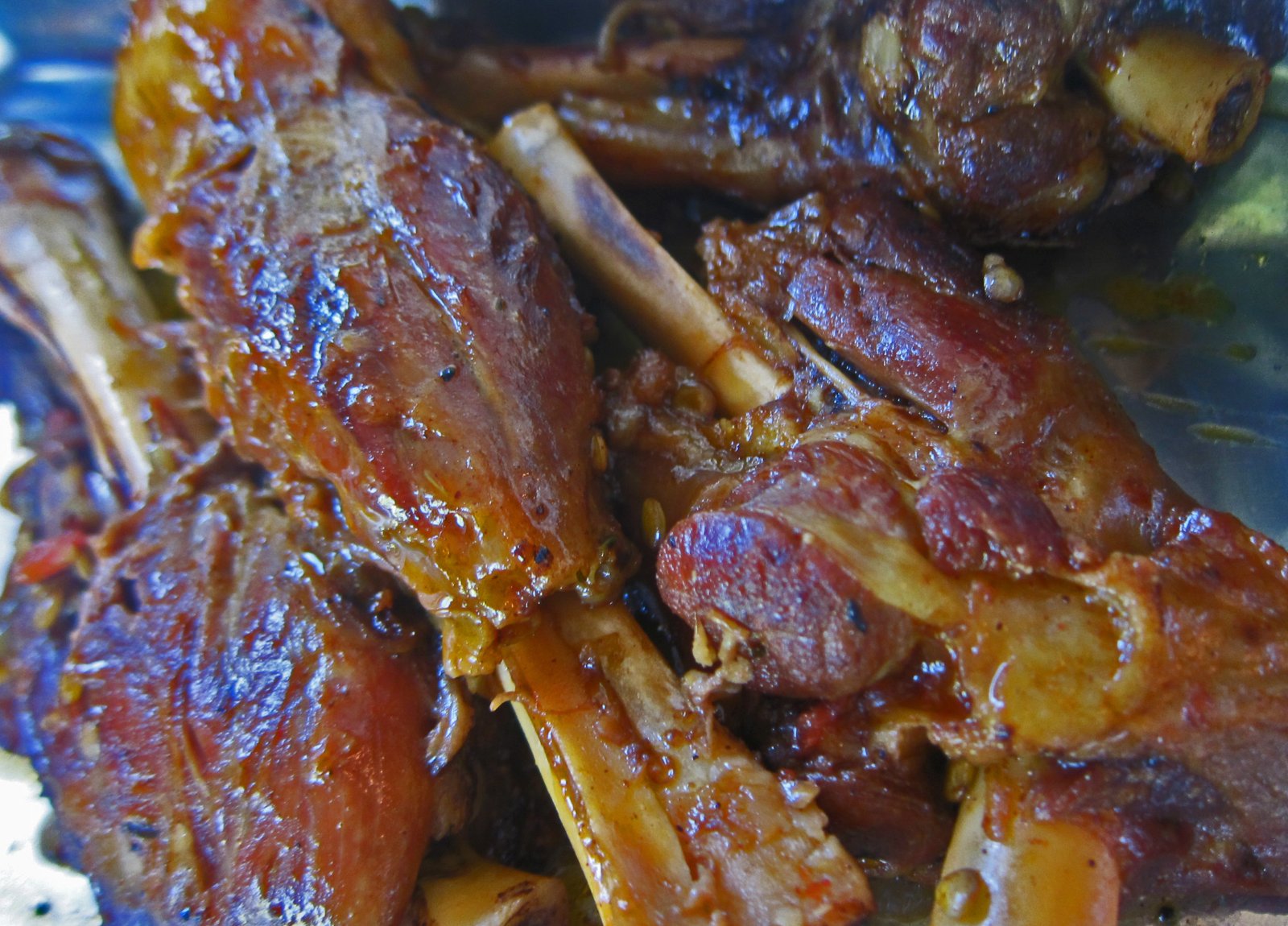
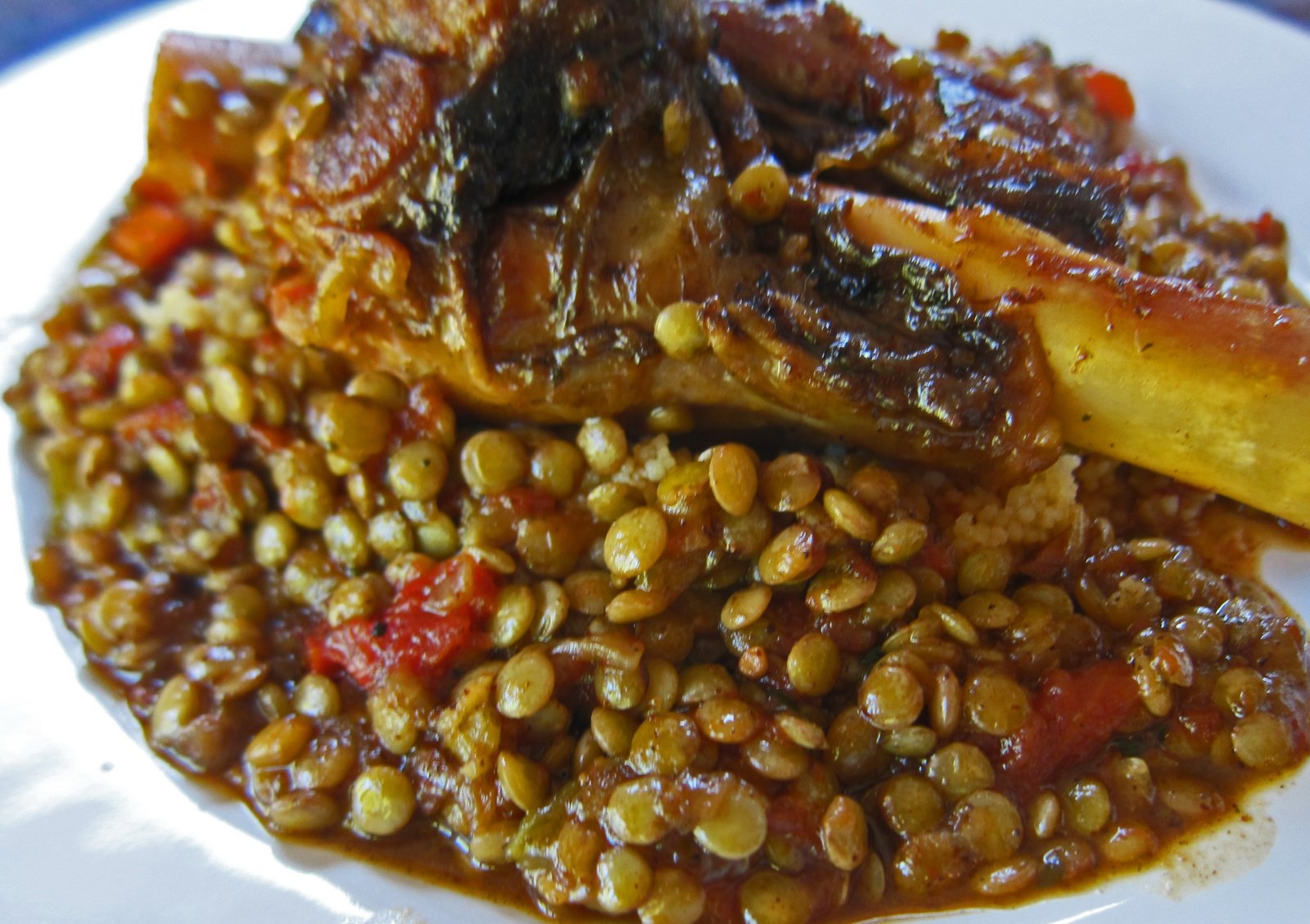
The first dish I tried out was the Lamb Shanks Braised with Lentils & Curry, which I paired with some on the fly couscous with sundried tomatoes and pinenuts toasted in roasted garlic olive oil. I'm sorry to say my photos don't do it justice.

03112012 053

My presentation in most of them looks kinda sloppy and the best one is the one above which is actually from a container that the Missus took to work with Her.

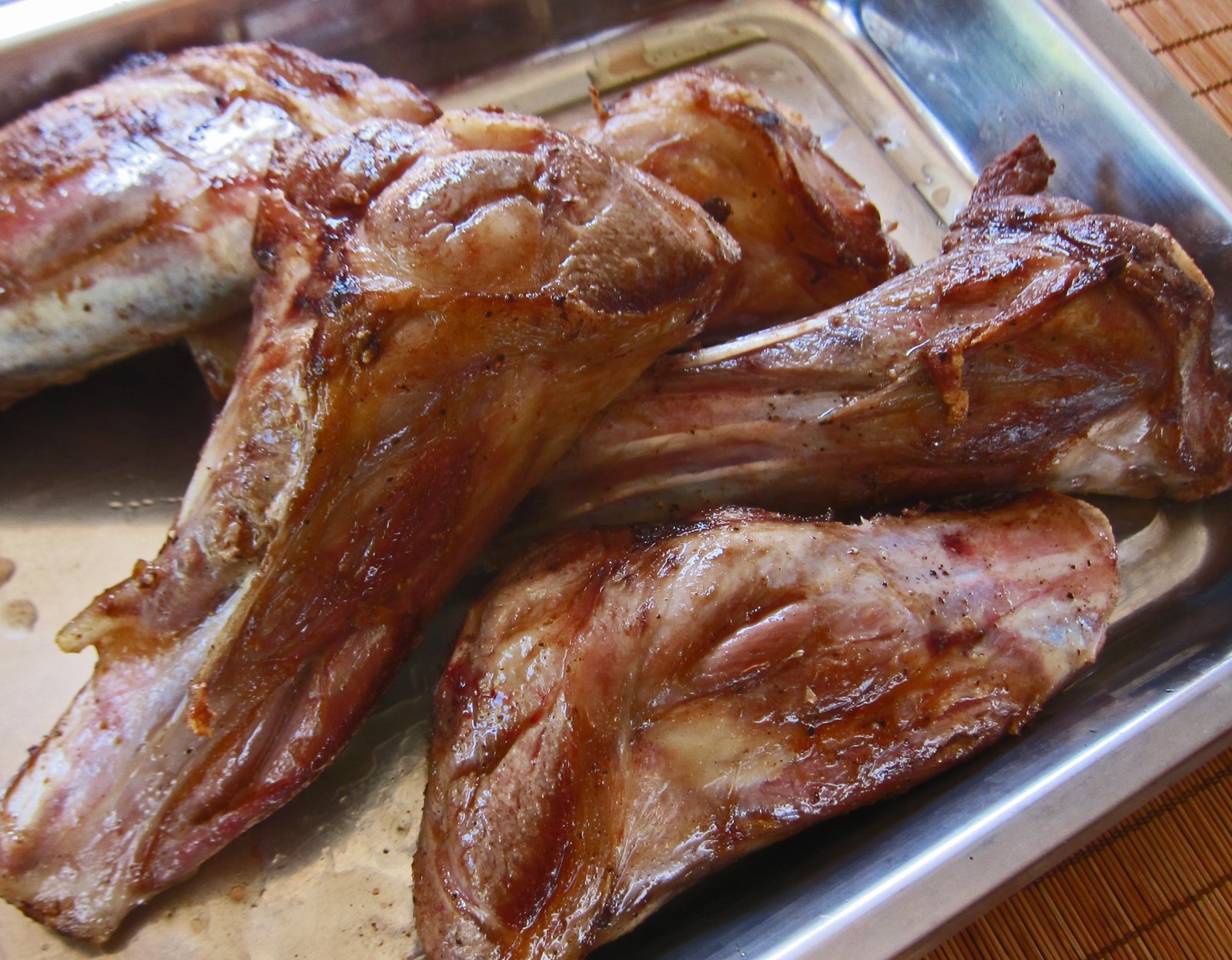
03112012 034I'd made up my mind that I'd do it right this time around, no cutting corners. So things had to start with some lamb stock. On that Saturday, I had ot head of North a bit, so I stopped by PQ Market in Ranchos Penasquitos. A small unassuming market with shelves empty, but a freezer full of beautiful Halal lamb. I got five lamb shanks, about a pound each and three pounds of lamb bones which looked especially clean and the nice gentleman cut into pieces for me. I thawed the shanks in the fridge and the bones on the counter; the weather was very mild so I knew a couple hours would be just fine. Needless to say, I spent the late afternoon first roasting, then lightly simmering the bones making a nice, clear stock. With the French Oven I was able to maintain that light, undisturbed bubbling necessary to create a nice stock. Just strain, cool, and refrigerate overnight, skim off the fat the next morning, and you a stock with the essence of lamb, with a mild, almost sweet flavor.

There are a couple of key points that I enjoyed about the recipe, one was parcooking the lentils and setting aside until the last part of the braise. One of the reasons I dislike lentils is that they are usually served really mushy. The recipe calls for Le Puy Lentils, a highly sought after green lentil(which looks almost black/blue) grown near the town of Le Puy in France. I just went with some good quality green lentils and the results were fine. The other was reinforcing the seal of the pot by laying some parchment paper over the rim, pressing down close to the braise and covering the pot. I also loved the common sense steps in recipe, especially to check in on the braise while it's in the oven to make sure it's not boiling, something that will make the meat fall apart and mushy. It's something I normally do anyway, but it's good to see stuff like that in a cookbook…..it makes it more than a color-by-numbers experience.

03112012 041I did diverge from the recipe in a couple of ways, I added a whole small can of peeled plum tomatoes which I crushed instead of measuring a cup. Next time, I think I'll add the juices as well as the recipe says to drain. I used six cloves of garlic instead of four, well, I could say because the number four is bad luck in Chinese, but really, if you've read long enough….we love garlic. I used a bit more stock because I knew we'd be running out of the wonderful braising liquid to pour over things, ditto with the lentils. Also, the recipe calls for Madras Curry powder, which I used. But instead of adding them after the aromatics, I added it straight to the oil to "bloom". I did end up cutting down on the total braise time because everything seemed to be coming together quickly and green lentils tend to cook faster than Le Puy lentils.

Anyway, enough with the blah, blah, blah…..

03112012 044

Lamb Shanks Braised with Lentils and Curry

2-3 Tb Extra Virgin Olive Oil
5-6 Lamb Shanks – about a pound  a piece
1 large red onion chopped
3 small-medium carrots peeled and coarsely chopped
1 large stalk celery coarsely chopped
6 cloves garlic minced
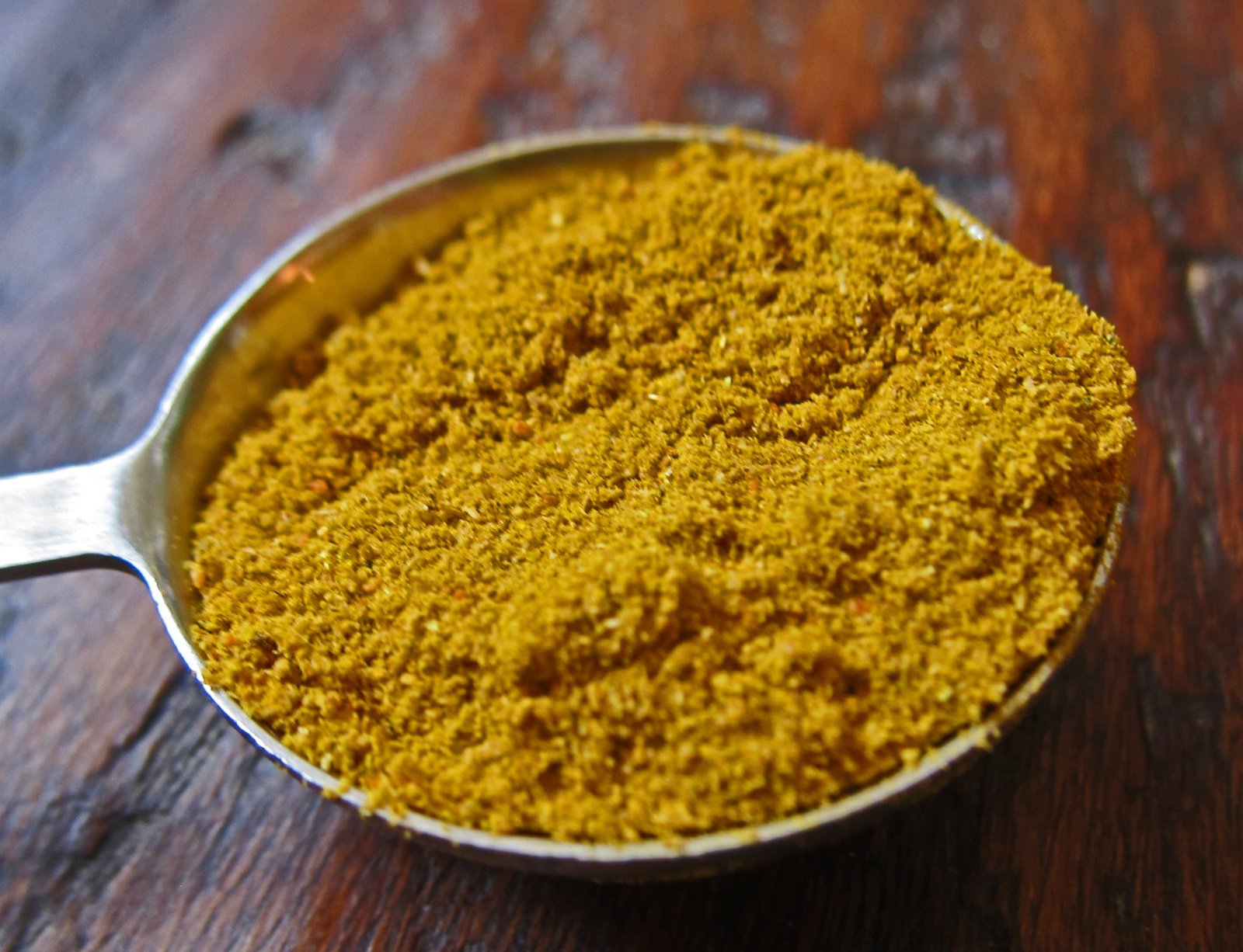
1 1/2 Tb Madras Curry Powder
1 1/2 Tb chopped fresh thyme
2 Bay leaves
1 14oz can peeled plum tomatoes drained and crushed
3 Cups lamb stock
1 1/2 Cups green lentils
Salt and fresh ground black pepper

– Preheat oven to 325
– Trim lamb shanks if necessary03112012 038
– Heat the oil in braising pot over medium-high heat. Season the lamb with Salt and Pepper then brown. Do this in batches, turning with thongs. Remove shanks to a plate or pan.
– Pour off all but 2-3 Tb of oil from the pot. Add curry powder stir and allow to bloom for a minute or two.
– Add the onion, carrots, celery to the pot stirring to coat well. This should take 7-9 minutes, it's ok if the vegetables have slightly browned edges.
– Stir in the garlic, 1 Tb of thyme, and bay leaf, stir and cook for 1-2 minutes.
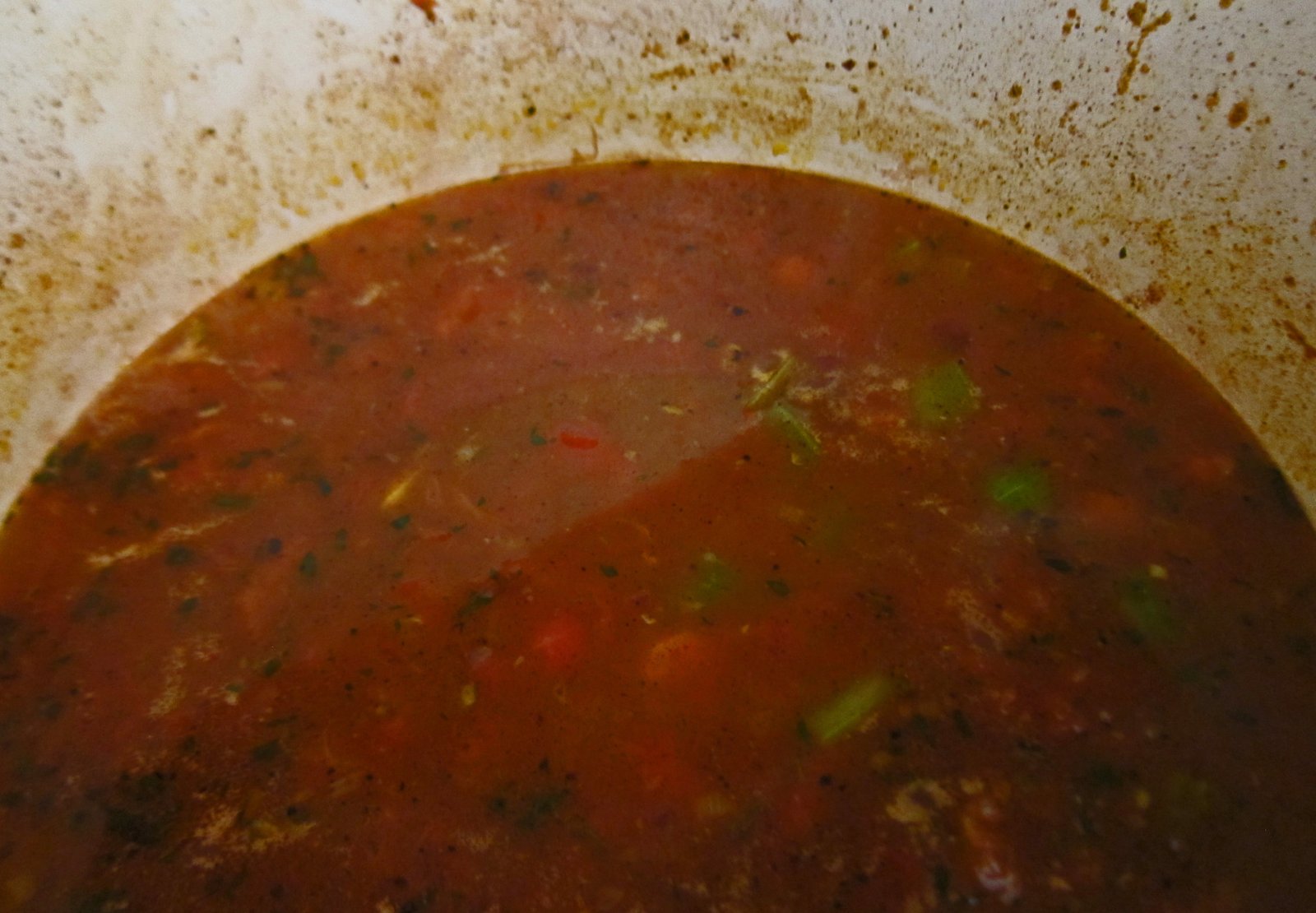
– Add tomatoes and stock. Stir and make sure to scrape off all those lovely bits on the bottom of the pot.

03112012 040

– Bring the pot to a boil and keep at low boil for a few minutes.
– Return the lamb shanks to the pot arranging them in layers if necessary. Don't forget any juices from the lamb on that plate/pan.
– When the liquid returns to a simmer cover with parchment ten the lid and place in the 325 degree oven.
– Check after 15 minutes. The liquid in the pot should be at a gentle simmer. If it is not lower the temperature.
– After one hour, check on the shanks and rearrange, turning the lamb shanks over, and moving the ones on the top to the bottom if layered.
– Continue braising for another hour
– Meanwhile place lentils in a saucepan with 3-4 cups of water, the remaining 1/2Tb of fresh thyme, the remaining bay leaf. Bring to a boil then reduce to a simmer for ten minutes.
– Drain the lentils and spread on a sheet pan, with the bay leaf and let cool.
– After the second hour as passed, remove the lamb shanks from the pot. Skim fat from the liquid then adjust for seasoning.03112012 051
– Stir in the lentils and place shanks back into pot. Place parchment back on along with lid and braise for additional thirty minutes.
– Check after thirty minutes, the lentils may need another 15 minutes.The lamb shanks should be tender but not falling to pieces off the bone.
– Transfer the shanks to a pan and cover loosely with foil.
– Taste the lentils and liquid and adjust.
– Serve the way you feel like. We served over couscous03112012 050 made with the remaining lamb stock, sun dried tomatoes and pine nuts, along with lemon wedges.
You can garnish with parsley or other herbs to make more colorful….I was just too darned hungry to even care.

03112012 048

You know, this waiting until the Missus "just needs" something has been working out rather well.We recently finally got an immersion blender because She absolutely couldn't live without it. What do you think about my chances of Her needing a Sous Vide Water Oven? Yeah, I might be waiting for a while for that one……

Thanks for reading!

Roasted Parsnips and Kabocha with Caper Dressing

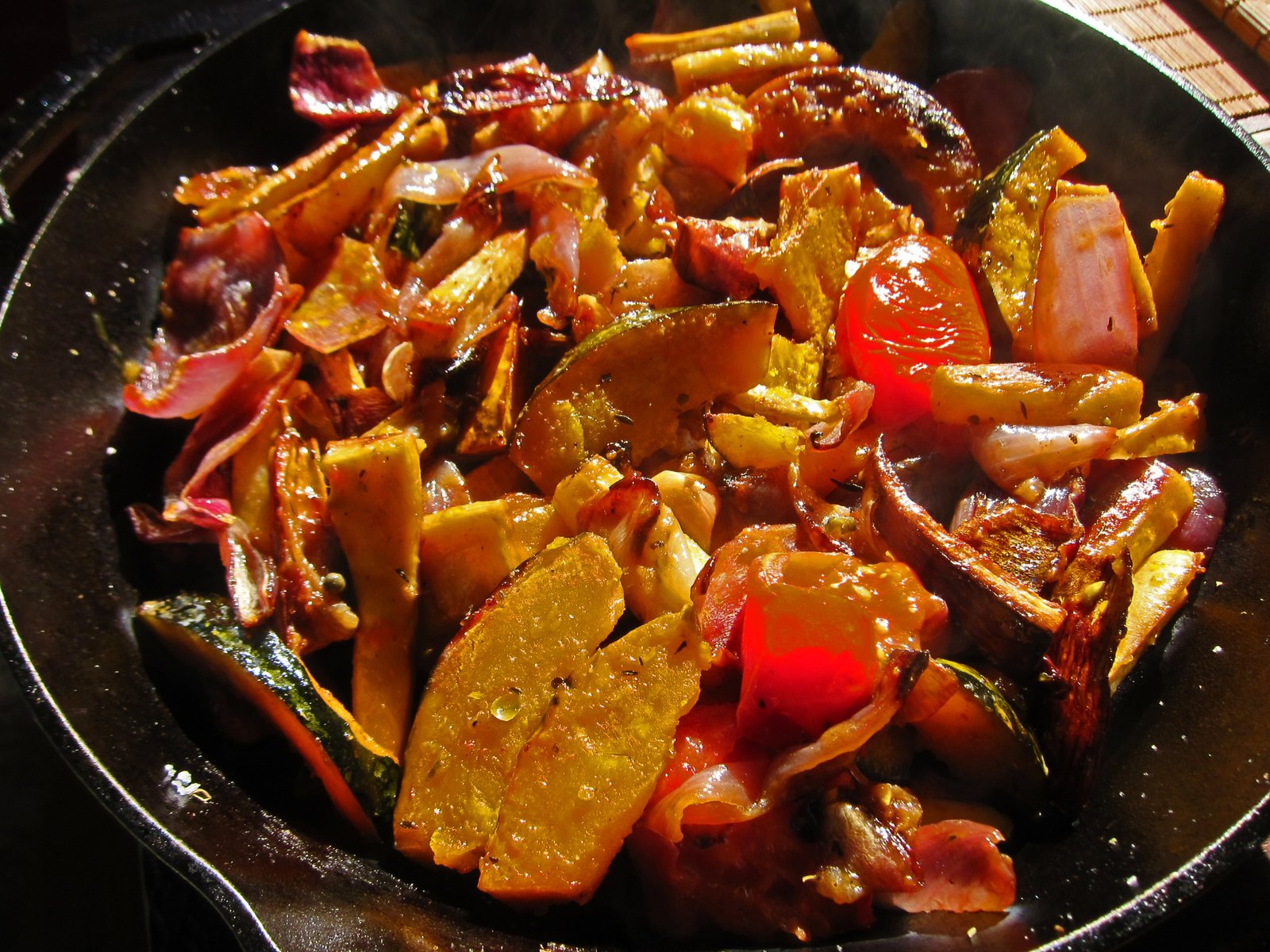
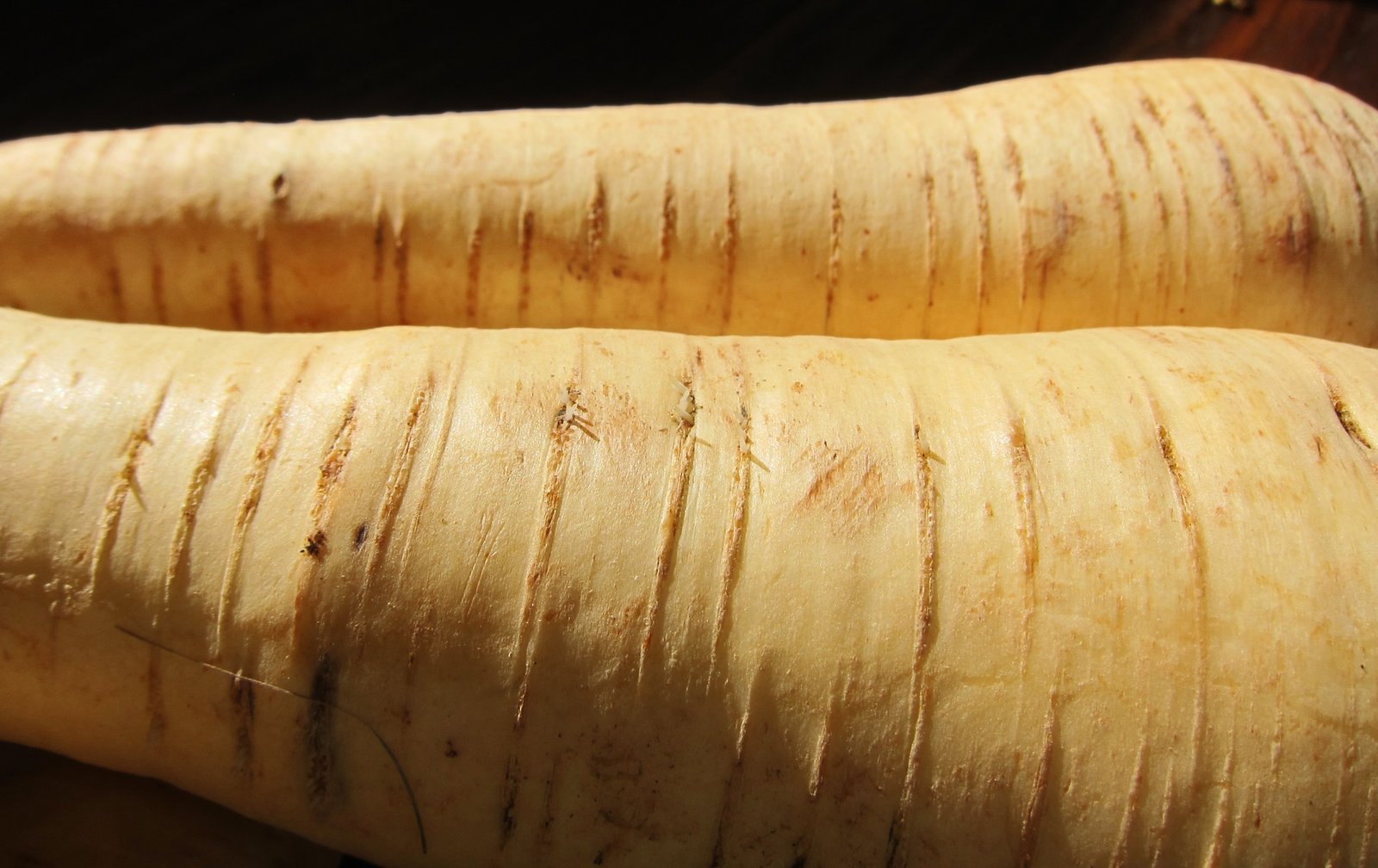
The Missus has been trying to cut down on meat consumption over the last year and I'm really trying to support Her. However, there's just so much roasted vegetables, which we make twice a week one can really deal with. This started me off on trying other vegetables and greens, stuff like Chard, Kale, Celeriac, Rapini, even sauteing Collard Greens. Mushrooms now is a big part of the Missus' diet. I'll often now make protein for me and a large shared veg dish for us, or even something just for the Missus. We're also trying not to waste as much….and I had half a Kabocha staring me in the face. For New Years I'd made Kabocha Nimono using half the squash…..now I needed to do something with the other half. I'd also bought a bunch of parsnips most of which I roasted with potatoes….

Looking for some inspiration, I opened Yotam Ottolenghi's wonderful cookbook, Plenty. I really trust this cookbook, ever since I tried out the Mushroom Ragout with Poached Egg recipe and it turned out to be one of the best things I made all year. As fate would have it, I opened up the book to a recipe for roasted parsnips and sweet potatoes with caper vinaigrette…….I guess it was meant to be. I basically subbed the kabocha for the sweet potatoes and adjusted the cooking time.

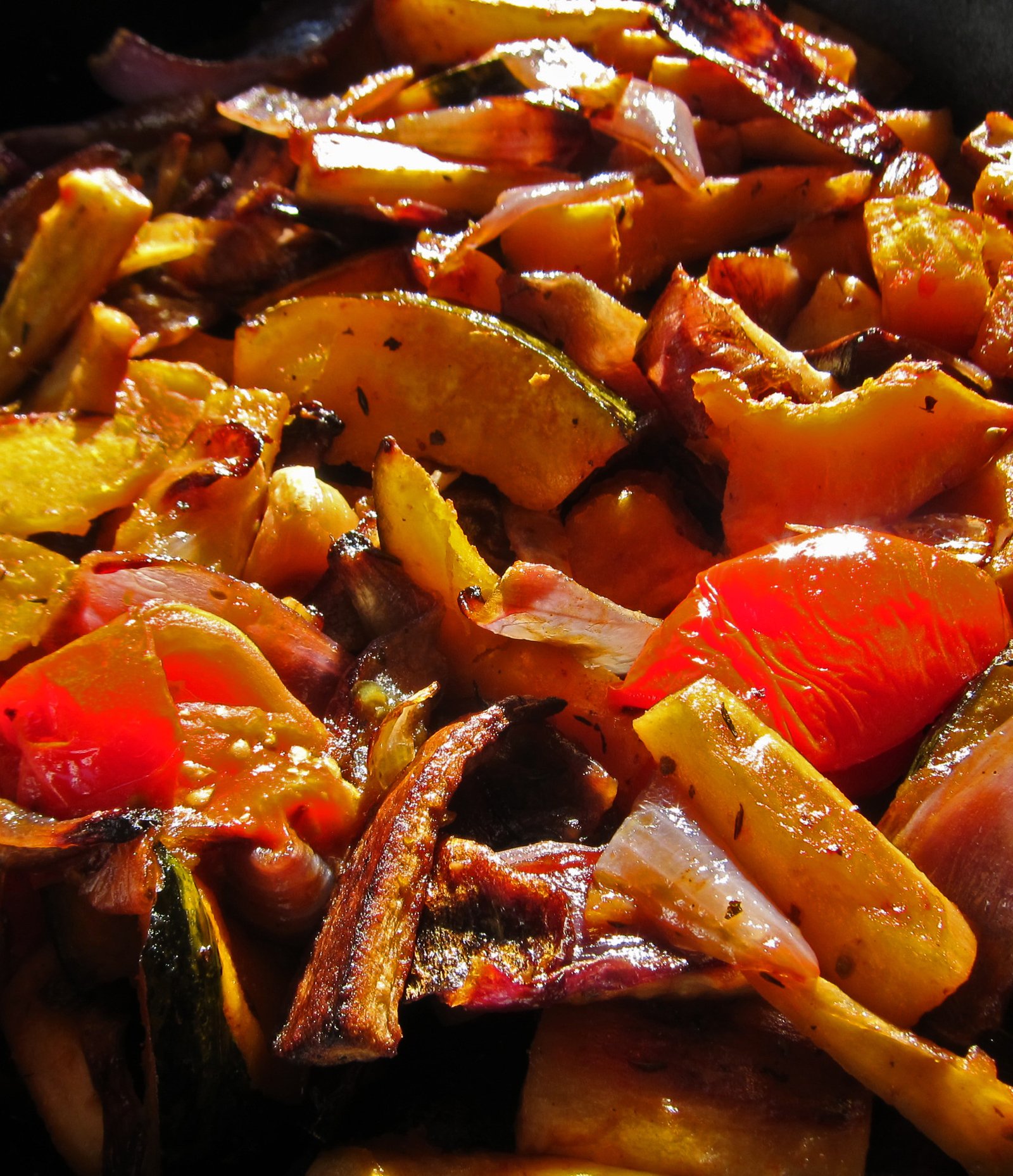
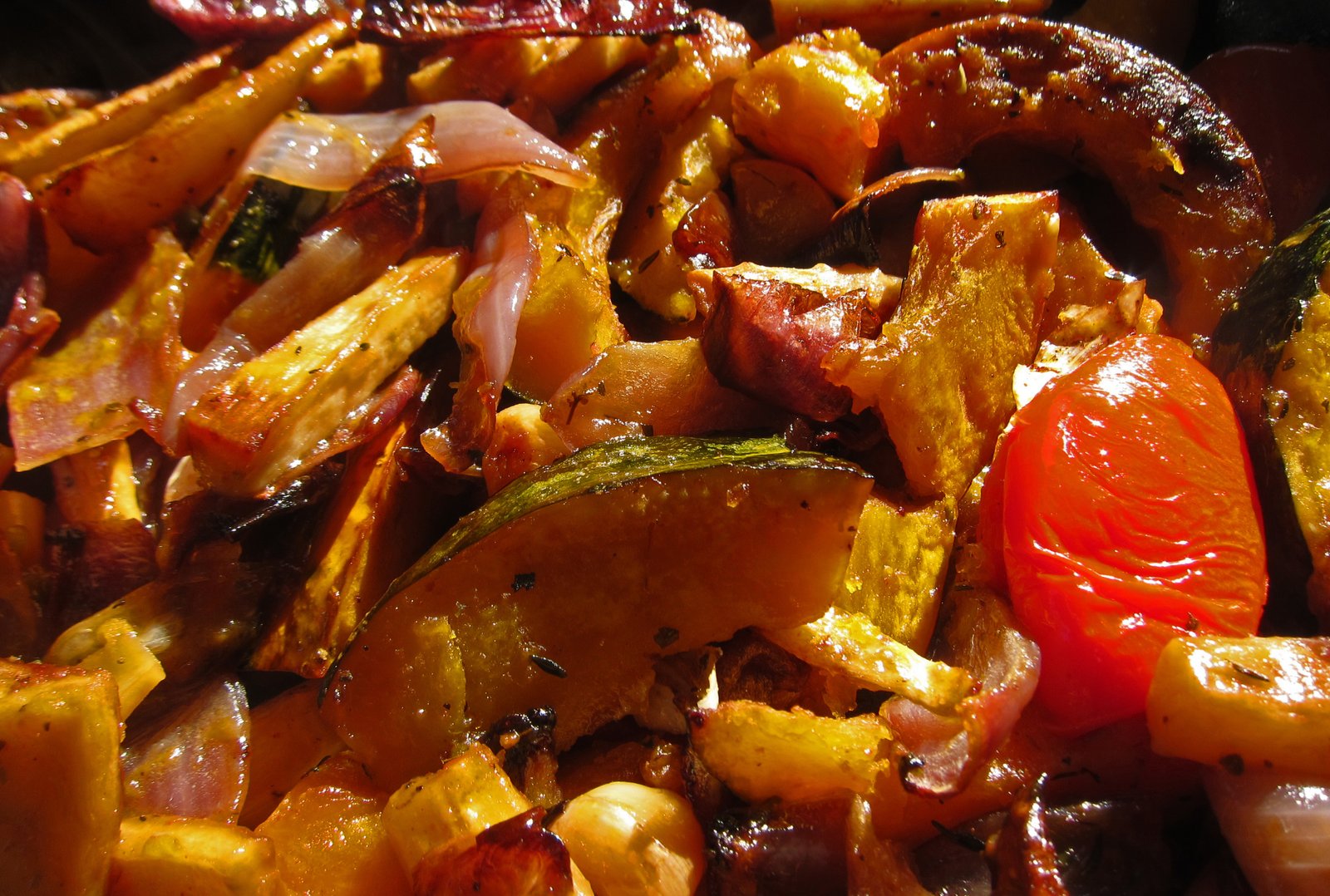
RoastedParsnipKabocha01

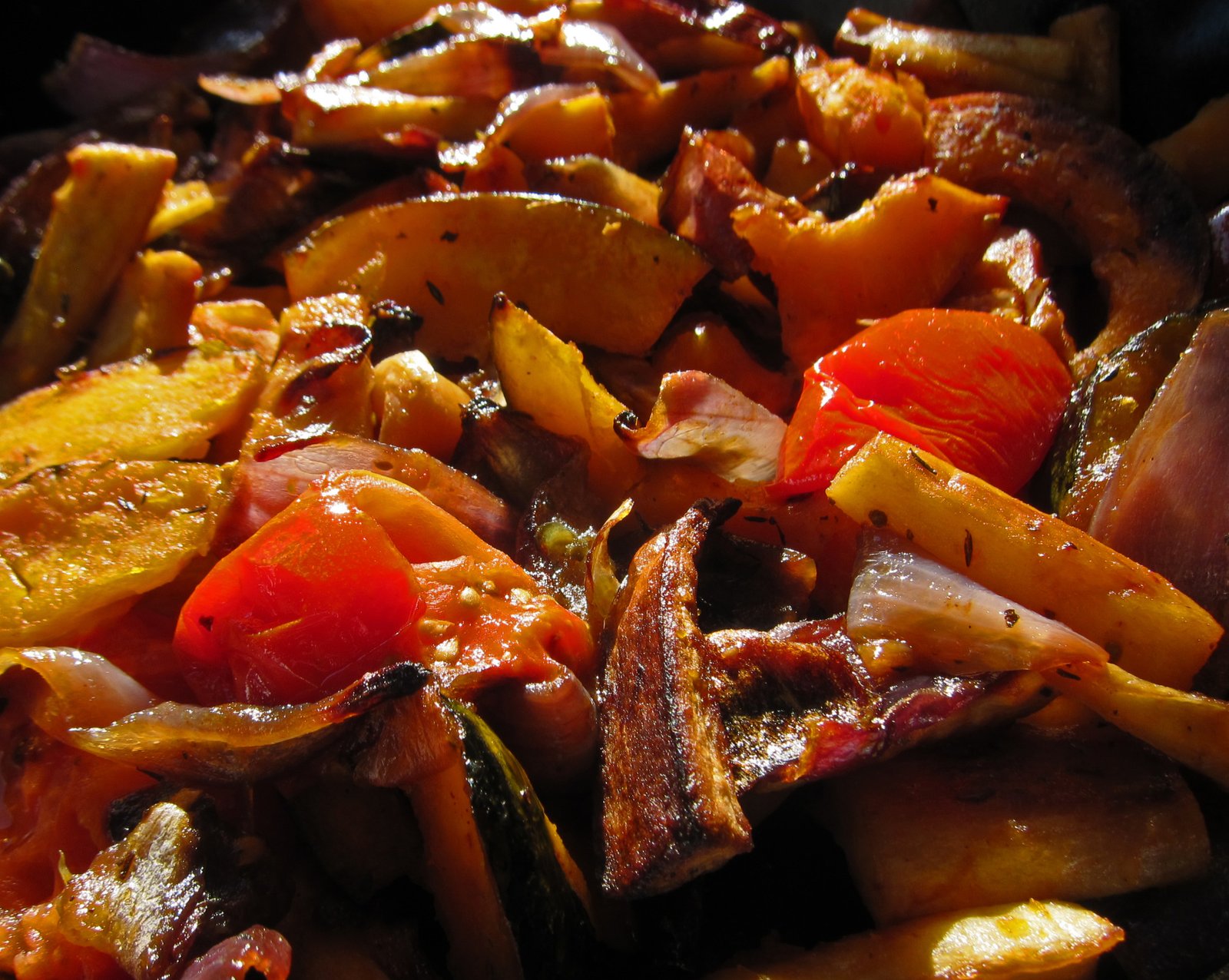
RoastedParsnipKabocha02For me, cookbooks tend to be a set of ideas and guidelines, though many times I'll follow the written recipe the first time through, making adjustments later. To me, Ottolenghi's book is more of an idea book. Using items I had on hand and adjusting for taste, this came out real well. The adjustments? I used 12 cloves of peeled garlic rather than a split bulb, kabocha for the sweet potatoes of course, replaced the fresh thyme and rosemary with dried thyme and oregano, two fairly large red onions instead of four, two vine ripened tomatoes instead of cherry tomatoes, and I used honey instead of maple syrup in the vinaigrette. The recipe times the addition of the vegetables into three stages to make sure that everything is cooked, but not overcooked.

Speaking of the vinaigrette, the Missus initially didn't want me to use it, but I eventually wore Her down and She ended up loving what it added to the dish…..just a slight acid and mild sweetness, not enough to interfere.

RoastedParsnipKabocha03

Roasted Parsnips and Kabocha with Caper Vinaigrette

About a pound or a bit more of (peeled)parsnips cut into 1 1/2" – 2" long by 3/4" pieces
2 medium-medium large red onions cut into wedges RoastedParsnipKabocha04
12 cloves garlic peeled but left whole
1/2 kabocha pumpkin sliced into pieces about the same size as the parsnips (leave the skin on)
2 tomatoes cut into eighths
Dried Thyme
Dried Oregano
3/4 Cup Extra Virgin Olive Oil (I used Spitiko)
Salt and Pepper

– Preheat oven to 375
– In a bowl coat the parsnips, onions, and garlic with 1/2 cup of the olive oil, salt, pepper, thyme, and oregano.
– Spread on a baking sheet or roasting pan
– Roast for about 20-25 minutes.
– Coat kabocha with more olive oil and add to the pan, combining with the other ingredients.
– Roast for about another 30 minutes
– Add the tomato wedges to the pan and roast for about another 15 minutes. You may want to give everything a gentle stir then finish off.RoastedParsnipKabocha05 Taste and adjust salt and pepper.

After adding the tomatoes put together your dressing.
Combine:
4 Tb Capers chopped
1 Tb Honey
1/2 Tb Dijon mustard
3 Tb Extra Virgin Olive Oil – I used a low acidity Picholine Olive Oil for this
2 Tb fresh squeezed Lemon juice

Whisk ingredients together to emulsify.

Remove vegetables from the oven….I put everything into a nice cast iron pan which I intended to use at the beginning bt proved too small.
Pour dressing over the veggies and lightly mix.

This turned out well….I can only imagine what other combinations of root vegetables and herbs can be done in this manner.

RoastedParsnipKabocha06

I hope everyone had a great weekend!

Mushroom Ragout with Poached Egg on Toast

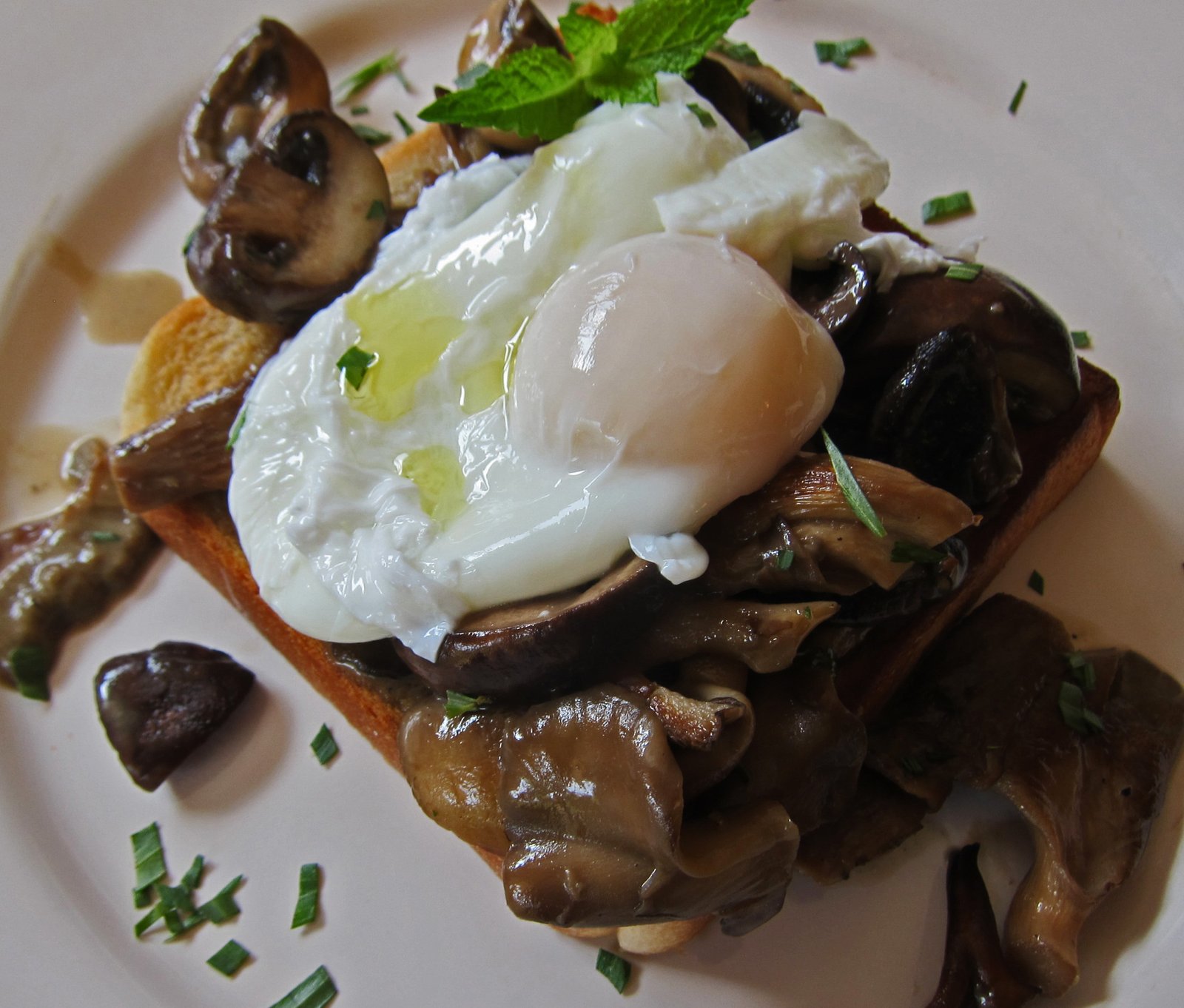
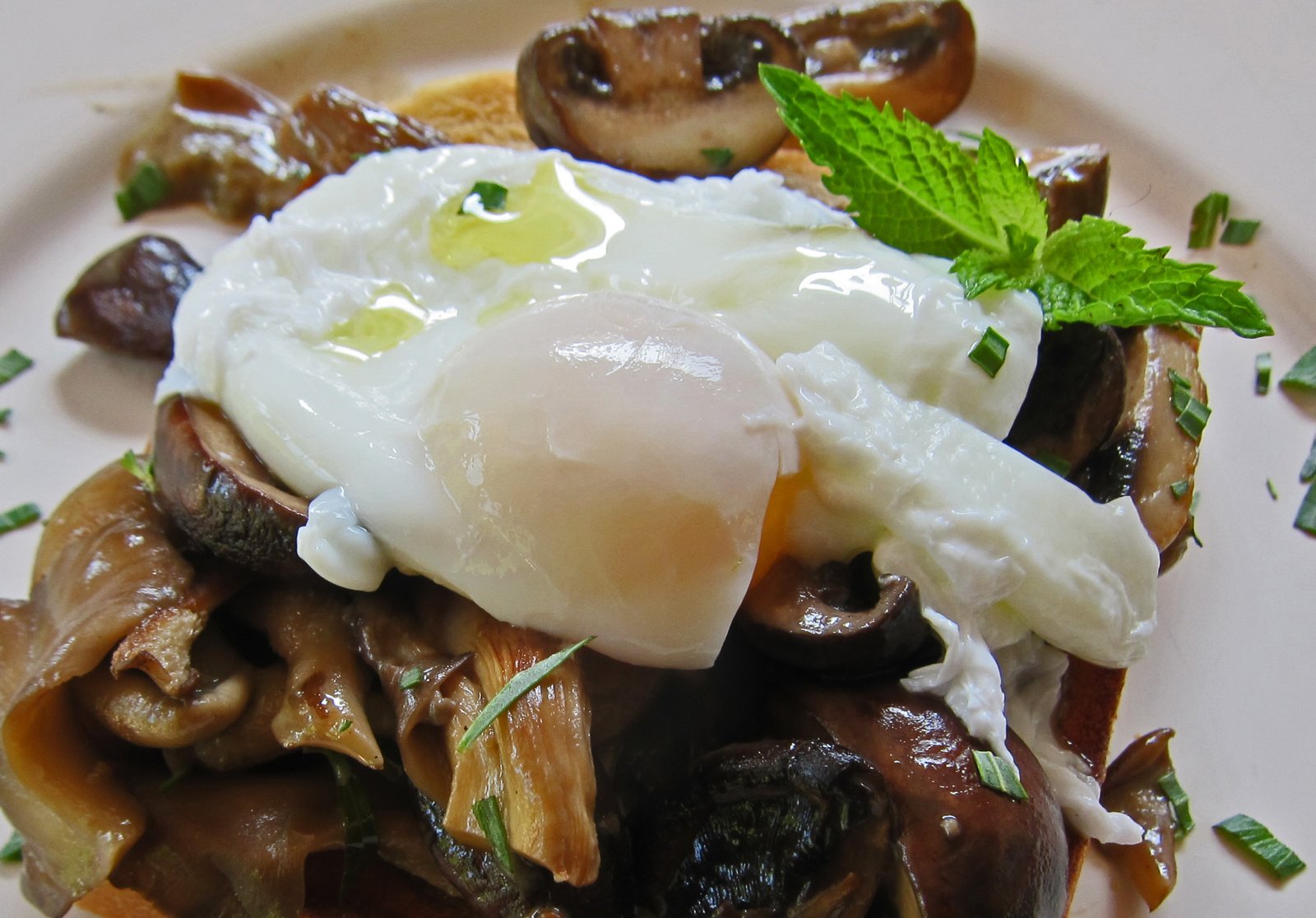
I recently purchased Yotam Ottolenghi latest cookbook Plenty. Yes, it is a vegetarian cookbook, but I love the simple, yet hearty recipes and the Missus has taken to the photos. We're still in the mode of eating at home so I thought I'd make this for Saturday brunch. The original recipe uses duck eggs, I had some really nice extra large organic eggs so I used that. I didn't fuss about with creating sourdough toast in the oven, I simply went with some Cherry Blossom white bread brushed with roasted garlic olive oil. Also, for some reason I couldn't find any fresh thyme….and I really didn't want to spend too much, ahem, time (pun intended) looking for it. I had some fresh oregano on hand so I subbed that. I hadn't poached eggs in years….like fifteen years, so they didn't come out as pretty as I desired…..but man this was good.

Mushroom Ragout Poached Egg 01 

Mushroom Ragout Poached Egg 02

Man that drizzle of truffle oil does take it up a level too…….

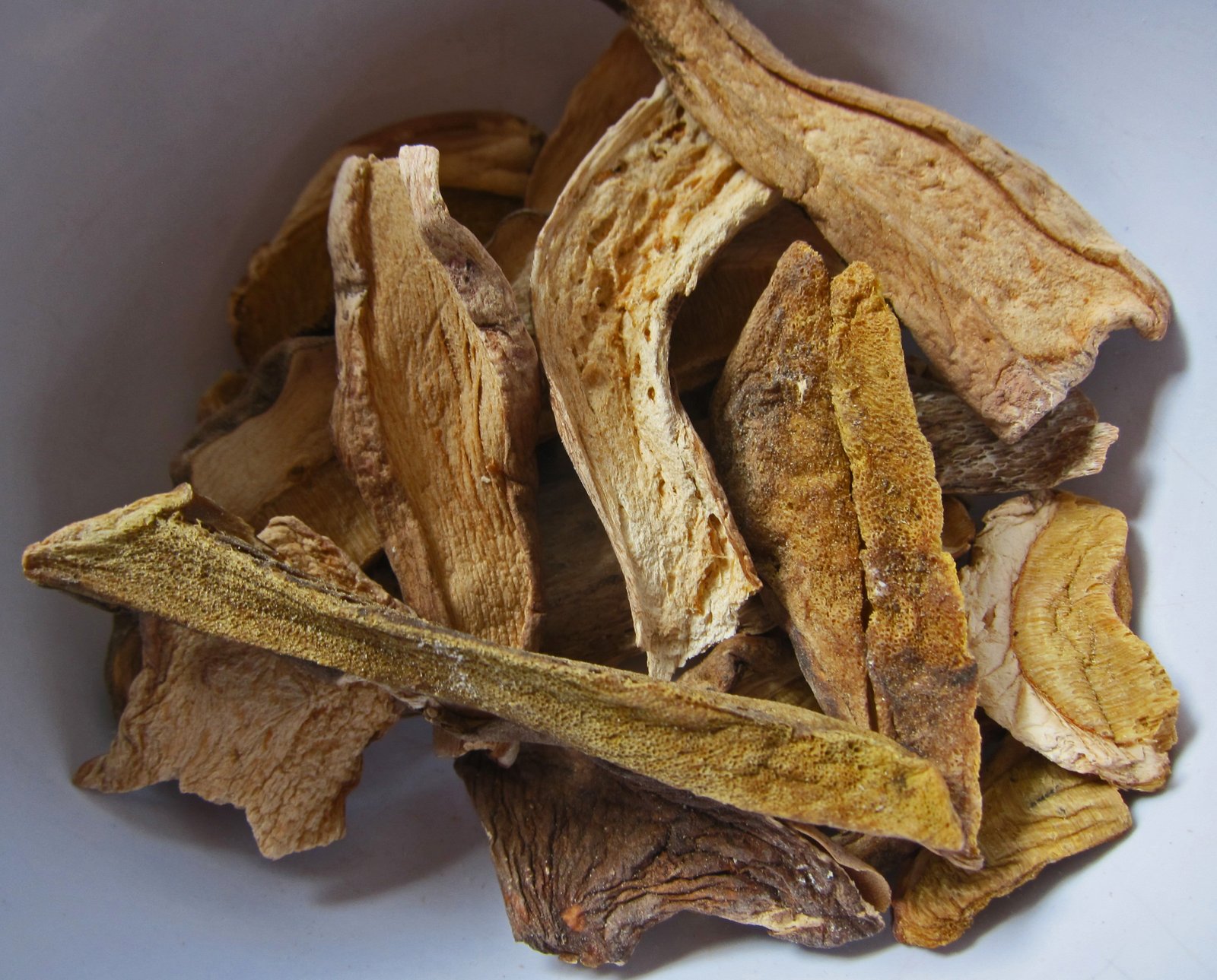
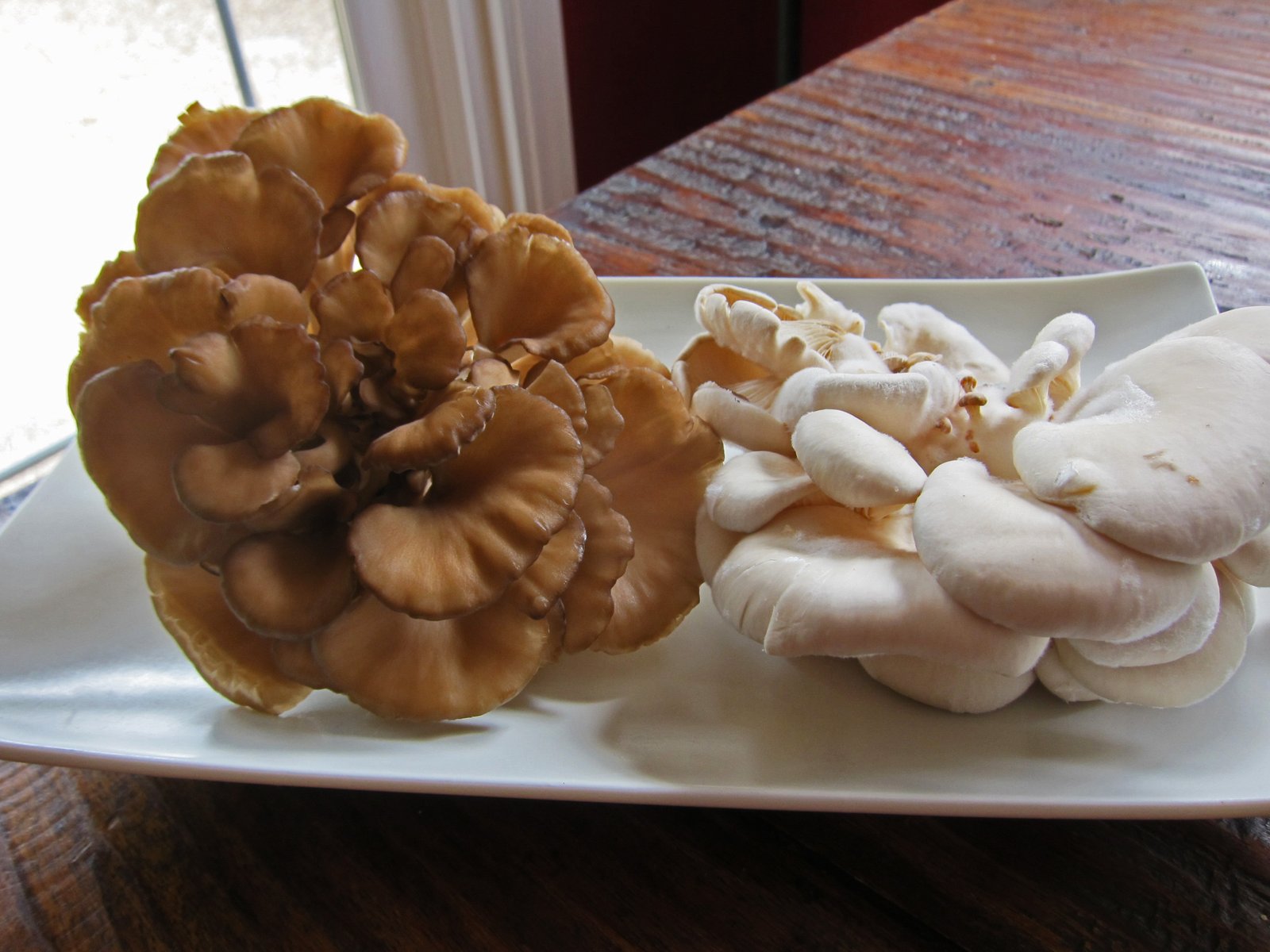
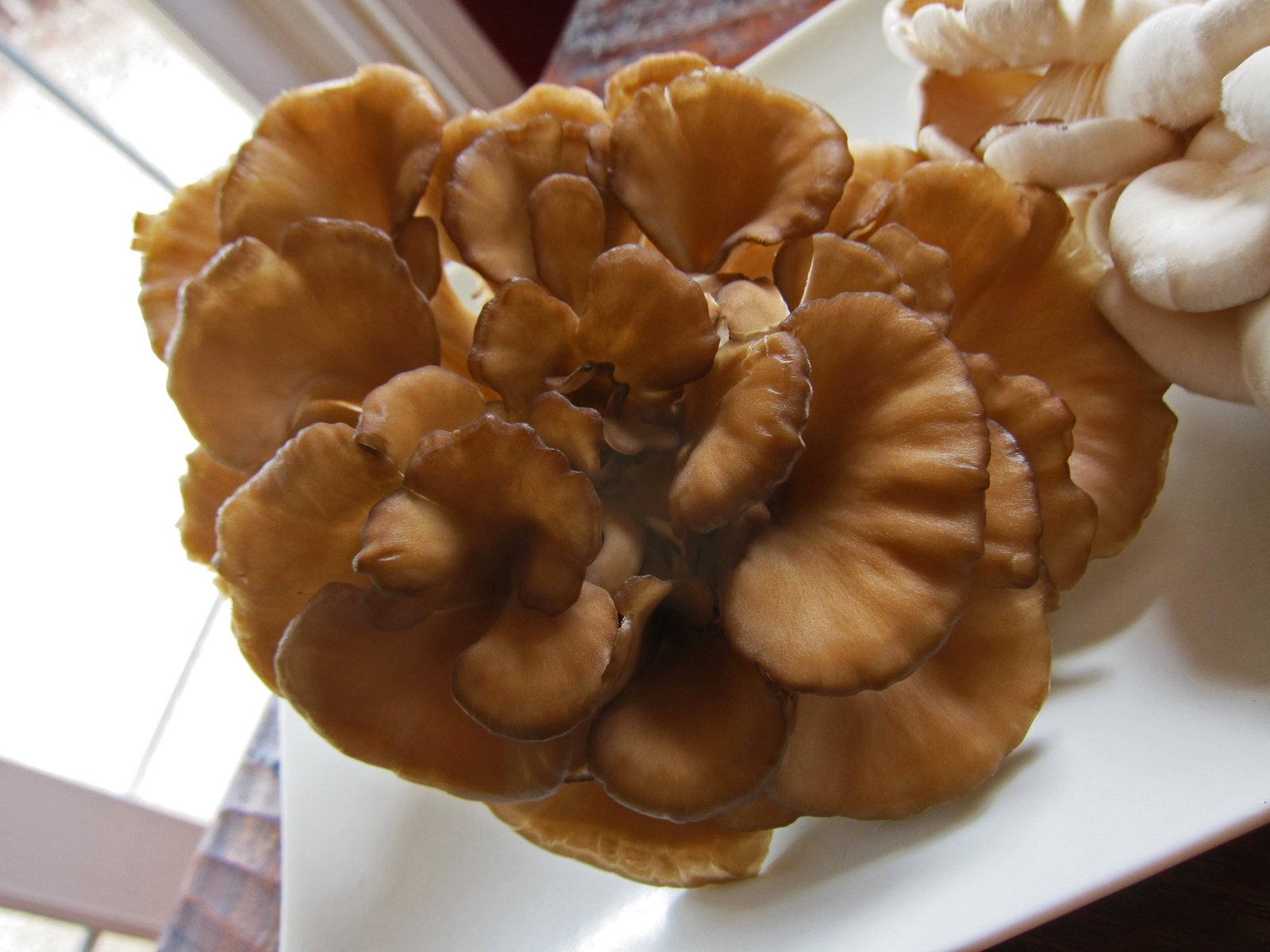
Things not to sub out; the dried porcini plays a key role. Do use a variety of mushrooms…..I mean really, you don't have to go hunting for chanterelles or anything, but I did use oyster mushrooms, along with some maitake mushrooms to go with the standard white and crimini mushrooms. Of course the Missus spent a good deal of time picking out the porcini mushrooms to savor. I added garlic to the dish because, well, we love garlic and replaced sour cream with creme fraiche….because….well, just because.

Mushroom Ragout Poached Egg 03 

So with out further ado…..

Mushroom Ragout with Poached Egg on Toast

Mushroom Ragout Poached Egg 05 

1/2 oz dried porcini mushrooms
2 1/2 cup water
1 1/2 lbs mixed fresh mushrooms
5-6 Tbs extra virgin olive oil
2 garlic cloves minced
1 onion sliced
1 carrot sliced
3 stalks of celery sliced
1/2 cup white wine
2 Tb chopped fresh oregano
3-4 Tb chopped tarragon
4 large poached eggs
3-4 Tb Creme FraicheMushroom Ragout Poached Egg 04
salt and pepper
chopped tarragon for garnish
truffle oil
4 slices thick cut toasted white bread brushed with roasted garlic olive oil

– Soak the porcini mushroom in 1 cup of luke warm water for 30 minutes
– Clean and slice mushrooms
– Heat 1 Tb of olive oil over medium heat in a thick bottomed pan and scatter one-third of the mushrooms in pan (do not crowd). I divided up the mushrooms based on cooking time. Leave mushrooms to caramelize for a minute or two without touching before turning to brown for another minute or so, then remove. Follow the same process for the rest of the mushrooms.Add oil as necessary.
– Once mushrooms are done, add 1-2 Tb of olive oil and put onion, celery, and carrot into the pan and saute, but do not brown.
– Once the vegetables soften add the white wine and let simmer for a minute or two.
– While vegetables are softening remove porcini soaking liquid, squeezing out excess liquid. Chop into pieces matching the cooked mushrooms and combine.
– Add the porcini liquid to the pan, making sure to not add the grit and bring to a simmer.
– Add 1 1/2 cup water, garlic, the oregano and tarragon, and salt and pepper to taste.
– Let this liquid simmer slowly for 15 – 25 minutes until you have about 1 cup or so liquid left.
– Strain this mixture over a large bowl and discard the vegetables.
– While the stock is reducing poach your eggs.
– When you are done poaching eggs and the stock has been strained, put stock back in pan, adding in mushrooms and heat. Add creme fraiche to thicken.
– When the dish is composed drizzle a bit of truffle oil over the eggs.

Eat, then go back to bed……

Mushroom Ragout Poached Egg 06 

Pan Fried Cucumber with Perilla – Zi Su Jian Huang Gua

Yep, we're still "veggin' out……" Here's another recent vegetable dish. I'm always on the look-out for something a bit different, perhaps the use of an ingredient that I'm familiar with, but had never thought of using in a type of cuisine. I saw a recipe in Fuchsia Dunlop's tome on Hunan cookery, The Revolutionary Chinese Cookbook, that caught my attention because it used Perilla. The original recipe uses zǐ sÅ« (玫苏), purple perilla, but the only perilla I could find in the quantity I wanted and in good shape was Korean Perilla, which I substituted for purple perilla. What little info I could find on the use of  Perilla in Chinese cuisine was a reference to Perilla Leaf Porridge as a remedy for common colds, and its many medicinal uses

StirFriedCucPerilla01    

This turned out to be a remarkable dish. The cleansing flavor of the cucumber, along with the spiceStirFriedCucPerilla02 of dried chilies and chili oil (substituted for fresh chilies), the salty umami of soy sauce, along with a touch of sour from the clear Chinese rice vinegar. The vinegar also added a bit of sweetness to which I added a touch of sugar(my own addition), sesame oil added a nice rich nuttiness to the dish, which was all wrapped up with a good amount of minty-anise-herbaceous perilla, which really cut through the spice.

StirFriedCucPerilla03  In her book Fuchsia Dunlap calls the cooking method used for this dish as "jian", pan-frying, versus "chao", stir-frying. And indeed to get the best result, you begin by laying the cucumber in a single layer in the wok to attain a nice golden color. Be aware that the yield is about 60% of what you started with.

As usual, I've taken a few liberties with the recipe.

StirFriedCucPerilla05   

Pan Fried Cucumber with Perilla

1 Large English Cucumber, sliced in half lengthwise, seeded, and cut crosswise into 1/4" slices
3-4 Cloves fo garlic chopped
2 tsp Premium quality light soy sauceStirFriedCucPerilla07
1-2 tsp Clear Chinese Rice vinegar
1/2 tsp white sugar
2 dried chilies deseeded
1 Tb Chili Oil w/flakes
1/3 Cup of perilla leaves, cut into a chiffonade
1 tsp Sesame Oil
3 Tb peanut oil

– Heat wok over high heat until smoking
– Add oil and swirl around wok. Add dried chilies and scald, but do not burn.
– Add the cucumber slices in a single layer around the wok and fry until the cucumber slices start turning golden brown
– Turn cucumber slices as necessary.
– Once slices start developing color, add sugar, garlic, and chili oil, and stir fry.
– When dish becomes fragrant, splash in soy sauce and vinegar, and mix well.
– Remove from heat and mix in perilla leaves. Stir in sesame oil and serve.

StirFriedCucPerilla06

The 2007 San Diego County Fair-Part I- before it opens

Welcome to mmm-yoso, the blog.  Cathy's turn today.  Kirk is busy doing something else.

So, what are there events called County Fairs?  Well, in general, long ago, before all this technology, farmers generally stayed on their land, worked it daily and produced crops or animals that would provide them money, food, sustenance until the long winter came and they could not produce such crops. 

As autumn and 'bad' growing weather started up, the neighboring farmers would gather together and trade their foods with each other, basically showing off what they had grown, as well as providing a variety to share with everyone involved.  A lot of the stuff needed to be preserved to last the entire winter and at some point a 'competition' began, gradually expanding into more public showings of what local people can do, as far as livestock and small animals and having exhibits of crafts, fine art, designs in wood, photography, photojournalism, digital arts, collections, gems, minerals, jewelry, a flower and garden show foods,  craft brewing of homemade beer as well as wines.. oh, and preserved foods.

The San Diego County Fair is the fifth largest County Fair, in terms of attendance, and I believe square footage, in the United States. It opens this Friday, June 8.  In addition to the above noted exhibits, there are daily contests, various areas of entertainment on stages as well as interactive entertainment, daily evening concerts, carnival rides, a plethora of food carts, sales booths of just about everything imaginable.  Ours is the first of a series of County Fairs in California which will head north, culminating in the State Fair in Sacramento in October of this year.

I do consider preserved foods the "heart" of the Fair and will concentrate on that aspect in this post.Sdfair_015   

This booklet was in your local Public Library in March of this year.  It has the information on how to enter your art, craft, preserved food into competition.  If you walk into the Fair when it opens on Friday at 10 a.m., there will be ribbons on most items in the Home and Hobby as well as Art sections of the Fair.  It has all been judged.

As you can see, the theme this year is " A Salute to Heroes" and on each day of the Fair a different group of 'Heroes' will be honored- military, law enforcement, entertainers, sports and even animal heroes.

There is a lot of information on the official fair website, as well as what is handed out when you walk in the front gates.

So, you may have read the booklet and saw that the Preserved Foods had to be brought in and entered on May 22 and 23rd.  Judging was on Friday May 25. It was a cloudy day, the day before the Memorial Day weekend, but the decorating of the Fairgrounds was starting:Sdfair_002

Here are a couple of views of the entries:Sdfair_003

You can see (click and all photos enlarge) Sdfair_004 that entries are divided into Classes and then into larger Divisions. (example: in the 'Jams' Division, there  are fruit/vegetable butters; apricot; apricot-pineapple; berry, other than listed; boysenberry; low sugar, mixed fruit, including berry; mixed fruit without berry; peach, plum, raspberry; strawberry and other than listed). Other Divisions are: jellies; dried foods, canned fruits, canned vegetables, other soft spreads, pickles, relishes and sauces, and the ubiquitous 'miscellaneous' (which includes, juices; honey, syrup, herb/non-sweet vinegars, fruit/sweet vinegars, and other).  All in all 10 Divisions and 55 Classes, also including a "Gift Pack" Division.Sdfair_005  
This year there were less than five Judges.  Not as many entries this year, possibly due to the many days in a row of frost we had and so fruit trees in the backyard did not produce. Also, many of the Classes have very few, if any products entered.

The people who are Judges are admonished to not let anyone know they are judges, primarily to eliminate any sort of  questions as to "Well, why didn't I win?" as well as to not have an overt influence if they happen to know a competitor personally.  Judging is done blindly- the competitor names are folded over and paper clipped on the entry forms and should not be on the jar, however the jar must be labeled with the type of product and process used to preserve it, as well as date it was processed (examples given in the Competition booklet are: apricot jam, pectin method, boiling water bath, apricot halves, raw packed, boiling water bath…Green beans, hot packed, 10 pounds pressure at 240° for 25 minutes).

Judging criteria: how the product is packed (is there enough 'head room' in the container so that the product is preserved properly as well as vacuum sealed-about 1/2 inch is standard)(does the judge hear the seal open) how does the product smell, look, the texture of it and finally how does it taste?

Here is a view from the Judge's seat…Sdfair_008_4 

These happen to be some (but not all) of the peach jams entered this year.  They are brought up by a "Runner", along with the recipe used to make the product, confirmed with the "Secretary" to be the correct entries in the class and then the Judge takes over, opening, smelling, taking out a bit onto a paper plate to see the texture and eventually, tasting.  Judges are given crackers, lemon wedges and water to clean the palate.Sdfair_012_3

Despite what you may think, it is not an easy job to do, and is not overly fun in some ways (most people would not sit down and eat sugary things for4 hours straight in one day).  Judges 'prepare' by not eating any carbohydrates for the day or two before they judge, so that they won't get overly 'sugared up' on the day they judge.  If they don't do this, the most likely will not feel very good for days after they are done with judging.  Some items entered are so similar in taste, texture and preservation method that it is very difficult to give a ribbon differentiating between First and Second or Third…and many 'Honorable Mentions' are also given. People who preserve foods well know what they are doing, and a lot of times the same names are seen over and over again as winners, showing that the blind tastinsg done by the judges can still discern great tasting foods.

Recipes are read to see ingredients used and to see if that flavor is discernible in the tasting- for example one of the 'other than listed'  jams this year was called "Plum Chile" jam…turns out that "chile" was habañero… but usually, cinnamon is added to some of the fruit items, sometimes vanilla..it depends. Sdfair_010
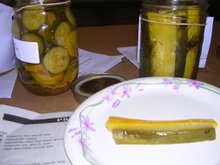
The salty/not sweet entries are possibly more prone to not be prepared properly (you can't get botulism from sugar based items, but watch out for tomato based home made items!) or are more apt to 'go bad' quicker.  Pickled items, holding up the vinegar base/flavor for months show that there are proper methods used for the preservation of the food, as well as, of course, the taste. 

All of the judges participate in judging the Strawberry Jams- since that class has the largest number of entries every year (19 different entries this year).  The Blue Ribbon winner of the Strawberry Jam category this year will have their name printed on the jars of strawberry jam sold in the Home and Hobby section of the Fair next year (which means last year's winner's name is on the jars sold this year) along with selling a cookbook showing the recipes of last years winning entries from all categories of preserved foods as well as daily contests(including 28 Spam recipe winners from last year).Sdfair_013 Sdfair_014

In the end, the first place winner from each Division is put up against the others and the judges choose the "Best of Show".

This is a photo of the competitors in the "other than listed above class" of the "Miscellaneous" Division…Sdfair_011

You can see asparagus, beets, 'false capers' (made with nasturtium buds), carrots and up front, those  preserved Chinese Tea Eggs…well, those won first place in their Class, Division and- Best of Show!  They were made in 2006, but the vinegar was still potent, the egg white has a good tannin tea flavor (despite the fact that the recipe said it was made with Japanese tea and I would think that flavor would dissipate more than Chinese black tea) as well as the whites also having a good, heat 'kick' from the red chiles…and the yolk…it was yellow and strong flavored and tasted like a fresh, hard boiled egg…truly this entry was a great example of properly preserved food.

There are a lot more things to do and see and eat at the Fair, and those will be covered in a future post, done after the Fair opens.  If you do go, please do take the time to see all the Fair has to offer.  Home and Hobby is upstairs in the Grandstand section.  You can't taste the preserved foods or any entries (they were opened about two weeks ago, remember)…the recipes will be available in Next year's cookbook, though…but there are plenty of other things available this year to purchase, including Fried Coke (frozen Coke syrup dipped in bater and then fried), chicken sandwiches served on a split (plain glazed non-jelly filled) Krispy Kreme donut, a roast beef sundae (roast beef on a pile of mashed potatoes and gravy  topped with a cherry tomato), rattlesnake chili (I will taste this only for your sake) and the standard cream puffs, pasta, Indian Fry Bread, Australian Battered Potatoes..and much, much more!

San Diego Country Fair,  Del Mar Fairgrounds I-5 to Via De la Valle.  Free Parking (versus $9 in the lots adjacent to the Fair) at the horse park about one mile east as well as other locations.  (www.sdfair.com) $1 entry on opening day only- if you buy tickets at Ralph's.  Discount tickets for other days also available at Ralphs and  at Costco.  There is also a "frequent fairgoers pass", good for any three days, also group discounts are available.  (858) 794-1096 .  Regular adult admission is $12.

Open June 8-July 4, (Closed on June11,12, 18, 19 and 25 ) 10 a.m.-10 p.m. (11 p.m. on Friday and Saturday nights and midnight on closing day, July 4)
Braised Lamb Shanks with Lemons, Tomatoes, and Green Olives

I was looking over a cookbook that I purchased a few months back from a bookstore bargain bin. The title of the book is How to Cook Meat by Chris Schlesinger and John Willoughby. The Missus happened to peek over my shoulder and noticed this braised lamb recipe…and it was off to North Park Produce, for lamb shanks, olives, and all the other supplies for this dish. I’ve made a few adjustments to account for our taste preferences, and also to cut down on the amount of skimming, and other tasks that are done several times in the recipe, it didn’t seem necessary. I think it came out pretty well, and went well with our current overcast and cool weather.

Brlambshanks01

Braised Lamb Shanks with Lemons, Tomatoes, and Green Olives

5-6 Lamb ShanksBrlambshanks03
2 Tb Olive Oil
2 Onions Sliced
2-6 Cloves Garlic, minced(depends on how much you love garlic – guess how many cloves I used?)
1/2 Cup Diced Celery(About 2-3 stalks)
2 Cups White Wine
2 Cups Chicken Stock, or even better Lamb Stock
6 Sprigs Fresh Thyme
1 Tb Fresh Thyme Leaves
2 Bay Leaves
2 Whole Cloves
3 Lemons(or 2 large) peeled and segmented
2-4 Tomatoes, cored and seeded, cut into a large diceBrlambshanks02
1/2 Lb Green Olives, rinsed, pitted, and sliced in half
Salt and Pepper to taste
Chopped Fresh Parsley

1 – Preheat Oven to 325

2 – Season lamb shanks with salt and pepper and brown over medium-high heat in Olive Oil in a Dutch Oven, or similar pot. I had to do this in batches.When the lamb shanks are browned well, transfer to a plate.

3 – Pour off excess fat in the pot(leave about 2 Tb), and add sliced onions, celery, and garlic.Cook over medium heat, stirring occasionally, until translucent. Deglaze pot with white wine and stock(if you have lamb stock, more power to you!) scraping up all the nice brown bits. Bring liquid up to a simmer and add lamb shanks back into the pot along with the sprigs of fresh thyme, bay leaves, and cloves.

4 – When the liquid is simmering, cover and place the pot into the oven. Cook for 2 to 2 1/2 hours, checking the lamb for doneness with a fork.

5 – When the lamb shanks are done, transfer them to a plate and cover with aluminum foil. StrainBrlambshanks04  the cooking liquid, and pour it back into the pot. Bring the liquid back to a simmer, skim off the fat from the braising liquid and slightly reduce the liquid. Add green olives and tomatoes into the liquid and cook for 5 minutes, stirring occasionally. Add lemon segments, and cook for 5 more minutes. Add shanks back into liquid and simmer over low heat for a few more minutes.

6 – Remove the pot from heat,add in Thyme leaves, and adjust the seasoning with salt and pepper.

7 – Serve over Couscous.

The dish turned out well, and fulfills my "cookbook obligation"….to limit the purchase of cookbooks, I have promised to make at least one dish from each cookbook I purchase. I’m still trying to figure out what I’ll be able to make from Yoshihiro Murata’s, Kaiseki……

Brlambshanks05

A kind of funny thing happened at North Park Produce….not really paying attention, I asked the guy behind the meat counter for 6 lamb shanks….I guess he heard 6 pounds of lamb shanks. When I brought the bag home and opened it 9 lamb shanks rolled out. So I browned three of the lamb shanks without seasoning, and the Missus made braised lamb shanks and rice for Da Boyz…..in my next life, I want to be one of Da Boyz! Though the food coma can be really hard on you!

Sammyfoodcoma

The Buta Kakuni Experiment

Butanokakuni01

*** I’ve had a few emails and several comments below asking about the origins of Buta Kakuni…best that I can tell is that Buta Kakuni is based on a Chinese Dish that the Japanese call Tonporo. Which to me means it’s probably Dong Po Rou(Dong Po Pork), if you follow the link, you’ll see that it looks very similar. Dong Po Rou is named after the poet Su Dong Po, you can see a translation of one of His poems here.

The other day, I was paging through a cookbook I had lying around titled The Japanese Kitchen, authored by Hiroko Shimbo. The recipe I just happened upon (lucky me!!!) was for Buta Kakuni, the Braised Pork dish that originated in Nagasaki Prefecture. Apparently, Buta Kakuni is based on a Chinese Pork dish, and Nagasaki was a busy port city where ships from all over the world docked. So somewhere between the sixteenth and eighteenth century Buta Kakuni arrived(lucky us!!!)……..

There are two Buta Kakuni recipes that I have used in the past. In the first recipe, the pork belly is first fried, than simmered for several hours. In the second recipe, the pork belly is first boiled in Okara(tofu lees) for several hours before a short braise in a sake-soy sauce-mirin-sugar liquid. What caught my attention was that Hiroko Shimbo’s recipe first steamed the pork belly, before cooking in the flavoring liquid. And what was even more interesting was that the pork belly was first covered with grated daikon! According to the book, Daikon contains two digestive enzymes, protease and diastase which help to remove excess fat and tenderize the pork belly.

What you see above is the result. I used the steaming technique in the book, but the flavoring is the one I’ve used before from other recipes. I’ve had some recipes from Hiroko Shimbo’s book not turn out really well. Since this was an experiment, I only used a 12oz portion of pork belly, which waaay more than enough for us! Buta Kakuni is pretty rich anyway, and I can only eat maybe 3 pieces….before the extreme remorse starts.

The Buta Kakuni Experiment

2 1/2- 3 Cups Grated Daikon(liquid and all)Butanokakun02
1 – 1 1/2 Lb Slab of Pork Belly
1/2 Tb (or more) Grated Ginger
1 1/2 Cup Water
1/2 Cup Sake
1/3 Cup Soy Sauce
1/3 Cup Sugar
4 Tb Mirin

1 – Set steamer over a pot of rapidly boiling water
2 – In a heatproof dish(make sure that it will fit the steamer) place 1/3 of the grated daikon and liquid over the bottom of the dish. Place the pork belly on top of grated daikon. Cover the pork with the remainder of grated daikon.
3 – Transfer dish to steamer and steam for 2 to 2 1/2 hours. I use a bamboo skewer after about 90 minutes to see how tender the pork belly is. Remember to keep replenishing the steaming liquid as necessary.

Butanokakun03
4 – Once the pork can be easily pierced with a bamboo skewer, remove the dish (carefully) from the steamer. Place the pork belly in a bowl of lukewarm water and gently rinse the pork.

Butanokakun04
5 – Dry the pork with paper towels, and cut it into 2 inch cubes.
6 – In a pot large enough to hold the pork in a single payer mix together the rest of the ingredients. Place pork in pot and bring to a boil. Once boiling, reduce heat to a simmer.
7 – Simmer for 30 minutes, and check flavoring and texture. Make adjustments and simmer for at least 30 more minutes.
* On this day I added slices of daikon and boiled eggs before the last 30 minutes of simmering. Oh, and don’t forget the Hot Mustard!

Butanokakun05

The Pork Belly was very tender, and the remaining fat was smooth and velvety. The Missus thought it a bit too sweet, but I could have done with something cooked a bit longer, but I think the pork would have started falling apart. Of course, I’ve heard of places simmering their Buta Kakuni for 12 hours or more, but I don’t think I’ll be doing that in the near future.

Lest you think I was living on pork belly alone…..

I made the Missus some Karei Karaage:

Karei01

And some Chicken Karaage:

Karaage01

And to cut the fatty flavors, some Pickled Onions with Ogo:

Onionwogo01

Dscf1520 And followed it all with a double shot of Lipitor(I’m kidding, of course)! I did have a bit  of one of my new favorite sakes, Yaegaki "Mu"…why they would name a sake "emptyness" is beyond me. This sake has a bit of a sweeter profile(not as sweet as Kurosawa), though I think it goes really well with food.

I did wish I still had another bottle of this on hand though!

Dscf1190

Midweek Madness

Wow, it's Wednesday already. Here are a few midweek odds and ends.

Kayaba

One half of the new food stands in the Mitsuwa Marketplace has revealed itself.

P1060886

From what I understand Kayaba will be doing Soba, Katsu, and the like. I'm hoping for a Santoka Ramen as well. One can always hope……

The Missus had a hankering for Una-Don, so I purchased some Unagi from Nijiya, but decided to make my own quick and dirty Nitsume(Eel sauce). We've purchased the bottled stuff, and found it either to be too salty, or too sweet, or having strange flavors. So I decided to try a slight modification of an interesting recipe I found in DK Kodama's  Sushi Chronicles from Hawaii, which I purchased on my visit to Sansei a few weeks back. The recipe is pretty easy, and after seeing the amount of Sake in it I had my doubts, but it turned out to be quite good. Maybe a tad on the sweet side, but not bad at all.

P1060881

The recipe uses some short cuts, like hondashi…which worked out well, since I didn't happen to have a whole bunch of Eel trimmings lying around. The recipe also calls for the Hondashi to be boiled…which made it a fishy-bitter during the first pass, so I cut the amount in half, and added it right before the reduction process, and it worked. I'd been taught never to boil anything after adding Hondashi, but in this case it worked during the low boil. Purists may just want to skip the recipe, if it hurts too much.

Easy Unagi Sauce(Nitsume)

2 Cups Sake
1/2 Cup Mirin
1/2 Coy Sauce(Yamasa or Aloha)
1/2 Cup Sugar
1/4 Tsp Hondashi

1 – Mix all ingredients except Hondashi in a pot. Bring to a boil stirring to dissolve the sugar. Reduce heat to medium-low and add Hondashi.

2 – Reduce mixture by half to a light syrup.

3 – Store in a tightly sealed container and refrigerate. According to the original recipe this will keep for up to 1 month.

I still don't quite know what to do about the Missus's other current obsession:

P1060878

Have you ever known anyone who craved brussel sprouts???? With Nitsume??? And Rice???

One last item – mmm-yoso's very own Cathy Doe has been recovering from illness, so I'd like to make sure to tell Her to hang in there, and get well soon. She's still posting too..what a trooper!

Turnip Cake

Did I ever happen to mention the Missus’s obsessions? It really doesn’t take much…just a simple mention of an item, and a fast growing seed is planted. It’s something that demands immediate attention…if left alone to germinate, well, let’s not go there.

This past Saturday, we had a wonderful lunch at Chin’s with Ed from Yuma, mizducky, Howie from A Foodie’s Eye View, and last but certainly not least Codergirl. In the midst of the lunch Howie happened to mention that a friend of his makes Turnip Cakes at home. Now at the mention of this little comment, I saw the Missus perk up, and though I don’t think anyone else noticed it, with just the little "they make it at home…" I knew we’d be making turnip cakes.

And so it’s off to 99 Ranch Market we go……

We’ve always had pretty good outcomes with recipes from Ellen Leong Blonder’s book Dim Sum: The Art of Chinese Tea Lunch, and used the recipe as the basis for making turnip cakes, which turned out to be quite easy. We did make a few changes and adjustments in the recipe. The result is pictured below.

Turnipcake07

Turnip Cakes

2-3 Tb Small Dried Shrimp(optional – also soaking them in hot water for 20-30 minutes and draining is optional, we didn’t do this)
2 1/2 – 3 cups(lightly packed) Coarsely shredded Daikon RadishTurnipcake01
1 Lup Cheong(Chinese sausage) finely diced
2 Green Onions (include white parts) finely sliced
1-2 Tb Cilantro – finely chopped
2 Cups Rice Flour (* Important note – use rice flour, do not use sweet/glutinous rice flour)
1 Tsp salt(adjust up if not using shrimp)
1/2 Tsp Sugar
1/4 Tsp Ground White Pepper
1 1/2 Cups Water
Vegetable/Canola Oil

1 – Place shredded radish in a small pot or saucepan with water. Bring mixture to a boil, than reduce the heat to a low and simmer for 15 minutes or until tender, stirring occasionally. Remove from heat. Remove radish from liquid(do not discard the cooking liquid) and place in measuring cup. Add in cooking liquid to bring the amount to approximately 3 cups. Let the mixture cool to a lukewarm temperature.

2 – While radish is cooking, heat 2 teaspoons of oil in a skillet or wok. When oil starts to smoke add the Lup Cheong,Green Onions, and Dried Shrimp. Stir fry for 1 or 2 minutes. Remove the mixture from heat and stir in Cilantro.

Turnipcake03

3 – Get the steamer going.Turnipcake02_1

4 – In a bowl mix the rice flour, salt, sugar, and white pepper. Add the radish and cooking water, and stir to a batter-like consistency. Add the Lup Cheong mixture to the batter and mix. Pour mixture into a 8×8 cake pan, or a 9 inch round cake pan.

5 – Place cake pan into steamer, and steam at a medium-high boil for 35-45 minutes.

6 – Once done, remove the turnip cake from the steamer and let cool.

Turnipcake05

Once cool, you can cut into squares and fry, or fry, than add egg, or whatever preparation you Turnipcake08 desire.

I fried up a few squares, and the Missus told me, "you know what this means, don’t you?" "Wellll, I guess no more store bought, and we’ll cross this off our Dim Sum list, ala’ Sticky Rice in Lotus Leaf?"

Thanks alot Howie…just kidding of course. Turnip cake turned out to be much easier than we thought.

I’ve had a few Emails asking if I still cook, and yes I am, but recently it’s been really simple things like Soboro, and other stir fries, but I thought this would be of some interest. I’ll be back with another restaurant tomorrow.