Sticky Rice in Lotus Leaf

P1020133

Since fellow bloggers Jo, Reid, and Kathy have already figured out that we were going to make these; I’ll get right to the point. We did see these during our Thanksgiving visit to Pearl (Yes Angie, we really did see them), but since I had just gotten the book Dim Sum – The Art of Chinese Tea Lunchby Ellen Leong Blonder, we decided to give this a shot:

Sticky_rice01

We headed off to 99 Ranch Market and purchased some Dried Lotus Leaves, though I enjoy calling them Water Lily Pads…..which is what they are:

Sticky_rice02

We made many changes to the original recipe, mainly because we wanted to use what we had on hand, and also because we enjoy having a bit more "filling" then the usual "smear" of filling that is the norm.

Sticky Rice in Lotus Leaf

Makes 8 "packets"

2 Cups Glutinous Rice
1 Tsp SaltSticky_rice07
6 Dried Shiitake Mushrooms – soaked in warm water for 30 minutes, then drained and sliced.
4 Dried Lotus Leaves
2 Tb Soy Sauce
2 Tb Oyster Sauce
1 Tsp Xiao Tsing
1/2 Tsp Sugar
3 Tb Vegetable Oil
1 Boneless, skinless Chicken Breast – Chopped to coarse texture
4 Oz Dried Shrimp – Soaked in water for 15 minutes and drained
1 Lup Cheong sliced to 1/4" roundsSticky_rice05
2 Oz Char Siu cut into 1/4" dice
4 Boiled Duck Egg yolks cut in halves
1 Tb Corn Starch mixed in 1/3 Cup Water

1 – Rinse and soak Glutinous Rice in water to cover, add Salt and let soak for 1 Hour

2 – Cut each folded lotus leaf in half and cover with hot water. Soak for 30 – 45 minutes, turning occasionally to make sure leaves are totally soaked. (Since I didn’t do a turkey this Thanksgiving, it was good to actually use a roasting pan for something!)

Sticky_rice04

3 – Cook rice in 2 cups of water. Once rice is cooked allow to cool slightly.Sticky_rice08

4 – Combine Soy Sauce, Oyster Sauce, Xiao Tsing, and sugar to create a sauce.

5 – Heat wok or skillet, add 1 Tb oil and stir fry the shrimp and lup cheong for 1-2 minutes, add chicken and stir fry until the chicken starts turning white. Add mushroom, char siu, and sauce mixture and cook for 1 minute. Stir in cornstarch mixture and remove from heat when the sauce has thickened. Place onto a plate and put aside to cool.

Sticky_rice09

6 – After leaves are soaked, rinse briefly and shake of excess water. Cut off about 2 inches from the "point end" of the leaf and trim any ragged portions of the curved edges with a scissors. Stack the leaves in the same direction and set aside.

7 – Divide the cooled rice and into eight portions.Divide the filling into 8 portions as well.

8 – Place the stack of leaves with the outer edge facing away from you. Spread a light coat of oil evenly over the leaf.

9 – Divide one portion of rice into two. Place this half potion of rice onto the lower center of the leaf and form into a 2"x3" rectangle. Place one portion of filling onto the rice, and place 1 half piece of egg yolk on filling. Place the remainder of rice portion on top of the filling. Press the layer gently together.

10 – Fold bottom end of leaf over the rice. Then fold over first the left then the right edges of the leaf over rice. Then roll up the rice packet to form a rectangular packet.

11 – Place seam side down in a steamer and steam for 20-35 minutes. (The book called for 15 minutes, but it was too short and the sauce and essence of the leaf had not permeated the rice).

Sticky_rice11

Some notes: The recipe in the book used raw shrimp, but we decided to just use the dried shrimp we had on hand. The recipe did not use egg yolk, which I thought was odd. We’ve always had this with a quarter to a half egg yolk in it. The next time we may add some peanuts for texture, and maybe a scallop. But overall these tasted really good, and weren’t that hard to make – just a "whole lotta soakin’ going on.

Next Up, Shrimp and Chive Dumplings????

A Nimono Kind of Night

"You know that I know how to make that stuff, don’t you?"

"Well why don’t you make me some then?"Nimono02

A typical conversation over the prepared food case at Nijiya. I usually would just go ahead and buy the stuff, but for some strange reason today I was overcome with bravado; and of course the Missus called me on it.  I haven’t really made any of this stuff in years. Well I decided to dig out some recipes, and some books and actually cook some of this. So instead of eating out this past Sunday, I had a "nimono(simmered food)-fest"! All these recipes are modifications of those found in various cookbooks I have.

Nimono04

Kiriboshi Daikon when rehydrated has a somewhat nutty taste, and a nice crunchy texture.

Kiriboshi-Daikon Ni
(Simmered Kiriboshi Daikon)

2 oz Kiriboshi Daikon
(Dried White Radish Strips)Nimono03
3 Fresh Shiitake Mushrooms
3 Chikuwa (Broiled Fishcake)
1 Tb Toasted Sesame Seeds
1-2Tb Vegetable Oil
1/4 Tsp Dashi No-Moto (optional)
1/2 Cup water used for soaking Kiriboshi Daikon
1 Cup Water
2 Tb Sake
1/4 Cup Soy Sauce(not Kikkoman)
3-4 Tb Sugar
2 Tb Mirin

1 – Rinse the Kiriboshi-Daikon in cold water. Squeeze out excess water, and place in a bowl. Add water to just cover radish strips. Soak for 30-40 minutes

2 – Slice Shiitake Mushroom and Chikuwa into thin (1/8") slices.Nimono05

3 – When Kiriboshi-Daikon is reconstituted squeeze out water, and cut into bite size strips if necessary.Set aside 1/2 cup of strained soaking liquid.

4 – Heat oil in a pot, add in order; the Chikuwa, Shiitake Mushroom, and the Kiriboshi Daikon, stir fry briefly using medium heat.

5 – Add Soaking Liquid and Water, and bring to a boil. Once a boil is reached add sake, mirin, and sugar, and simmer for 5 minutes.

6 – Add soy sauce and simmer until the liquid is almost completely absorbed.

7 – Sprinkle Sesame Seeds before serving.

Nimomo06

Hijiki is the black colored dried seaweed that is often seen stuffed into Onigiri (Rice Balls), and is often used as garnish or as a side dish at "Asian-Fusion" restaurants. It is high in vegetable protein, calcium, and iron.

Hijiki Nimono
(Simmered Hijiki Seaweed)

1 oz Dried Hijiki Seaweed
1/3 Carrot sliced into thin "sticks"Nimono07
1 Sheet Aburage (Thin Fried Tofu Sheets)
1-2 Tb Vegetable Oil
3/4 Cup Water
2 Tb Sake
2-3 Tb Mirin
3-4 Tb Sugar
1/4 Cup Soy Sauce
Salt to taste

1 – Place Hijiki in a bowl, and rinse several times in cold water. Soak in cold water for 20-30 minutes until soft.

2 – Pour boiling water over Aburage to remove excess oil, and cut into thin slices. Nimono10_1

3 – Drain Hijiki.

4 – Heat oil in a pot using medium heat. Add in the following order Carrot, Aburage, and Hijiki, and fry for 1-2 minutes.

5 – Add water and bring to a boil. Add sake, mirin, and sugar. Lower to a low simmer. When the liquid is almost absorbed add soy sauce and salt, stirring until almost absorbed.

Some notes; many times you’ll find this dish with Soybeans (Edamame), or cooked black beans, or topped with sesame seeds. You can also add Shimichi Togarashi (Japanese Chili Pepper Powder – actually "seven spice"…) for some zing. This dish tastes better the next day after flavors have had time to meld.

Nikiu_dofu01

Niku tofu is a real homestyle dish. This version features Shirataki, often called "yam noodles", the noodle form of Konnyaku.

Niku Tofu
(Simmered Beef and Tofu)

1/2 Lb thinly sliced beef – sliced into bite sized slicesShirataki
1 Block soft tofu
1 medium onion sliced
1-2 packages Shirataki (Yam noodles)
1 bunch green onions green part only sliced
1 Cup water
4 Tb Sugar
3 Tb Sake
3 Tb Mirin
1/4 Cup Soy sauce
Salt
1-2 Tb vegetable oil

1 – Rinse Shirataki under cold water. Then pour boiling water over shirataki to remove bitterness and smell (Shirataki has a very strong and unpleasant odor), rinse under cold water, and drain.

2 – Heat vegetable oil in a sauce pan or wok over medium heat. Fry the beef until slightly Niku_tofu02 browned. Add the Shirataki and onion and fry.

3 – When ingredients are heated through add Water and bring to a boil. Add Sake, Mirin, Sugar, and Soy Sauce. Reduce to a simmer.

4 – Add tofu and mix in, being careful not to mash tofu. Let simmer for 10-15 minutes.

5 – Top with green onions before serving.

I had a blast juggling three "active" pots. I haven’t had so much fun since I worked as a cook in a drive-in as a teenager! In fact I decided to make me a bento, so I made my "Mama’s Eggs", basically a "rustic" Dashi-Maki Tamago (Rolled Egg Omelette):

Mamaseggs01

Mamaseggs03 I scramble three eggs, add green onion, furikake, and 1 Tb Kikkoman Soy sauce.

Made a pretty good bento with all of this:

Nimonobento

Tomorrow it’s back to restaurants……

Oven Kalua Pork

P1010484_1

A few weeks ago Reid from Ono Kine Grindz, and I exchanged a few Emails about Kalua Pork.  Reid, it seems had planned to do a few "theme" posts, and asked if I’d like to participate….and viola’ another "joint cooking post" is born. Here’s Reid’s photgenic version.

So a few weeks ago, I took a trip down to the local 99 Ranch Market, and picked up a nice Pork Shoulder:

P1010447

P1010449 I picked up a good size roast that came in at a bit over 5 pounds. It’s also good to get one with a good amount of fat on it. The main items I use for seasoning on my Kalua Pork is Hawaiian (Sea) Salt, and Wright’s Liquid Smoke. The only ingredients listed on the liquid smoke bottle should be smoke and water. I usually get a bit of flack whenever I mention using liquid smoke; but look through Alan Wong’s New Wave Luau and you’ll notice that he uses Natural Liquid Smoke as well.

Oven Kalua Pork

3-5 lb Pork semi fatty piece pork butt/shoulder. If pork is very lean, get a piece of fatty pork belly to add.
3-5 Tb Sea Salt – I use Alaea & "Hawaiian Salt"
6 Tb Liquid smoke (check the bottle – the only ingredients are smoke & Water)
Pepper(optional)P1010451
4 cloves garlic(optional)
water

Score the pork deeply on all sides – rub with 3Tb salt and 3 Tb liquid smoke. Add a few turns of black pepper if you desire.

Wrap tightly in aluminum foil. Pour 1/4-1/3" of water into a roasting pan with 1Tb Liquid Smoke – you can add cloves of garlic into the cooking liquid if you want.

Place wrapped pork into pan and cover pan with foil, seal well, and leave a little "tent space" at the top. Place P1010453 into preheated 325 degree oven – 4hours for 3lb roast – add 1/2 hour for each additional pound. No, there will be no burying in the ground(imu) cooking for me!

When roast is done remove pork "package" to another pan.

Pour off about 1-2 cups of fatty liquid from roasting pan into a bowl.

Open pork package and shred with a fork. At this point taste the pork. It should be a bit on the "bland" side. Add additional salt and liquid smoke to the drained fat and liquid in bowl and mix until salt is completely dissolved.P1010459

Add liquid back slowly to pork and shred until desired taste is achieved.

A few notes; when I’m "home" I use Ti leaves to wrap the pork before wrapping in foil, but I’ve had two bad experiences with Ti leaves here on the mainland, so I’ve stopped doing that. People don’t seem to notice, even those Ex-Pat Kama’aina’s I’ve given this to!

Now why do I make this? Well I’ve found that a couple of the people at work love this! So I’ll make this once or twice a year, and I’ll send out an Email letting the "pork-lovers" know that I’ll be making this. One of the guys (Bruce…) will then send P1010482 out an Email changing the date, to select people, so that they won’t attend the pork-fest, leaving more for him….. I’ve even learned of a new Kalua Pork combination, that’s Kalua Pork in a toasted Pan De Sal(Filipino Rolls); it’s delici-yoso!!!

I really don’t eat much of the pork myself, I’ll do something like make a macaroni salad, and on this day I also made those Chicken Alice Wings. So I ended up having a nice "plate lunch"

P1010488

Chicken, Like Alice used to make? The Great Chicken Alice Recipe

*** I've revised my recipe a bit. You can find that post here.

Looking back, life was pretty simple and easy for me during the Mid-Late Eighties through the Mid Nineties. Four times a week, I'd get off work and work-out with my Buddies, first at World Gym on the Ala Wai, later at The Gym in Kakaako. And at least once (and as many as four) times a week we'd grab dinner at Chicken Alice on Kapiolani Blvd, right outside of Ala Moana Center. Many a good "pau hana" started at "Alice", over her crunchy, slightly spicy wings, and ended up in my Buddies drive way, with jokes and conversations, after more than a few cold ones.

Then rather suddenly, Alice closed her Restaurants, and seemed to have disappeared. And a piece of me evaporated along with those wings….

Flash forward a decade later, and I've been periodically checking the Internet to see if anybody has a reasonable facsimile of Alice's chicken recipe. Well there it was, in black and white; written up in the Honolulu Star Bulletin. And along with the story of Chicken Alice, was the recipe for those awesome wings! I was so thrilled, but then something brought me crashing to Earth:

P1010473

You see, according to the article "The key ingredient is Parks brand kim chee sauce — made locally and used primarily as the base for kim chee." This is something that you pretty much won't find on the Mainland; I was crushed; so close, yet still thousands of miles away! Enter Reid, of 'Ono Kine Grindz. I had made a passing comment to him about the sauce, and before you knew it, he had sent me two bottles of Parks brand Kim Chee sauce in a styrofoam cooler, and kept it cold using freezer gel packs! Talk about resourceful!

So what's in the Kim Chee sauce? According to the bottle, it's Chili Pepper, Garlic, Fish Sauce, Salt, Sugar, MSG, Paprika, and Ginger. What a combo! I got down to cooking right away, using the recipe from the article; right here.

So how did it turn out? Well I found it to be a bit on the mild side, and not salty enough, though the crispy stickiness was still there; and the color looked right. Also, the flavoring was just a bit "off".

So, armed with that experience, I made my adjustments, and came up with this recipe:

5 pounds chicken wings
Vegetable oil for deep frying P1010476

Batter:
1/2 cup Parks brand kim chee sauce
3 tablespoon minced garlic
2 tablespoons salt
2-1/2 cups flour
2 1/2 cups water

Combine kim chee sauce, garlic, salt and flour. Add water gradually, enough to make a thick batter, about the consistency of pancake batter.

Add chicken pieces to batter, mix well and marinate in refrigerator overnight.

Heat oil to 350 degrees.Deep-fry chicken pieces until chicken rises to surface and coating is deep brown.It's important to keep the oil at this temperature in order to assure the perfect crisp coating.

So you're wondering what it looks like, right?

P1010494

P1010492 I was amazed at how the color turned out; just a tad "lighter" than I remember, but close enough. The crunchy, slight stickiness was there. And the taste was nice and a mild-medium spicy. The changes I made; more garlic; more salt; a bit more water; and especially marinating overnight, instead of the 2-3 hours in the recipe did the trick. The chicken was still tasty and a bit crunchy 4 hours later, just like it used to be. Though it seemed the batter was thicker than I remembered, even though I added a bit more H2O.

P1010480

My tastes had changed over the last decade; I'm now used to really spicy Sichuan Food, among other things, and though Alice's Chicken doesn't thrill me like it used to, it's still darn good. But the memories are what this was really all about. Sitting down, munching on wonderful memories, my mind was a thousand miles away to a place and time when things were alot simpler, and time seemed to pass at a less frenetic pace, even if just for a few moments, made the decade long quest worth while.

Mahalo Reid, I'm forever in your debt!

At the SDAFF: 20:30:40, Saving Face, and Dumplings

Ah yes, another wonderful day at the San Diego Film Festival. Today we went early and saw Alice Wu’s fantastic film; Saving Face. Alice Wu’s Directorial debut is a wonderfully funny, yet an a amazingly perceptive and complex tale, one that is both light, and yet reveals very deep social and cultural issues that are put at the forefront.

P1010183

At the heart of the movie is the question; at what length and what price is one willing to pay to "save face". Saving Face is of the best most polished Asian American Films I’ve ever seen. After the film, Director Alice Wu, and the three lovely Leading Ladies, Joan Chen, Michelle Krusiec, and Lynn Chen were very generous with their time during a Q&A session. What I was really amazed to find out was that the film was completed in 27 days, all single takes!  If I’m being a bit vague with the plot details, it is with good reason. The film takes some really fun twists and turns, and keeps you guessing til the end. If you’re interested in a movie that’s like a cross between The Wedding Banquet and My Big Fat Greek Wedding, this is for you. By the way, I never knew Joan Chen could be so funny!

On Thursday Night we saw 20:30:40, a funny, yet very interesting and revealing Taiwanese/Chinese film Directed by, and starring Sylvia Chang. 20:30:40  portrays the life of 3 Women. Xiao Jie (Lee Sin-Jie), is a 20 year old, who has come to Taipei to become a pop star. Suddenly free, and learning about life with no responsibility, she starts learning and experimenting in her journey to find out about life and who she is. Xiang (Rene Liu), is a thirty-something Flight Attendant, attempting to find love by juggling two men, a married Dentist, and a possessive somewhat unstable Music Producer. Forty-something Lily (Sylvia Chang) is the owner of a Flower Shop. Her world is turned upside down when she finds out that her Husband has a second family.

P1010181

Though the women never actually meet, they pass each other, and their lives are intertwined through associations with other characters in the film. Featuring  some very funny moments, this is a showcase for the actresses and in the end a very honest and entertaining effort.

What about the food? Among the many food scenes in these two films were two that got our attention; in 20:30:40, Lily (Sylvia Chang) is having dinner with would be "Romeo", Jeff (Tony Leung Ka-Fai), as he teaches her to eat her dumplings by first eating an entire clove of garlic, he tells her; "what do you care, we’re both sleeping alone tonight…", one of the funniest lines in the film. In Saving Face, Joan Chen is making dumplings for a "mah-jong party".

So this evening, the Missus decided to end her self imposed Dumpling retirement, by saying, "hey, let’s make some shrimp and chive dumplings…" So even though it was after 6pm, I jumped into action and ran up to 99 Ranch Market to pick-up some shrimp and chive, while the Missus made the dough for the wrappers:

P1010189

Sorry that there is no set recipe for this. I will go through the ingredients, though. Dumplings have been a way of life for the Missus. She was raised in Qingdao in the Shandong province in China. P1010197 Dumplings, handmade noodles, and various breads are a way of life. This dough was made with flour and room temperature water. While kneading she knows at what point the dough is "ready". My job is easy; shell and devein 1 1/2 lbs of shrimp, which is then chopped to desired texture.

P1010185

The chives are chopped to desired texture. Here’s a very "rough" recipe for the filling for these P1010186_1 dumplings:

1 1/2 lbs shrimp chopped
1 bunch chives chopped
2-4 Tbs Sesame Oil
2 tsp salt
2 tsp Shao-Tsing Wine
2 eggs
Ginger Juice(everybody wonders what the garlic press is for)
Mix together and start filling them dumplings:

P1010188

P1010200 Here’s a hint; before mixing the dumpling filling, start boiling a small pot of water. When the mix is ready make a "test dumpling" and cook – it’ll be pretty quick since the dough is fresh. You can taste the filling and make adjustments. For me, the only way to eat these freshly made dumplings is to boil them. You get the full range of flavor and most of all the wonderful slightly doughy wrapper, that should have a bit of pull. Of course you can pan fry if you must:

P1010204

P1010196 This is one of the things that I am able to contribute to the whole process! Also making the sauce:

Chinkiang Vinegar
Soy Sauce
Garlic
Green Onions
Optional – Chili Paste, Sugar, etc….

The belief is that boiled dumplings are the true test, fried dumplings are for later. Even though she declared a "second retirement" after making these, I still love and appreciate the fact that she knew after watching all these "dumplings on film", that I’d be wanting some. Also, I know we’ve now got a few dozen in the freezer! he-he-he….. Need to find more dumpling movies!

P1010193

Kabocha Nimono

I had promised Milly from  Some Like it Hot a recipe using Kabocha a while back. So here’s a recipe for simmered (Nimono) Kabocha. Kabocha can be found in most Asian markets, and is a type of winter squash. Uncut, it can be stored for a pretty long time before using.

P1000525

The skin of this squash is very tough, hard, and thick. You need a very heavy knife, and possibly a hammer – jack-hammer, hand grenade, or maybe power saw (just joking…); to cut the Kabocha in Half:

P1000526

Any type of pumpkin can be used for this recipe, though the Kabocha, whose flesh is very sweet and creamy when cooked is probably best for this recipe.

Simmered Pumpkin (Kabocha Nimono, Kabocha No Fukumeni)

1 Medium Kabocha (choose one that is firm and heavy for it’s size) cut into chunks and discard seeds and tough fibers. You may cut off the hard skin if you feel ambitious.
2 cups dashi
4-5 Tb MirinP1000531
2-3 tsp sugar
1-2 Tb Shoyu
1/2 tsp salt

Place pumpkin pieces skin side down in the bottom of a pot (I do mine in half batches) in a single layer.
Pour dashi into pot until it comes two-thirds of the way up the pumpkin.
Add 3Tb Mirin, 1Tb shoyu, and salt. Sprinkle 2 tsp sugar on top of the Kabocha.
Cover and bring to a boil.
Once a boil is achieved reduce to a simmer.
Simmer for 10-15 minutes.
Taste liquid and make adjustments as necessary.
Simmer until tender, turn off heat and let steep in the liquid.

P1000533

I’ve also heard of a version of this dish, where the Kabocha pieces are first deep fried, than poached as above (Kabocha Age-Ni).

Poke’ – As in Po-Kee…OK????

The entire reason for my foray to Los Angeles was to purchase some ogo to make poke'. For those who don't know what poke is…. Poke in Hawaiian literally means to "slice or cut crosswise into pieces". Alan on his wonderful Food Blog ma'ona has a wonderful post on poke'. In it's most simplest form, poke consists of fish cut into bite-sized pieces seasoned with "Hawaiian" (sea) salt. Today, there are many variations of poke' with main ingredients that range from the traditional Aku and Ahi and Tako (octopus) to newer versions that use tofu and artificial crab. And poke' can be found everywhere in Hawaii from the Supermarkets to upscale restaurants such as Alan Wong's and Roy's. On any given day, there may be up to 20 -30 types of poke' sold from "deli-cases" in "local" Supermarkets in Hawaii.

Everybody I know who makes their own poke', has their own little "twist" or indispensable ingredient. Be it inamona (roasted kukui or candlenut chopped, crushed, or mashed into a paste) to limu (seaweed), or even shoyu (soy sauce). Ogo originally is the Japanese name of a specific type of limu, but nowadays, many, including myself use the terms limu and ogo interchangeably. I apologize in advance for any inaccuracies provided by my over-racked brain.

For me the itemMarukaiogo_1 that I need for my poke' is ogo, thus the trip to Marukai in Los Angeles. Marukai flies in farm raised ogo from Honolulu, and though it's not the "best grade", I think it's good enough for poke'. I have found ogo in San Diego, but it is usually so old and oxidized, that it would probably smell and taste like ammonia! The other thing I need is some "fish". I had the fish cutter at Marukai cut me a "block" of Maguro that weighed a little over a pound.

P1000206

I separated the fish into approximately two half pound "batches". With the first I made my "standard" poke:

1/2 Lb Ahi, Aku, or Maguro cut into bite sized (1/2-3/4") pieces
up to 1/4 Cup Aloha Shoyu (or Yamasa)
1/4 of a Sweet onion (Maui or Vidalia – heck I'm so desperate I just use brown onions) sliced thin.
2 Stalks Green Onion – Green parts only
1/4 cup Ogo Chopped.
Sea salt to Taste (I use Ala'ea, which is a sea salt colored with red clay)
Either Chili Paste, Chili Peppers, or Red Pepper Flakes to taste
Sesame Oil to taste
Toasted Sesame Seeds

Place cubes of fish into a bowl and add shoyu, a little at a time, to the point that the fish is only moistened. Add sea salt. Add onions and ogo and mix. Taste and adjust salt/shoyu as necessary. Add Chili Paste and sesame oil and mix. Top with Sesame Seeds.

Than I made my twist on Shoyu Poke:

1/2 Lb Ahi, Aku, or Maguro cut into bite sized (1/2-3/4") pieces
up to 1/4 cup of Kikkoman Soy Sauce
1/4 tsp Grated Ginger
1/2 clove of garlic grated fine
1/4 cup Ogo
2 Stalks Green Onion – Green parts only
Sesame Seeds

Mix all ingredients, top with sesame seeds. Serves 1 hungry Ex-Pat Kama'aina with a major Poke' "Jones".

Easy to make, huh? Just remember one thing, poke' is an easy dish, but will reflect the quality of the ingredients you use! My recipes should be used as a very, very, broad guideline.

P1000211

For those still interested, Sam Choy has a great little book on poke. I could go on and on about poke', how it's the original "pacific-rim, fusion" dish, about how every ethnic group has created and contributed to the vast varieties of poke'. Or how it feels like I'm really finally "home" when I buy a couple of different types of poke from Tamashiro Market, grab some musubi, and head to Kewalo's or some other beach and just sit down and "grind" – delici-yoso!!! Have fun "playing with your food"!

Homemade Tapenade

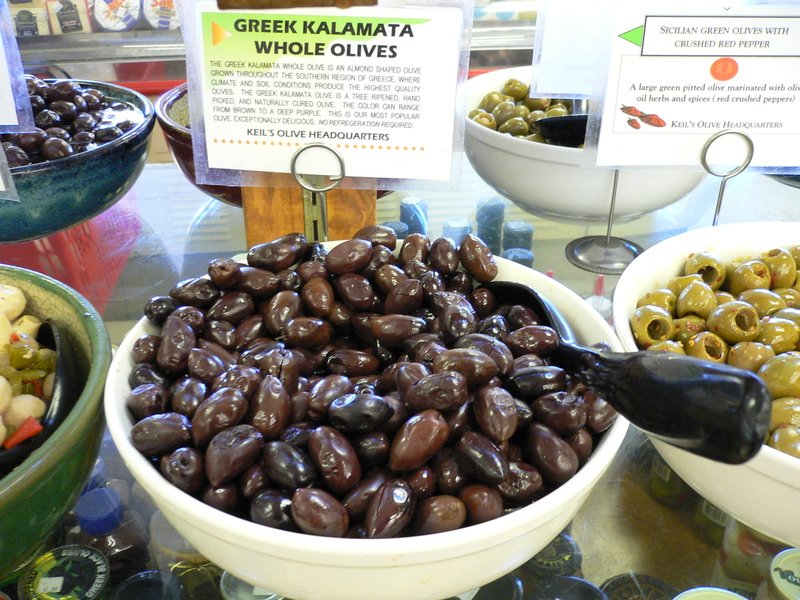
After eating my Muffeletta the other day, I developed a craving for some Tapenade. Nothing says summer like a nice Tapenade. So I marched over to the neighborhood market, which for us is an IGA; Keil's. They happen to have an olive bar with a nice selection:

Keils_olives

When we first moved into this area I scoffed at the existence of Keil's, it really doesn't look like much from the outside, and I would make the extra trip to go to one of the major chain supermarkets. But when I finally did shop at Keil's I was thoroughly surprised. They carry Keils01 everything from Boar's Head Deli Products to Tiparos Fish Sauce. Though I'm not impressed by the produce, Keil's is one of the few places where I will purchase ground beef. During the summer weekends they even have  a smoker going with ribs, chicken, and corn for sale.

So I grabbed some pitted Kalamata olives and some Niscoise olives and the other ingredients and headed the few blocks home. Now in the days BFP (before food processor), if I wanted to make a tapenade I would have spent a good portion of the evening pitting the olives, than chopping everything, before finally mixing. Now that I can get decent quality pitted Kalamata's (I still have to pit the Nicoise) and can use the food processor, my time is cut by 80%.

Here's the recipe – all measurements are approximations. I basically "eyeball" everything, and go by taste:Tapcook

Tapenade
2 cups good quality olives pitted
2 TB capers drained and dried
2 Anchovy filets
1/3 cup artichoke hearts preserved in brine – drained
1/3 cup sun dried tomatoes in olive oil – drained
Zest of 1/2 lemon
2 TB Fresh squeezed lemon juice
1/3 cup of Good Quality extra virgin olive oil

Separate half the olives and pulse 1-2 times in a food processor until you have larger chopped pieces of olive, remove to a bowl. Add the other half of the olives, capers, anchovy, sun dried tomatoes, and artichoke hearts, and pulse in the food processor. Add to bowl with olives. Add olive oil pouring slowly while mixing. Add lemon zest and lemon juice and mix. Refrigerate. Will keep up to a week tightly covered in the frig.

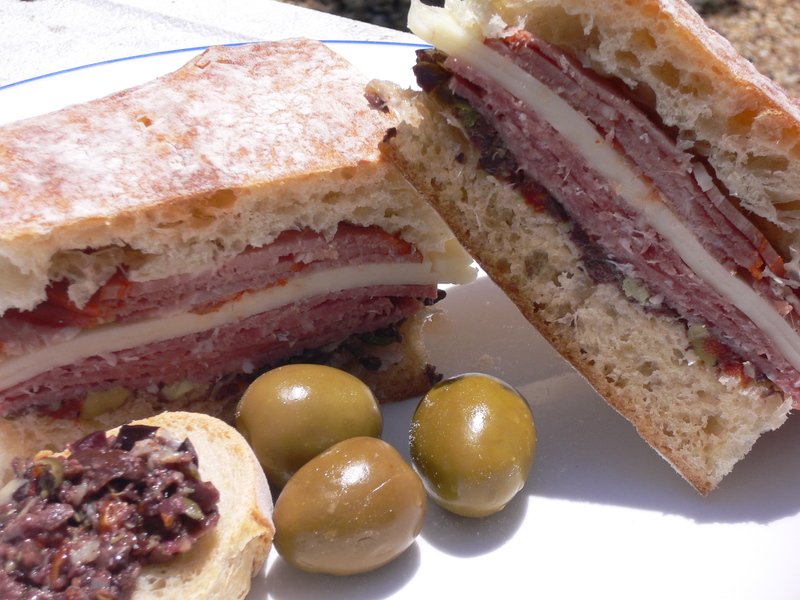
Slice ciabatta loaf in half, spread tapenade on bottom. Add a double layer of genoa salami, followed by a single layer of provolone cheese. Top with a double layer of Cappicola. Wrap sandwich in saran, place between 2 plates and press down; or use some other "pressing" method. Eat until olive oil oozes out of your pores, repeat as necessary.

Tapsw

Zion Market – Kalbi Time

***** I'm sure you already know that Zion Market has moved

After sharing a Kalbi recipe on Elmo's Site – Monster Munching, I became motivated and decided to do a batch of ribs for myself. So this entailed a trip to Zion Market:

Zion01

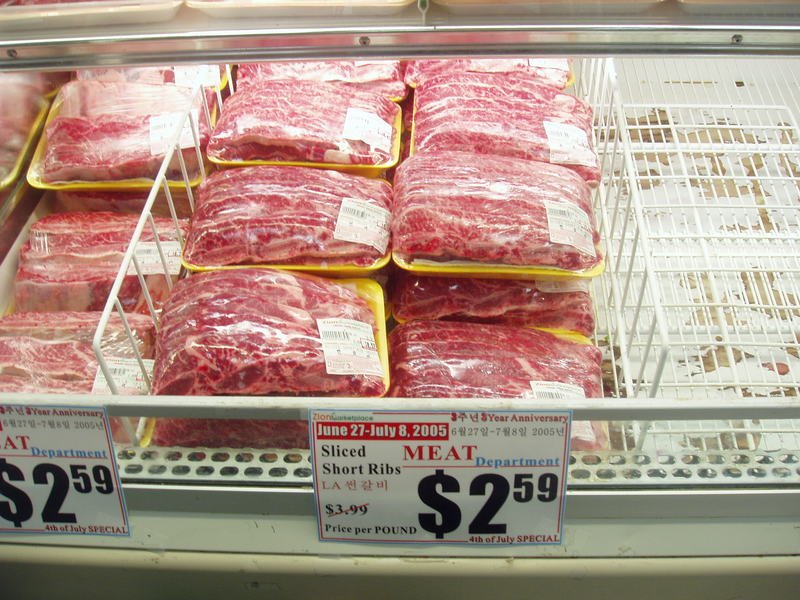
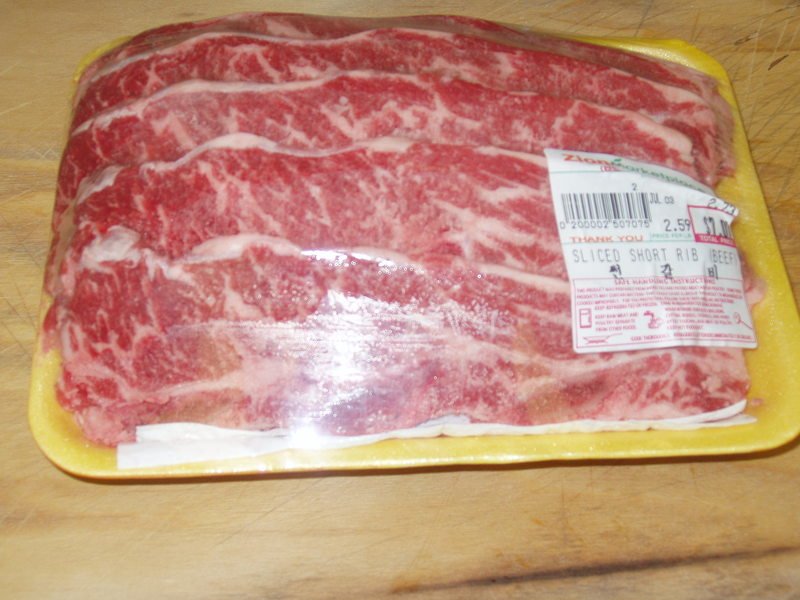
Zion Market is a huge Korean GrocerMorezion04 with a wonderful selection of produce, meat, and various Korean grocery items. Today I picked up some very fragrant Donut Peaches at $1.49/lb. I also picked up some other miscellaneous grocery items, that I'll go into later. There is also Zion02 a large selection of pan-chan – I call it the "Great Wall of Kimchee" as well as marinated meats. The quality and selection in the meat department can be mind boggling; for example, 3 "grades" of cross sliced short ribs and 4 grades of sliced rib eye. Maybe someone can explain the difference between 'A', 'B' and '10 up' sliced rib eye – some cuts look thinner and some are more marbled. The prices are also very reasonable $2.59/lb for short ribs is a bargain!Morezion03

There is also a small "food court" and a fresh seafood counter, and a bakery within the Marketplace.

Zion Marketplace
4611 Mercury St
San Diego, CA 92111
Between Engineer Rd and Dagget St

When I got home I started on the Kalbi.

Kalbi01_1 Here's my standard recipe:

2-3lbs Short Ribs
2/3c Soy sauce
1 c Water
1/2c Sugar
2 Tb grated, pureed or minced garlic
2 Tb grated, pureed or minced onion
2 Tb pureed ripe papaya or Asian pear
1/2 tsp pepper
1 large stalk green onion chopped
1 Tb sesame oil (optional)

I added a few twistsKalbi02  – There were no ripe papaya's, and the Asian Pears looked horrible – so I decided to use kiwi. Now I had heard that marinating with kiwi can be a bit dicey as it has a tendency to over-tenderize the meat, but I thought I'd give it a try. So scratch the papaya or Asian pear, and replace with 2TB pureed kiwi. I had also heard that  Malt Syrup gave kalbi a nice distinctive sweet flavor and gave kalbi a lacquered appearance, so I found and purchased a bottle. The Malt Syrup is amber in color, and tastes basically just like corn syrup. I replaced 1/2cup of sugar with 1/4 cup of malt syrup and 1/4 cup of sugar. I mixed the marinade, added the meat, and went to sleep. We'll see what happens tomorrow when I fire up the grill.

Roasted Beef Tenderloin

Today I had to take care of 2 birthdays – of my two "Boyz"….

Every year we celebrate both their birthdays with a cake from Paw Pleasers, and usually a filet mignon. This year though we wanted our share. So I got up this morning and drove over to Iowa Meat Farms. Now I can’t say enough good things about this place! Great service, great meat, and a knowledgeable staff. The cutter actually showed me a whole tenderloin, asking how many I would be feeding ( I didn’t tell them about the boyz…)Beeften01 . He than trimmed, tied, and cut me a 2 1/2lb Tenderloin, man this was a work of art!!! Now I didn’t want to be spending the whole morning, drool dripping down my chin, waiting for the tenderloin to finish roasting. So I cut it in half and seasoned very generously with Alae’a, fresh cracked pepper, granulated garlic, and a small amount of dried oregano.

Beeften02 I heated a pan to till smoking, and seared the tenderloin on all sides, than placed in a 350 degree oven.

While the tenderloin roasted I caramelized some onions:

Caramelized OnionsBeeften04
2 large onions sliced
1/3 – 1/2 cup mirin
1 – 2 Tb Sugar
Salt
Pepper
1/2 Tb Butter

Place sliced onions in a non-stick pan. Using medium heat, allow onions to "sweat". Once onions start to soften season with salt and pepper and 1 Tb Sugar. Stir onions, when onions start to caramelize, pour in half of the mirin, and allow to reduce, stirring periodically. Add butter and saute until onions are golden brown. Add additional mirin and sugar if onions are not sweet enough. Sweetness will vary based on the type of onions used.

Horseradish Sauce
1/2 Cup Sour Cream
3 Tb Prepared Horseradish
Juice of 1/2 lemon
Salt and Pepper.

Mix all ingredients until smooth. Chill.

Beeften06 When the internal temp of the roast hit 125, I removed and rested. The roast was so soft I could cut it with a fork. And the seasoning was "right on" I probably could’ve eaten the butcher’s twine and not think twice about it!

So what to do with leftovers? On a nicely toasted French Dip roll, 2Tb Horseradish sauce, 4 slices beef tenderloin, caramelized onions, Roasted Mushrooms, and Arugula!!! delici-yoso!!!

Oh, yes, "da boyz" enjoyed their share as well….Happy Birthday Sammy & Frankie!!!Pc020004_1