Simple Sardine Linguine: Ed’s $5 Friday

Cathy's busy, Kirk's busy, so today it's ed (from Yuma) sharing a favorite recipe.  And yes, ed sometimes cooks on a budget.

These days we are all looking for cheap and tasty eats when we can find them.  Stuck out here in the desert, I crave seafood, but craving seafood on a budget these days is  tough anywhere.  Today, however, I'm going to share with you an inexpensive and tasty seafood dish that can be made in Yuma and darn near anywhere else in the world.  And this week, the ingredients to feed two people cost me only about five dollars.

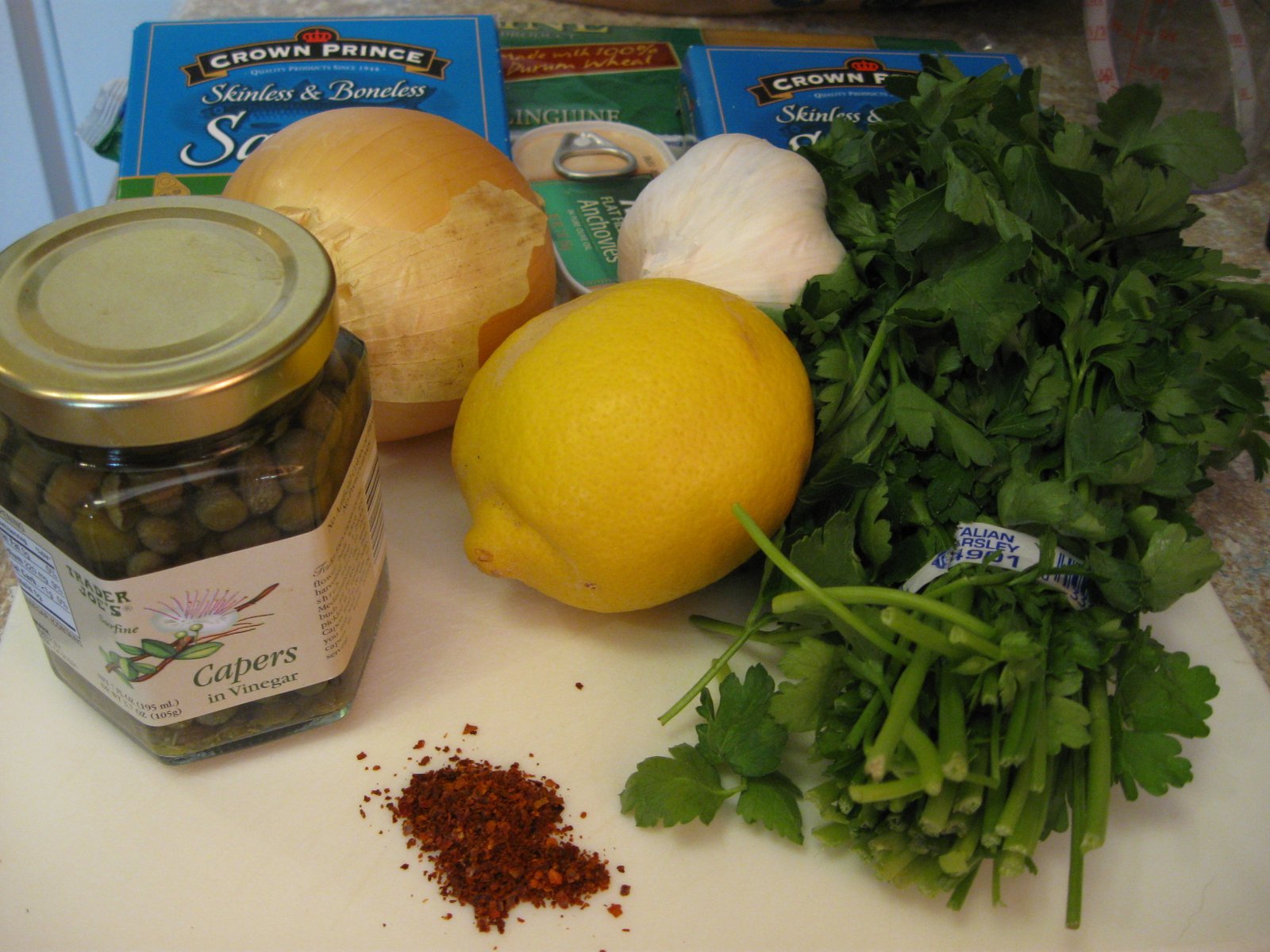
Here's what the ingredients look like:

IMG_0927 I will use both cans of sardines in olive oil (on sale this week for $1 each), about two thirds of a pound of linguine (figure $.65 worth), a bunch of flat leaf parsley ($.79 if memory serves), one yellow onion and a head of garlic (around a dollar total), one lemon (this time of year, given away free), four anchovies and a little of their oil, less than a tablespoon of Korean style crushed red pepper, and three tablespoons of capers (together they should bring me up to around $5).

Here's the list of ingredients:

 One medium onion (sliced into strips)
 One head garlic (chopped)
 One bunch flat leaf (Italian) parsley (destemmed and chopped)
 3 TBs drained capers
 Zest and juice of one lemon
 2 cans sardines in olive oil
 4 anchovy filets (and maybe some oil from can)
 2 tsp crushed spicy red pepper
 2/3 lb linguini or other pasta
 Some pasta water

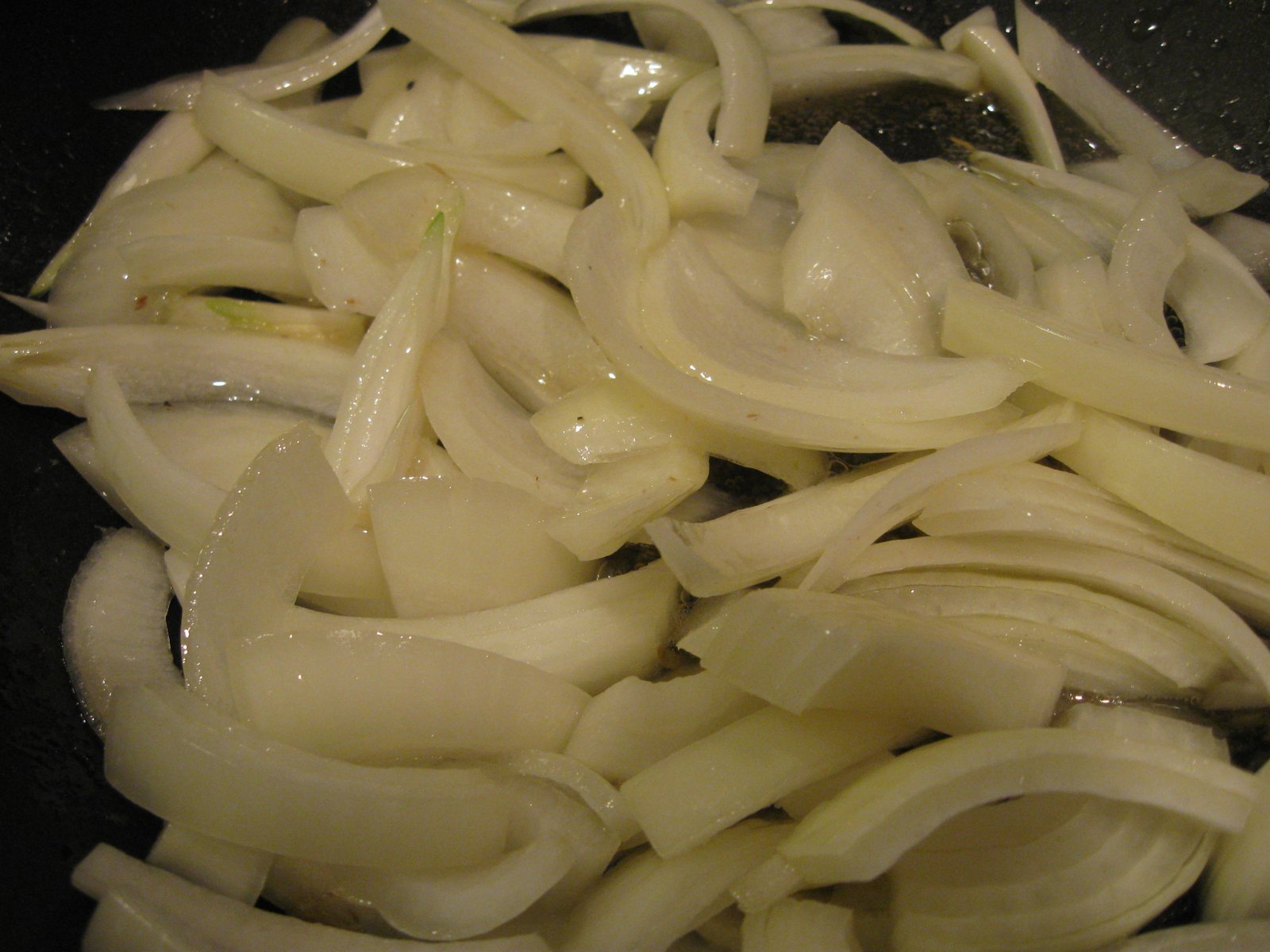
I begin by frying the onions in the oil from the sardines and anchovies:

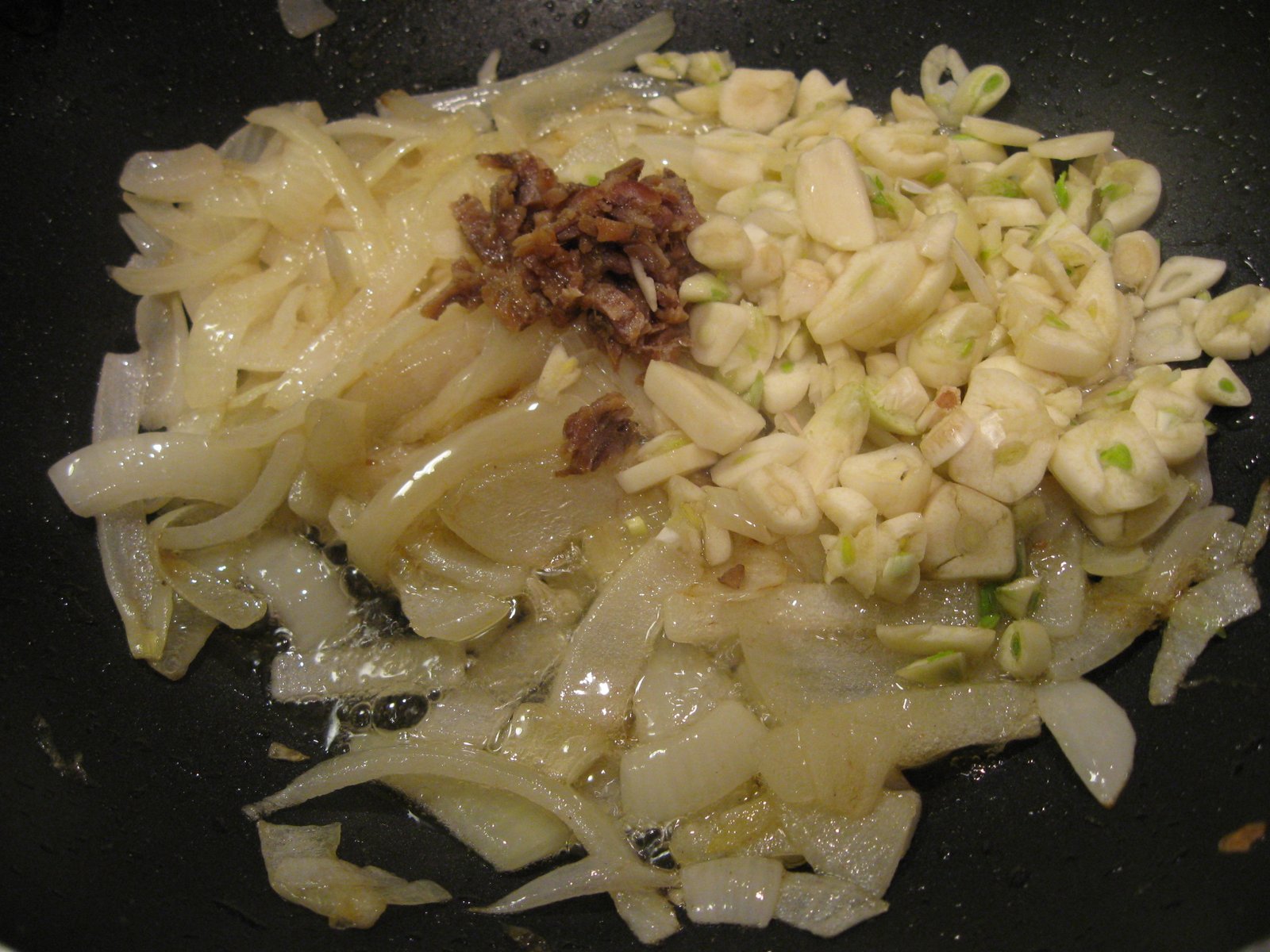
IMG_0940 After the onions are properly fried, I add the chopped head of garlic and the four anchovies, cut into small pieces:
IMG_0945 Before too long, I put in the crushed red pepper, the destemmed flat leaf parsley, and the capers.

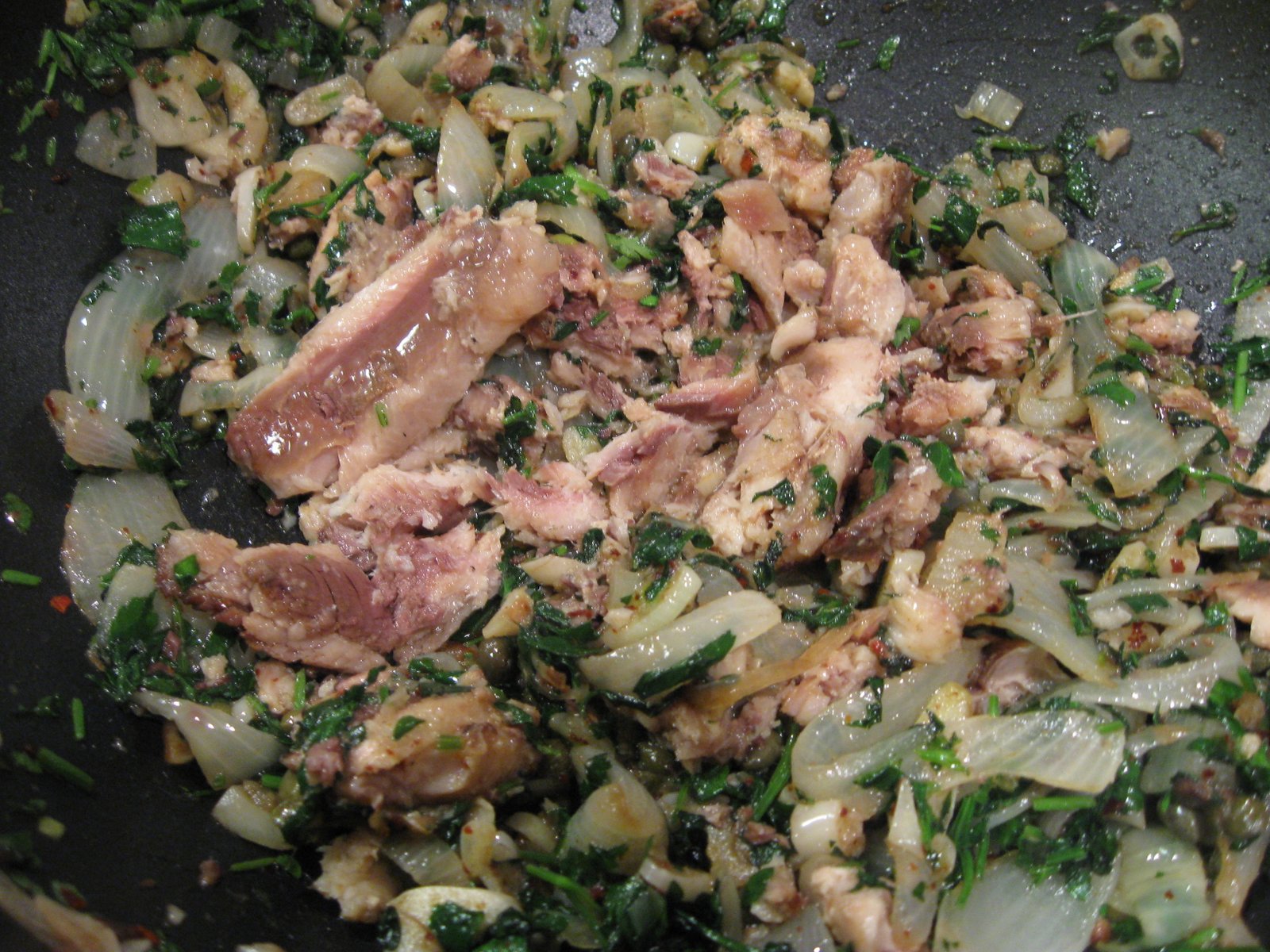
Toward the end of the process, I mash up one of the cans of sardines and break the other up into large pieces, adding them to the pan:

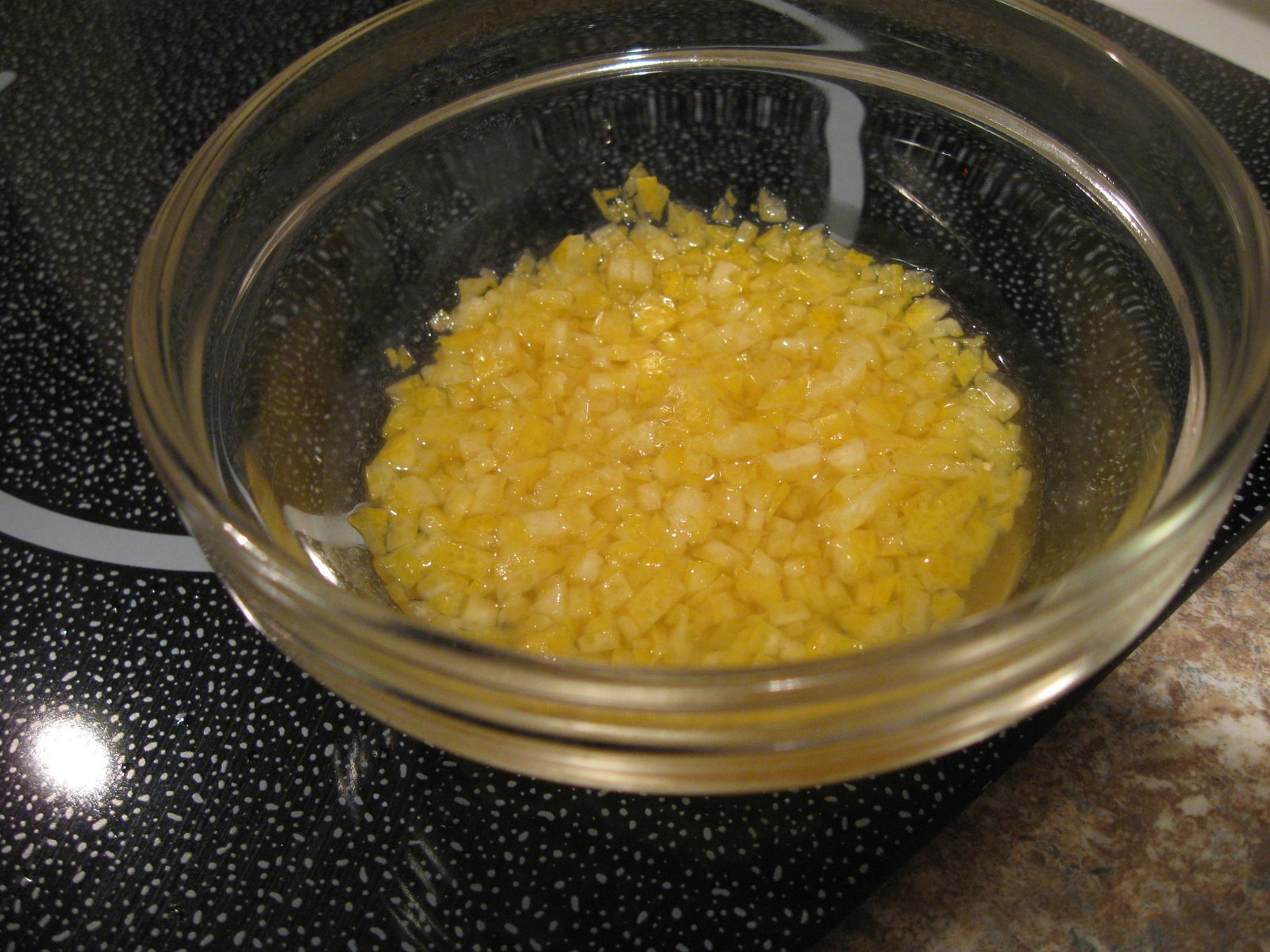
IMG_0948 As soon as they are properly stirred, I dump in the zest of the lemon with about half of the lemon's juice:

IMG_0951
If I've synchronized things correctly, at this point the linguine will be slightly aldente and ready to eat.  I add the linguine and a little bit of its pasta water into the pan, turn off the heat, and mix everything together.  Because of the fishy oils and the dissolved anchovy, even those noodles that aren't covered with fleshy bits are full of the flavor of the sauce.

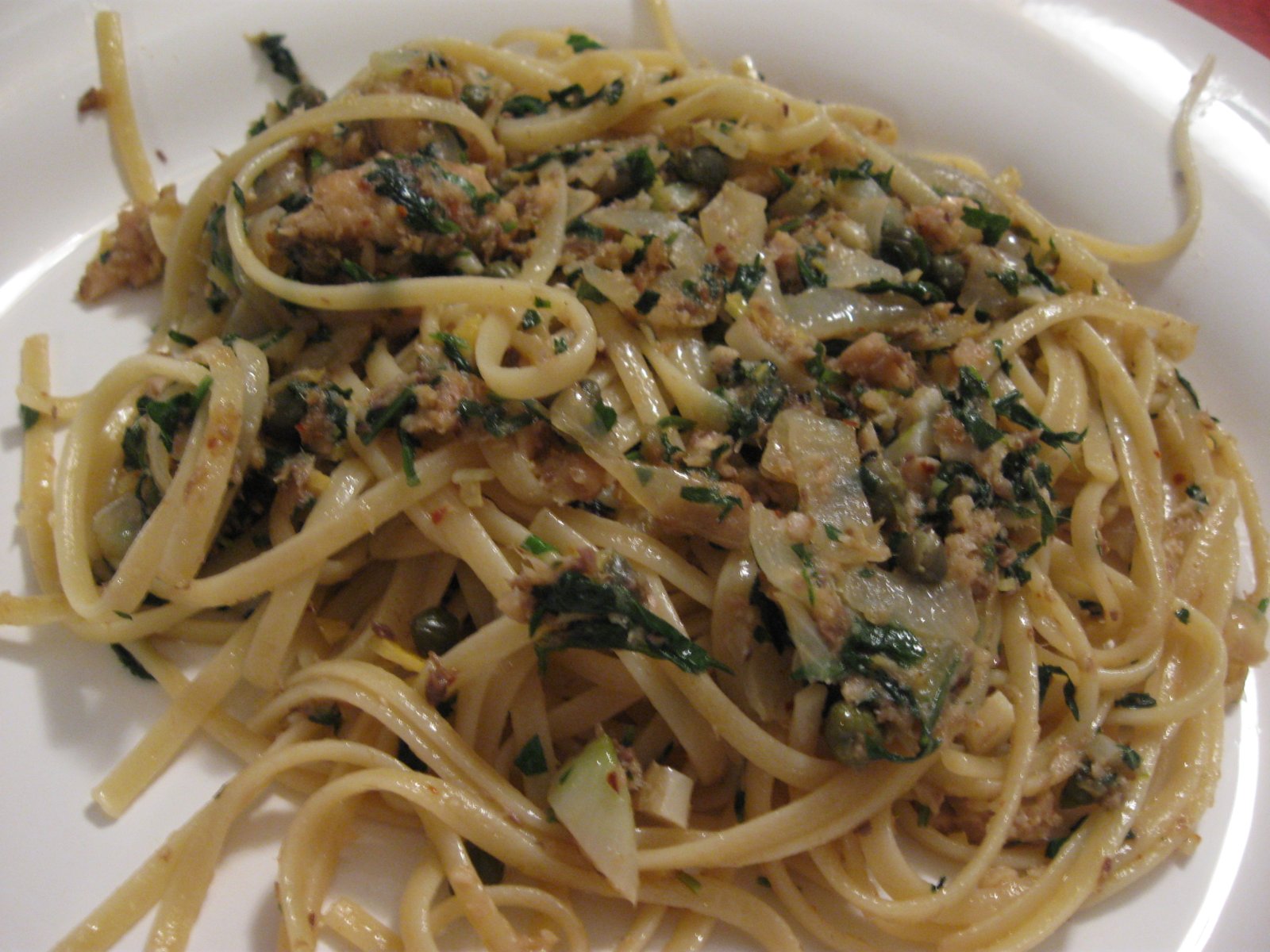
When the sauce does not fully integrate with the noodles, I place a clump of noodles in the middle of the plate and put extra sauce across the top of it. The finished dish (this is about one quarter of the complete recipe) looks like this:
IMG_0957 I don't like to brag on my own cooking, but doggone this is good. Even Tina likes it.  The sardine taste is upfront, deep, and thorough.  The lemon, red chili, capers, and abundant parsley contribute flavorful background notes.  Of course, none of my recipes is set in stone. Heck, some aren't even written down on paper. If I want more hot spice, more salty fish flavor,  more lemon caper tang, or even more green herby parsley, I know what to do.  But no cheese never.

Feeling frugal, Tina and I accompanied the pasta with a bottle of Rene Barbier Mediterranean White, which was a nice match – though it doubled the cost of the meal :-(  . But for the truly frugal, I'm sure that this dish would make a bottle of Charles Shaw Pinot Grigio taste better too.

Give this recipe a try. Then mangia!

The Market Restaurant at the Radisson: Yuma

While Kirk and Cathy are still eating and writing and preparing posts, today ed (from Yuma) wants to tell you about something new in the desert.

March 2011 update: The Recession hit this place hard. The food went on a slow decline (the last calamari I had there seemed to come frozen right out the the Sysco truck). The restaurant is still in business, but recently hired a new chef. I have not tried it recently. If you have, please comment here.

About a month ago, I was a volunteer pouring wine at the Yuma Art Center, which was hosting a wine tasting to benefit its galleries and collections.  A young man, who turned out to be the son of friends of friends, handed me several cards good for a free appetizer or dessert at the newly opened Market Restaurant.  At first, I felt special until I realized that virtually every attendee had received several of these cards.

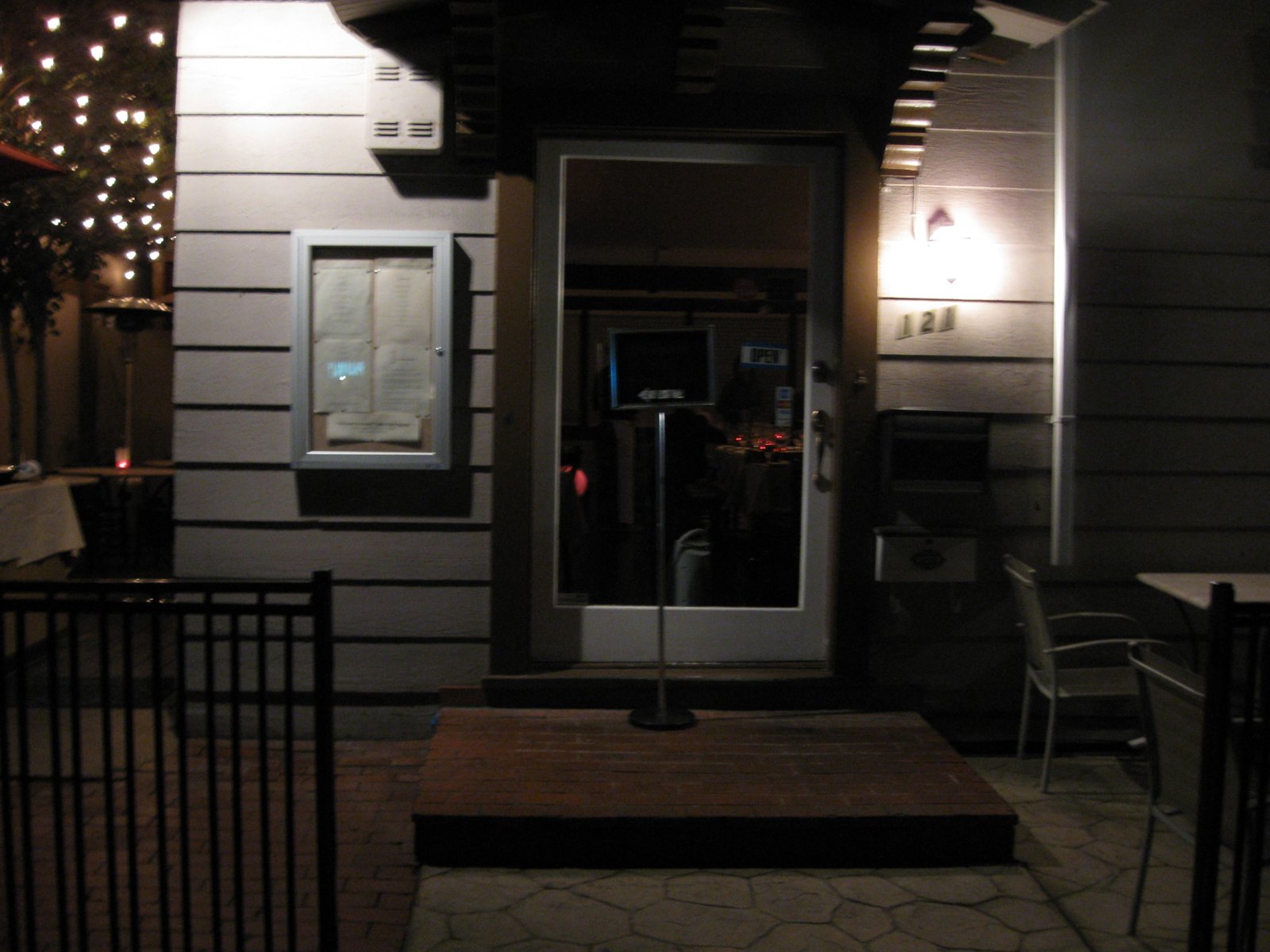
Truth be told, I was not even aware that we had a new Radisson Hotel in Yuma, much less that it housed a restaurant with serious pretensions.  From the outside, the place looks very nice, and the restaurant is on the main floor on the right-hand side of this picture:

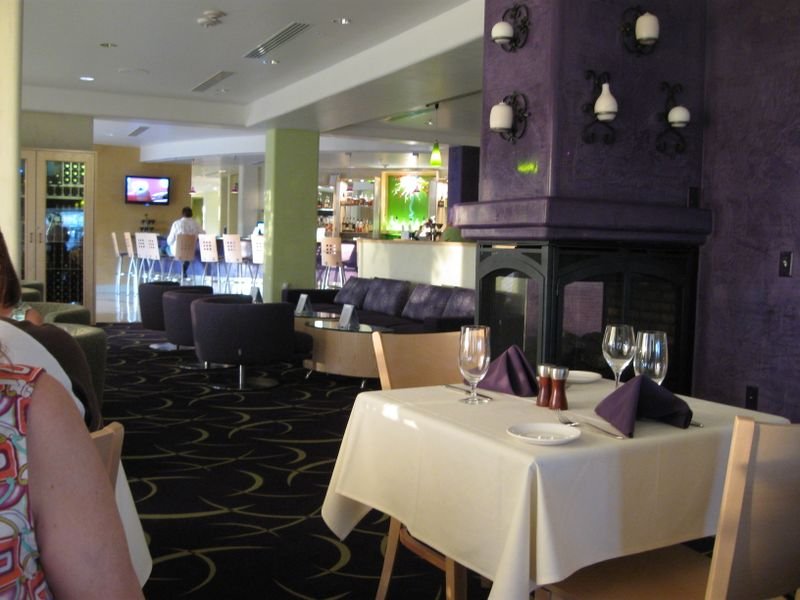
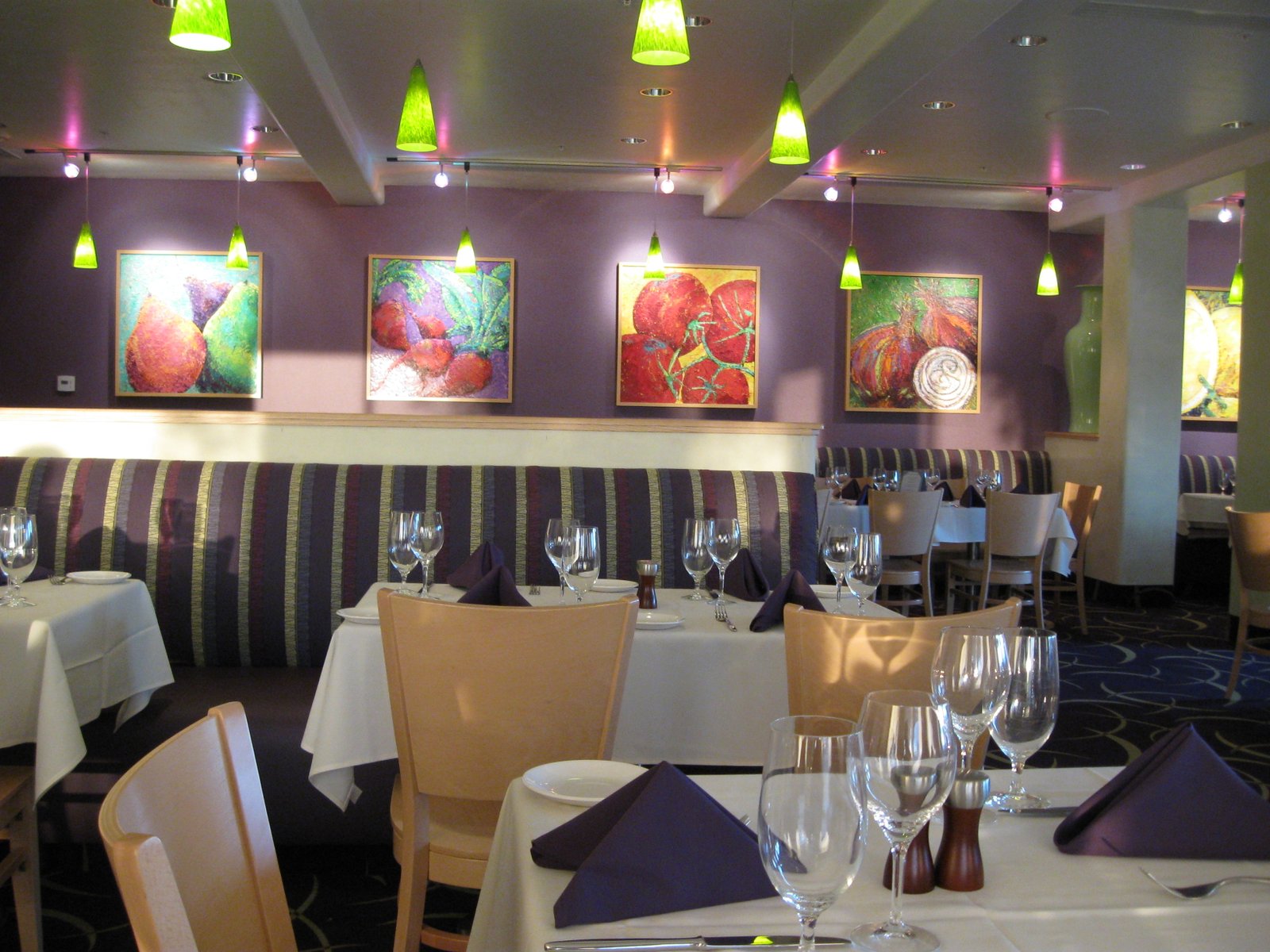
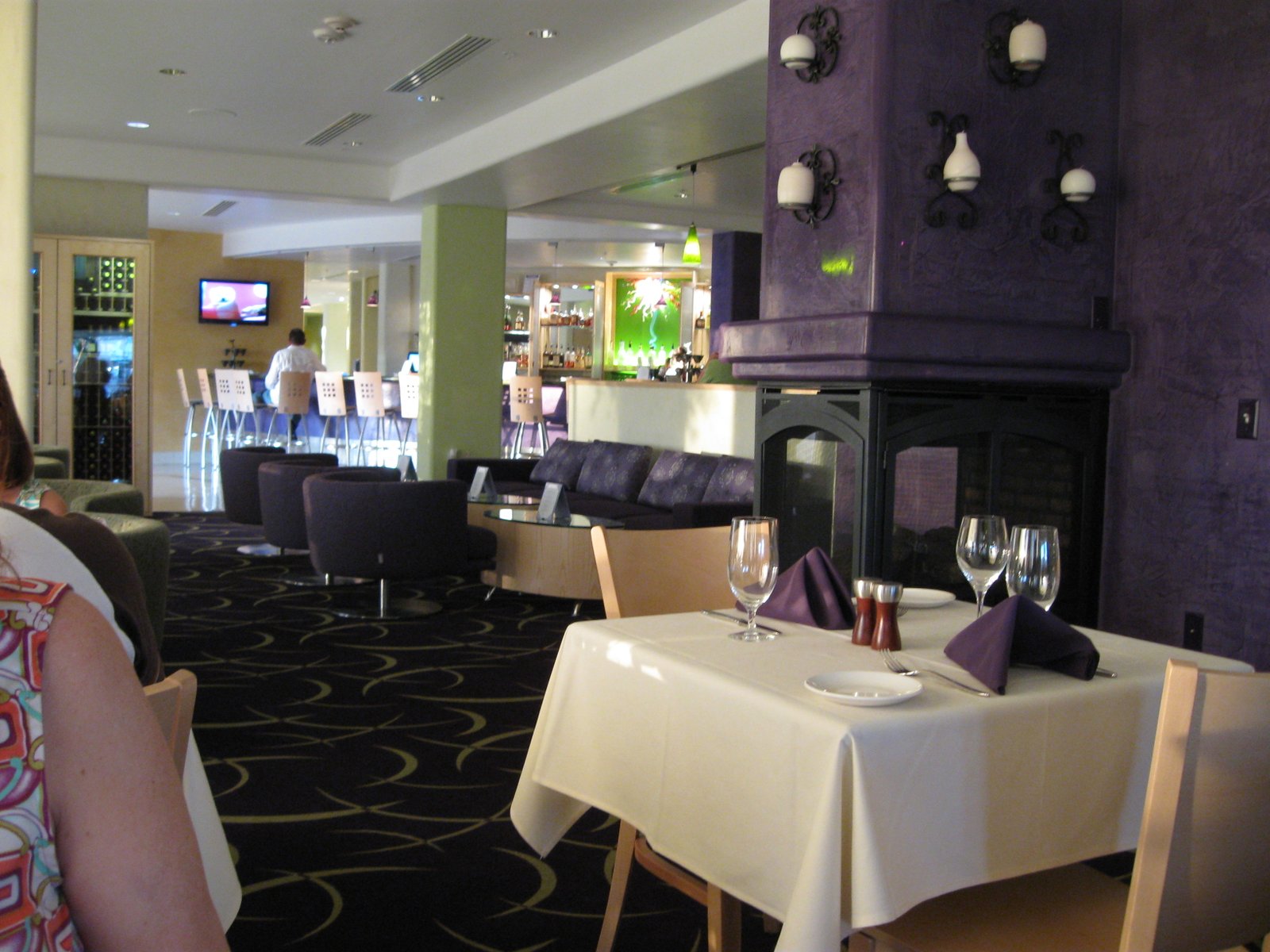
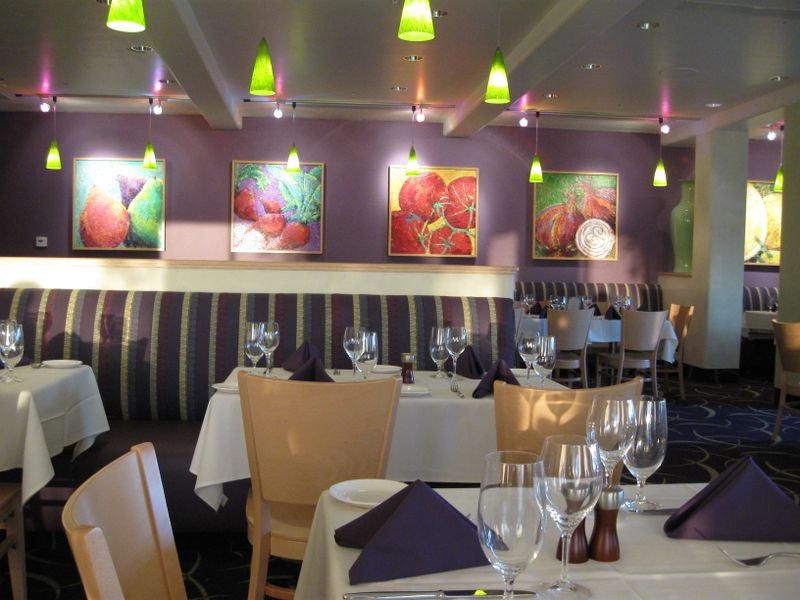
IMG_0752 The inside of the restaurant is bright, tastefully brash, stylish, and comfortable:
IMG_0849 

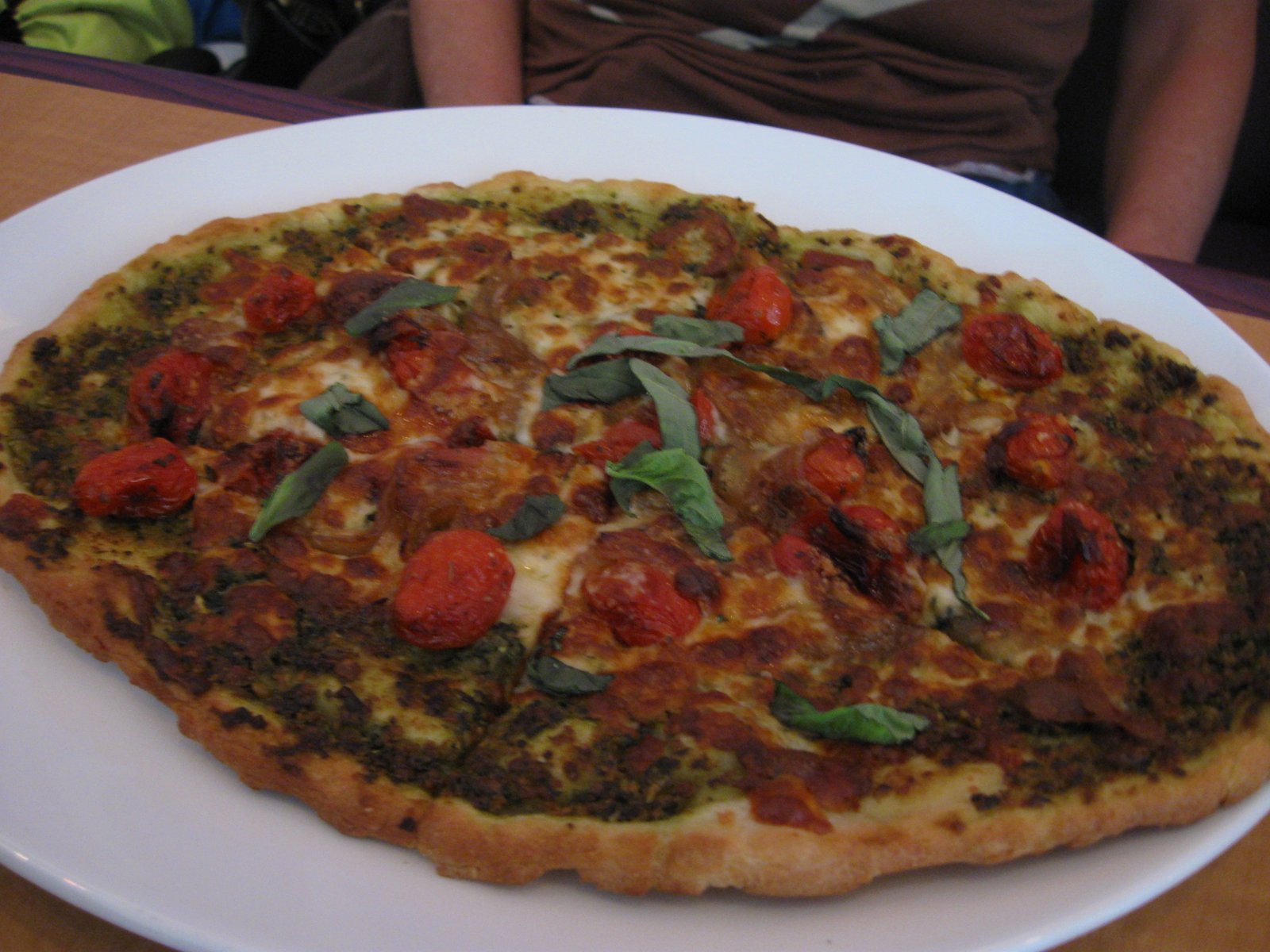
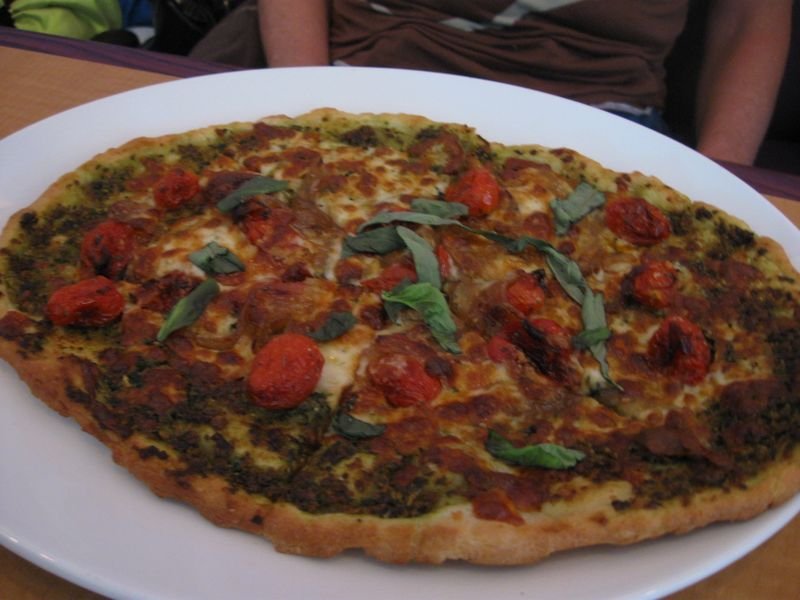
IMG_0850 Within a week, the Munch Lunch Bunch arrived for a Friday lunch.  Most of the lunch orders looked positively yummy.  This pizza with sun dried tomatoes and fresh basil leaves was a work of art:
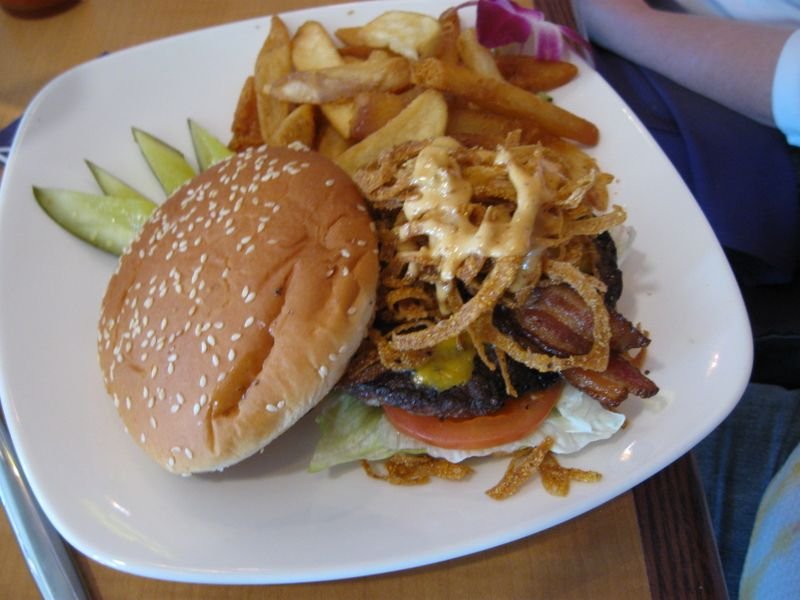
IMG_0766 Chip was very pleased with his burger and thought the light touch of blue cheese was a perfect complement to the beefiness of the patty.  He was also extremely impressed by the french fries, ordered extra crispy.  "The best I've had in town!"  he exclaimed:
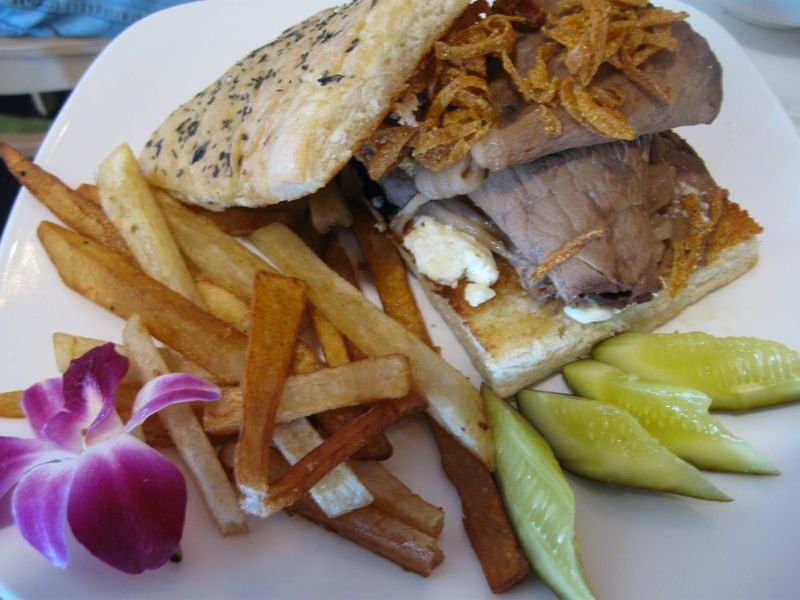
IMG_0769 My sandwich was called shaved prime rib with boursin cheese on ciabatta (?) bread.  While nothing earth shattering, this roast beef and cheese sandwich was quite tasty.  The creamy cheese and the focaccia bread provided enough richness so that no other spread or topping was needed:
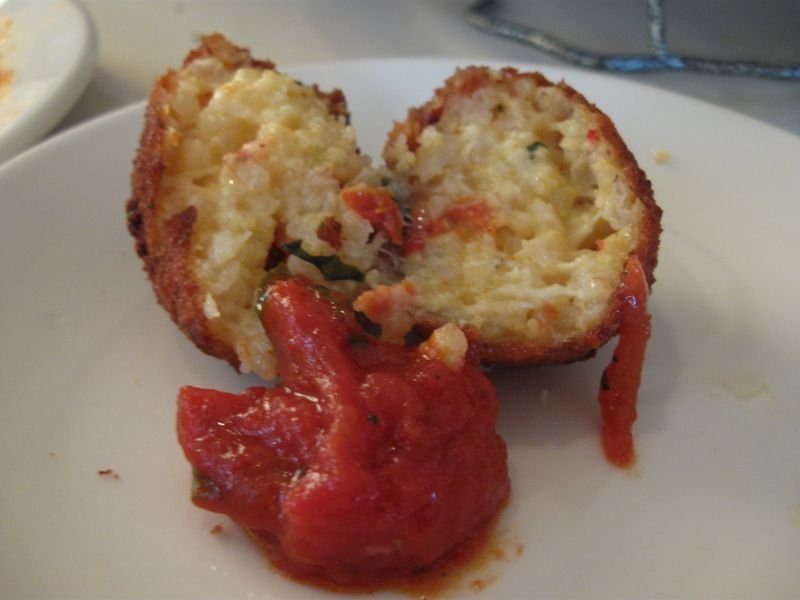
IMG_0772 All in all, the food had been good enough so I wanted to return for dinners.  One time, the first thing to hit our table was a rather unusual amuse bouche, deep-fried risotto balls served with marinara and a sprinkling of domestic Parmesan.  The crunchy exterior set off the creamy rice goodness inside. On my plate, one serving looked like this:
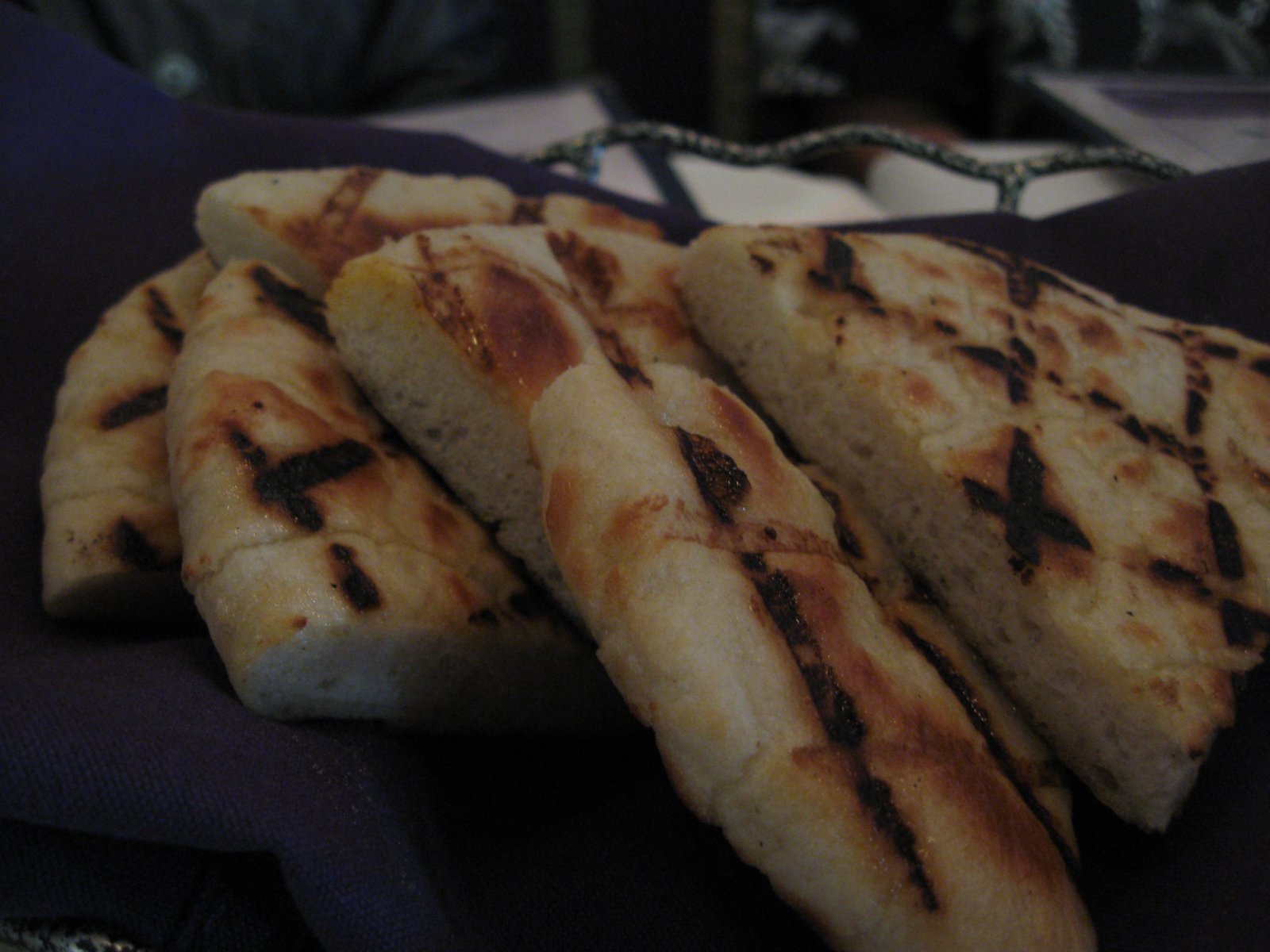
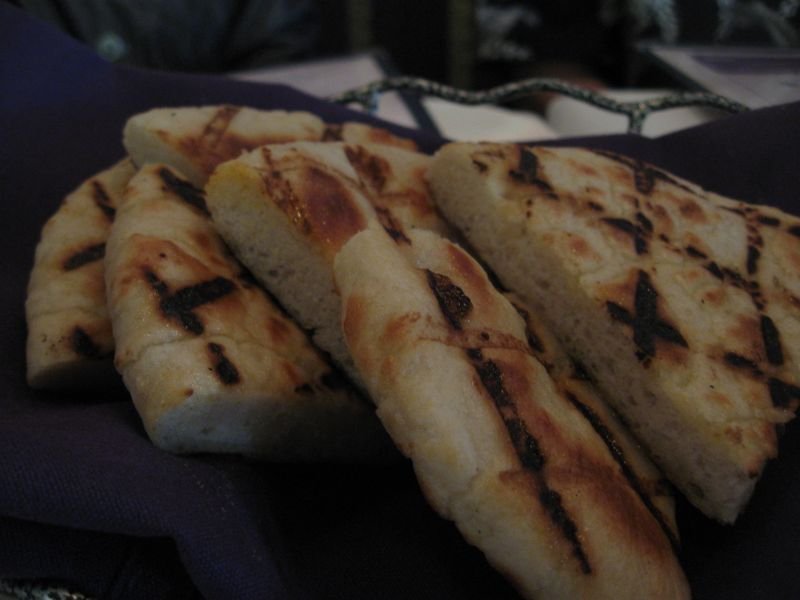
IMG_0851 Both dinners began with complementary pita bread, seemingly housemade, with a chewy texture and fresh-baked wheaty flavor.  Paired with balsamic and olive oil, it hit the spot:
IMG_0775 Also available was an appetizer choice of three spreads for the bread, one light Middle Eastern spiced tahini based, one centered on "Salmon caviar," and one dominated by blue cheese flavor.

Everyone was wowed by the blue cheese choice, the Greeky one provided a nice mild contrast, but I found the fish egg spread far too salty and fishy.  And I love ikura.

My favorite of the appetizer choices has been the calamari:
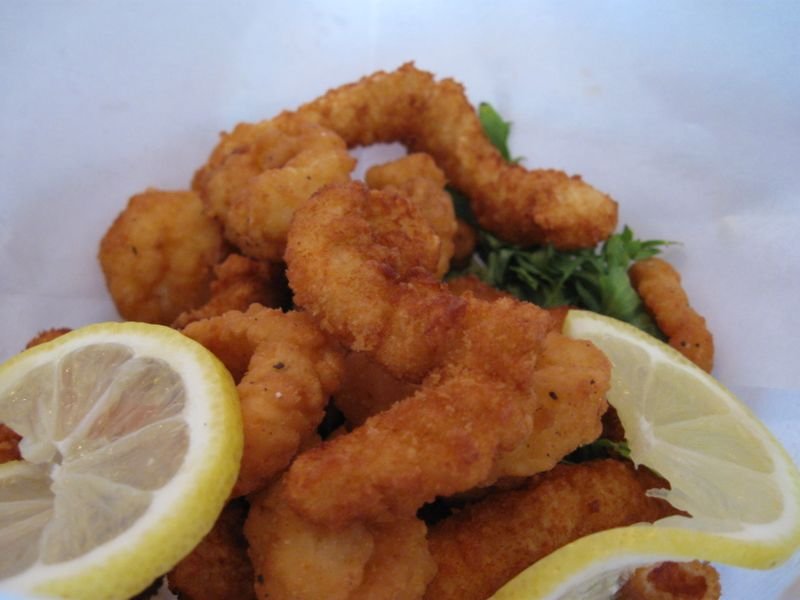
IMG_0754 It doesn't get any better than this.  The cracker crumb crust was incredibly crunchy.  The squid itself  was tender soft and flavorful.  Most of the seafood strips and circles were thick enough to provide a complete contrast to the breading.  The deep-fried cephalopod pieces were accompanied by a small ramekin of mild chile aioli.

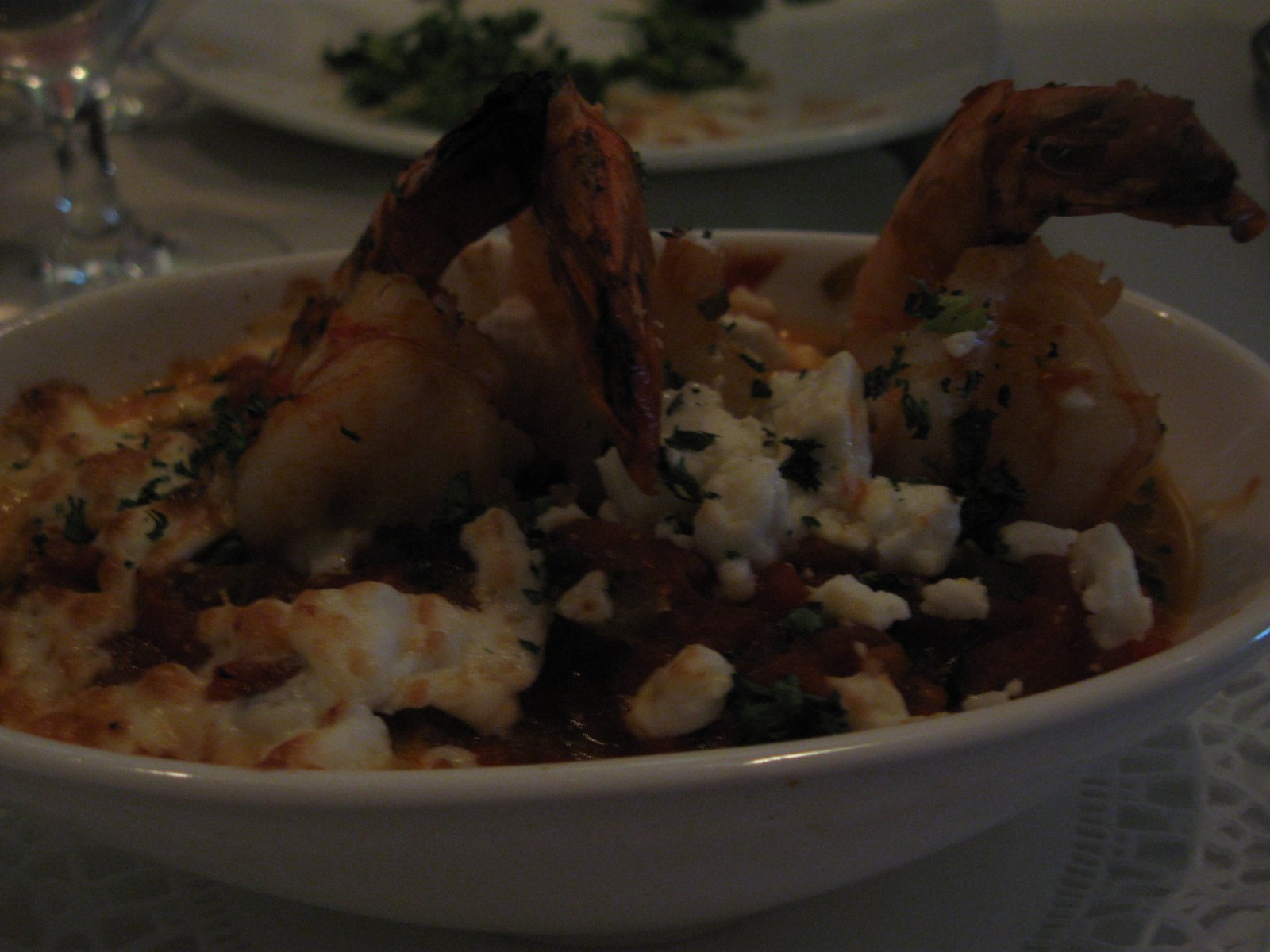
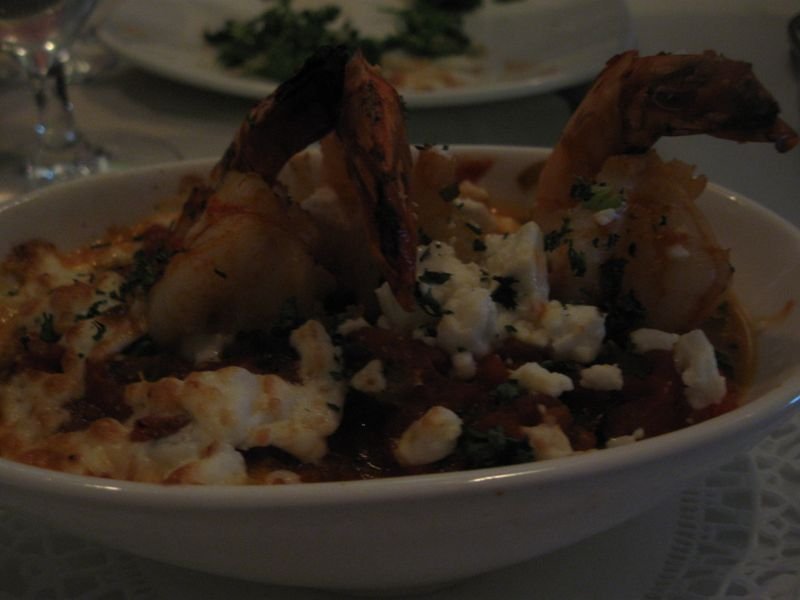
I have also liked the spanikopida and the shrimp appetizer, which features three jumbo shrimp bathing in a tomato/feta sauce:
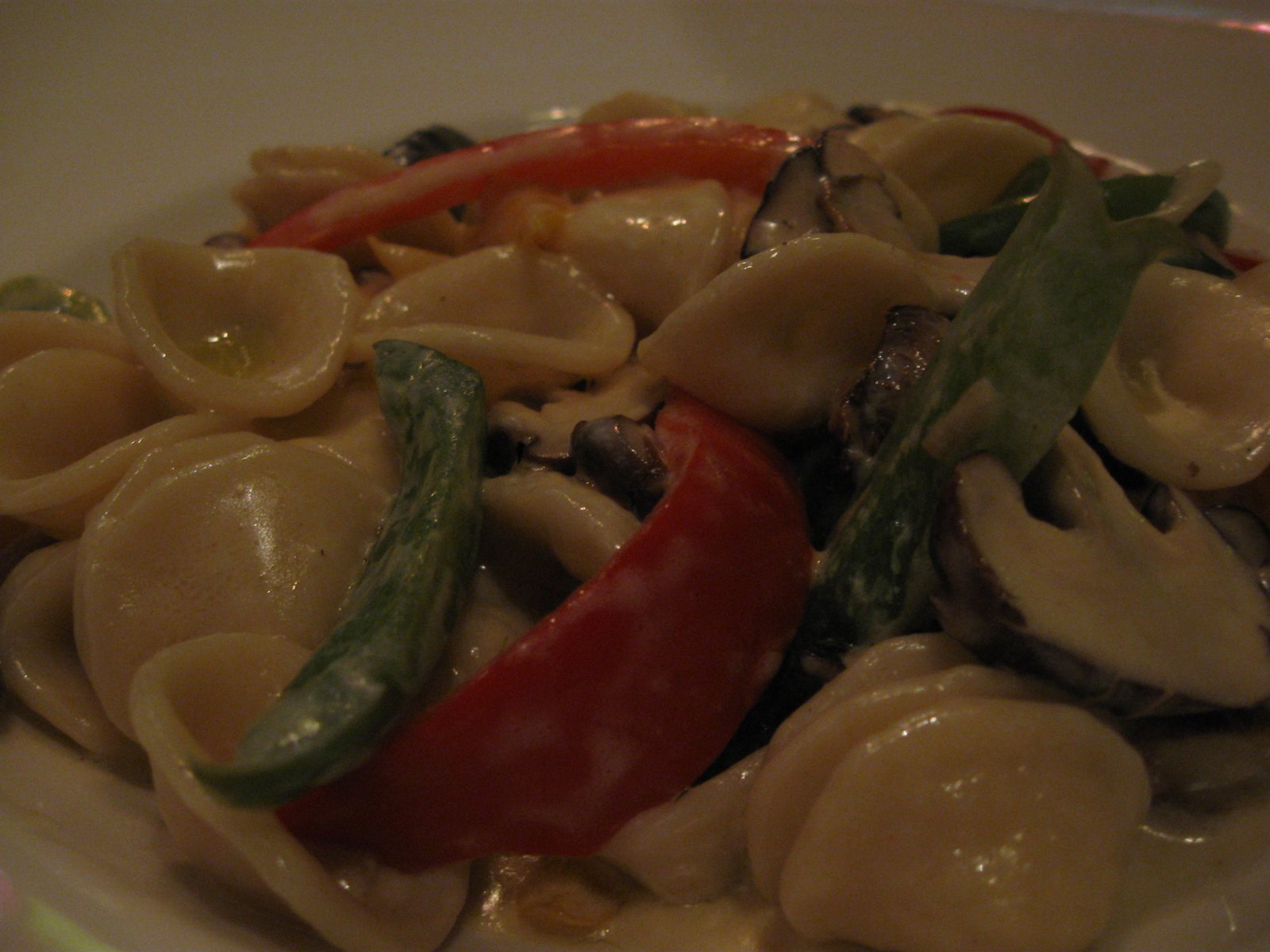
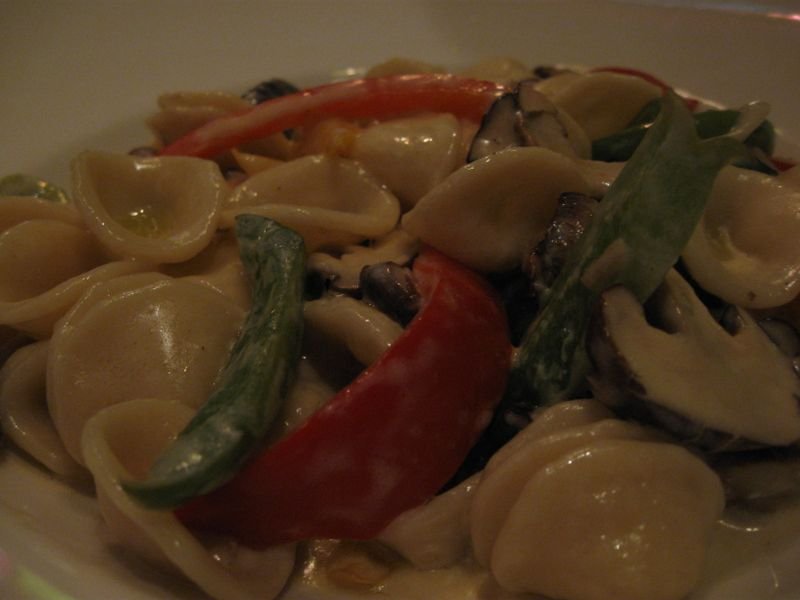
IMG_0783 One shortcomng to the restaurant's dinner menu has been the limited number of entrée choices.  My favorite of the pastas is this creamy vegetarian orrechietti:
IMG_0791 The restaurant prides itself on flying in fresh seafood daily, and I have had a very good chunk of sea bass wrapped in prosciutto with a mild red sauce the color of old bricks that tasted of sweet tomato. Though I would have preferred a more neutral side starch than the risotto it came with, it was a successful and flavorful plate.  You don't want to see the picture, trust me.  Greg had some well prepared Hawaiian yellowtail with a nice vegetable medley, although the mashed potatoes didn't strike me as the best of accompaniments.

Another strategy is simply to make a dinner out of the small plates.  On my first evening visit, I ended up with an appetizer for a main. So these lamb riblets became my entrée:

IMG_0796 (2) My apologies for the quality of that picture, but the curse of fine dining (for those of us who like to take food photographs) is that fine dining does not equal fine lighting.  The three lamb chops were perfectly prepared, cooked to an exact medium rare, and generously portioned.  The only thing not to like was the bed of overly salty deep-fried onions on which the chops lay.

On that same evening, I tasted a truly incredible dish.  When I heard that the soup special was a mushroom bisque, I just had to order it; plus it would be interesting to compare their version with the truly fine one that I had eaten at The Better Half over Christmas break.

But I wasn't prepared for this:

IMG_0788 This soup was OMG outstanding.  Seriously, I don't have enough superlatives to describe how good this tasted.  While a certain creaminess and a touch of marsala wine lay in the background, the dominating flavor was porcini mushroom.  That's not quite an adequate description; the taste of porcini mushroom was intense and pervasive.  It was not hard to find the reason for this intensity because every spoonful of soup turned up slices of chewy fresh porcinis:
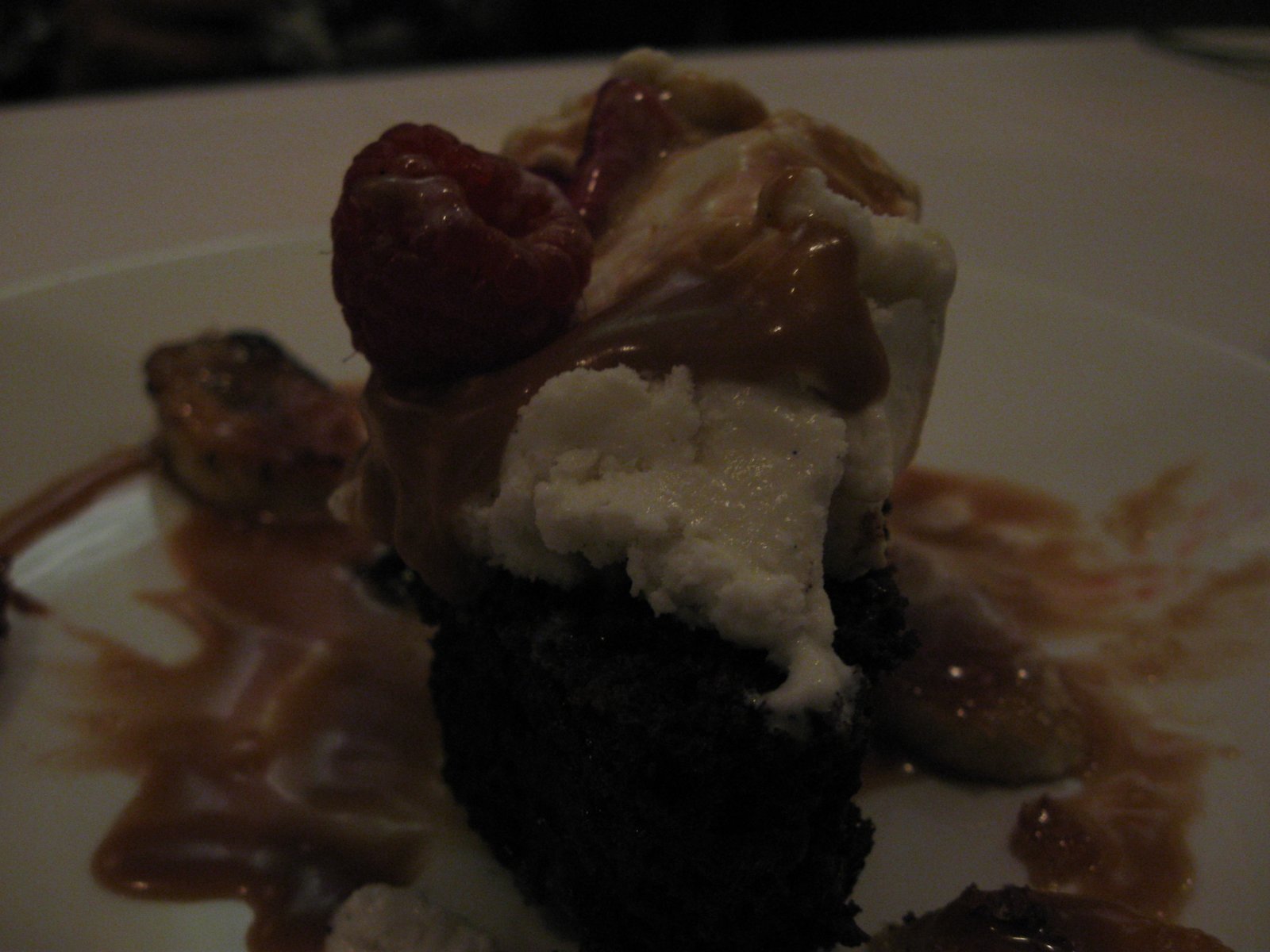
IMG_0789 Along with some good cannoli, I was impressed by one other dessert, the deconstructed bananas foster. While the banana slices were nothing to rave about, the chocolaty brownie, topped with sweet mascarpone, golden brown caramel syrup, and a fresh raspberry was very good:

IMG_0801 I have no copy of the menu with me and poor notes, so I can only provide a general idea of prices. Except for the pastas (which were $15-19), mains were in the $20-25 range. The small plates run $5-10. To my mind these prices are fair, if not a screaming deal.

The restaurant is also building up a wine list and already has several excellent bottles to choose from:

IMG_0779 I should point out, however, that many early diners at The Market restaurant were disappointed by the lack of any listing of wines. Several people felt that they paid far more for wine than they should have.  Although the markups on the wine are now very fair (a $30 retail bottle selling for $55, a $19 bottle selling for $35, and a $58 bottle selling for $99), the list is still tilted toward the high-end consumer.  In these economic times, I think many individuals (not just us poor folk) would appreciate a wider range of value choices.

It's far too early to anoint the Market Restaurant at the Radisson as the culinary King of Yuma, and who knows how long the restaurant will continue to provide some truly outstanding food, but nonetheless, I must say that they have served me some of the finest fine dining dishes I have ever tasted in Yuma (hey, in some cases, anywhere).  I can only wish them the best of luck and continued success.

The Market Restaurant at The Radisson Hotel Yuma, 1501 S. Redondo Center Dr,  Yuma AZ  85365,  928-373-6563
Yuma: Jeannie Wah’s Chinese & American Bistro

It's ed again, over in Yuma, not Kirk or Cathy. You are warned.

This old school Yuma Chinese restaurant has closed.

Shortly after I moved to Yuma, I decided to try every Chinese restaurant in town. It wasn't that hard — there weren't that many. Several old time Yumans recommended a Cantonese steakhouse named Gene's. It was the oldest Asian eatery in town.

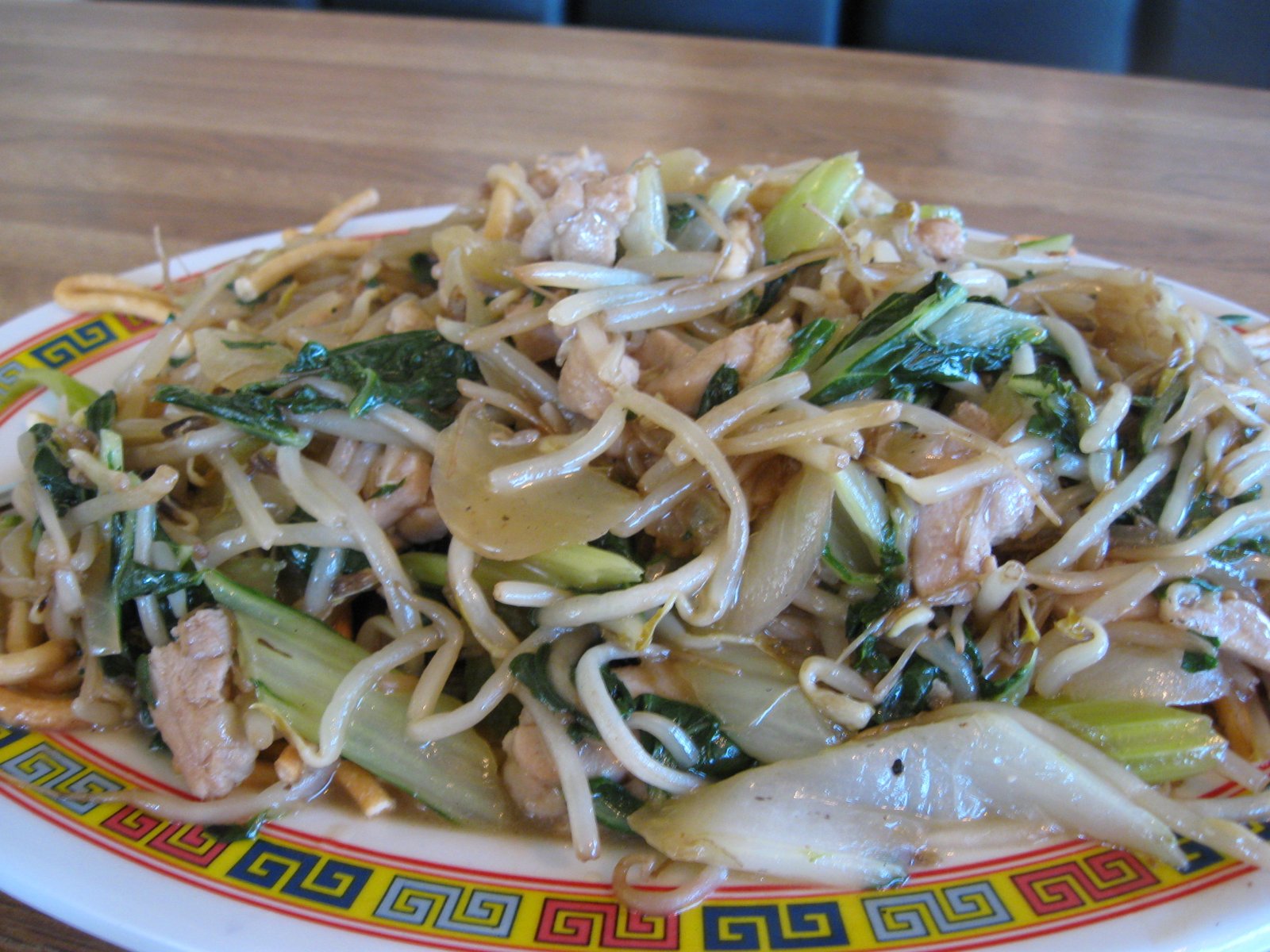
So I stopped by one lunchtime and ordered a lunch special: chicken chow mein. What I was served looked a lot like this:

IMG_0483

As soon as I began eating, I flashed back to my small town childhood and the "country and western" Chinese restaurant that was my parents' favorite in the 1950s and 60s. Every thing seemed exactly the same, from the combination of vegetables down to the predominant flavor of American soy sauce.

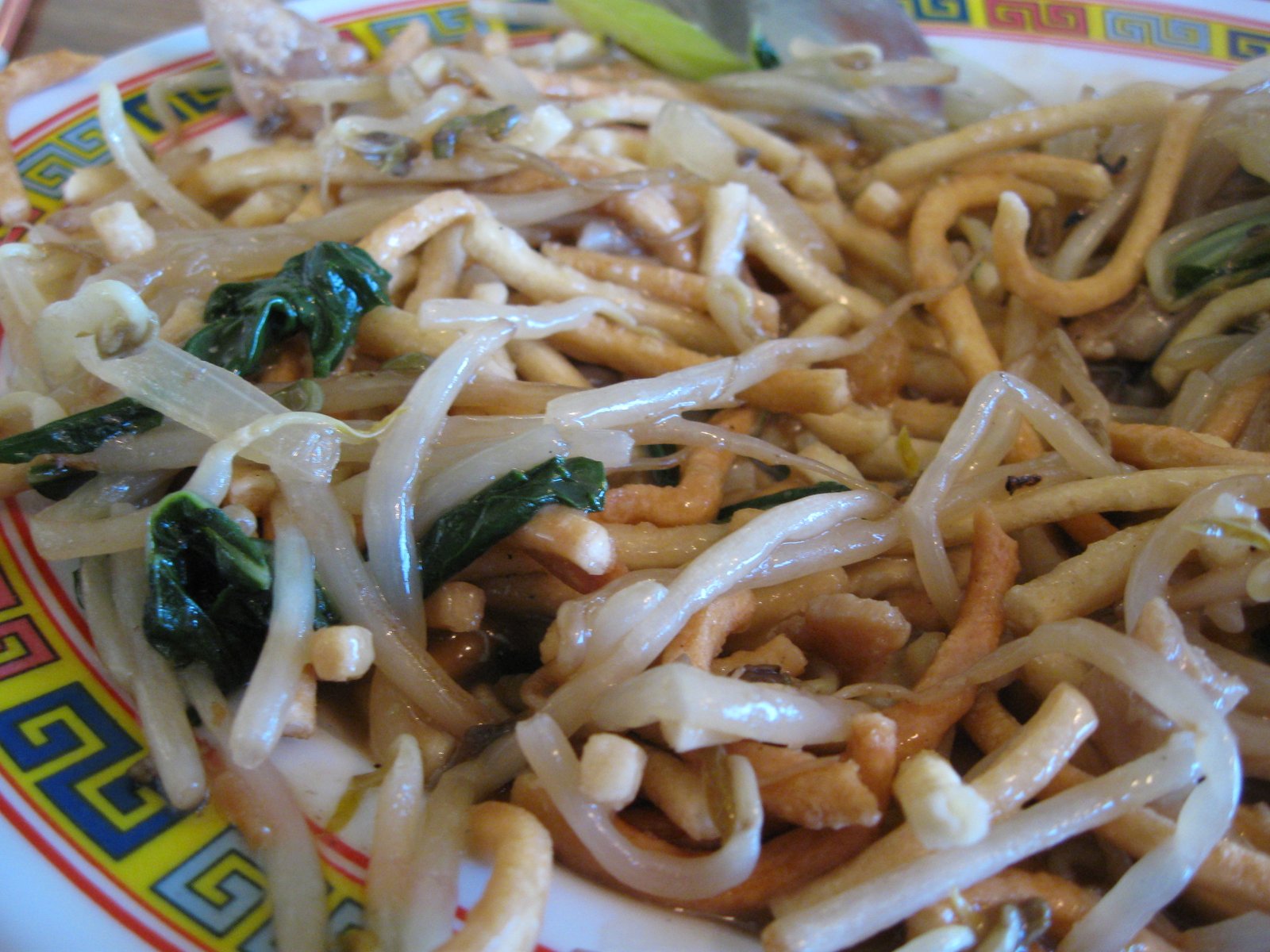
And like the memory from my childhood, this chicken and vegetable melange topped a thick pile of crunchy noodles, just like you could get out of the can:

IMG_0487

For me, this flashback was not the resurrection of a pleasant memory, though to be fair, I should mention some friends who moved to Arizona from Boston and are so happy to find these old-school dishes that taste "just like the Cantonese food back in Massachusetts." In any case, Gene's was never my favorite, and I considered it a typical and ordinary ABCDE (Kirk's coinage: American Born Chinese Dining Establishment).

Gene's no longer exists, but the friendly woman who was its last manager has recently opened a new dining establishment, Jeannie Wah's Chinese & American  Bistro:

IMG_0196

She has a tough task in this economy, but she is trying to attract new customers with new dishes while still satisfying the old customers from Gene's with American food, snickerdoodles, and dishes like that old-school chicken chow mein ($8.50). 

New note: I must say that the version of the chicken chow mein at Jeannie Wah's is better than the old version for 3 reasons. 1. The soy sauce is real soy sauce – not a complex flavor, but not bad either. 2. The Chinese greens mixed with the bean sprouts add a slight balancing touch of bitterness that works well in the dish. 3. The noodles are fried on premises and have real flavor and real crunch.

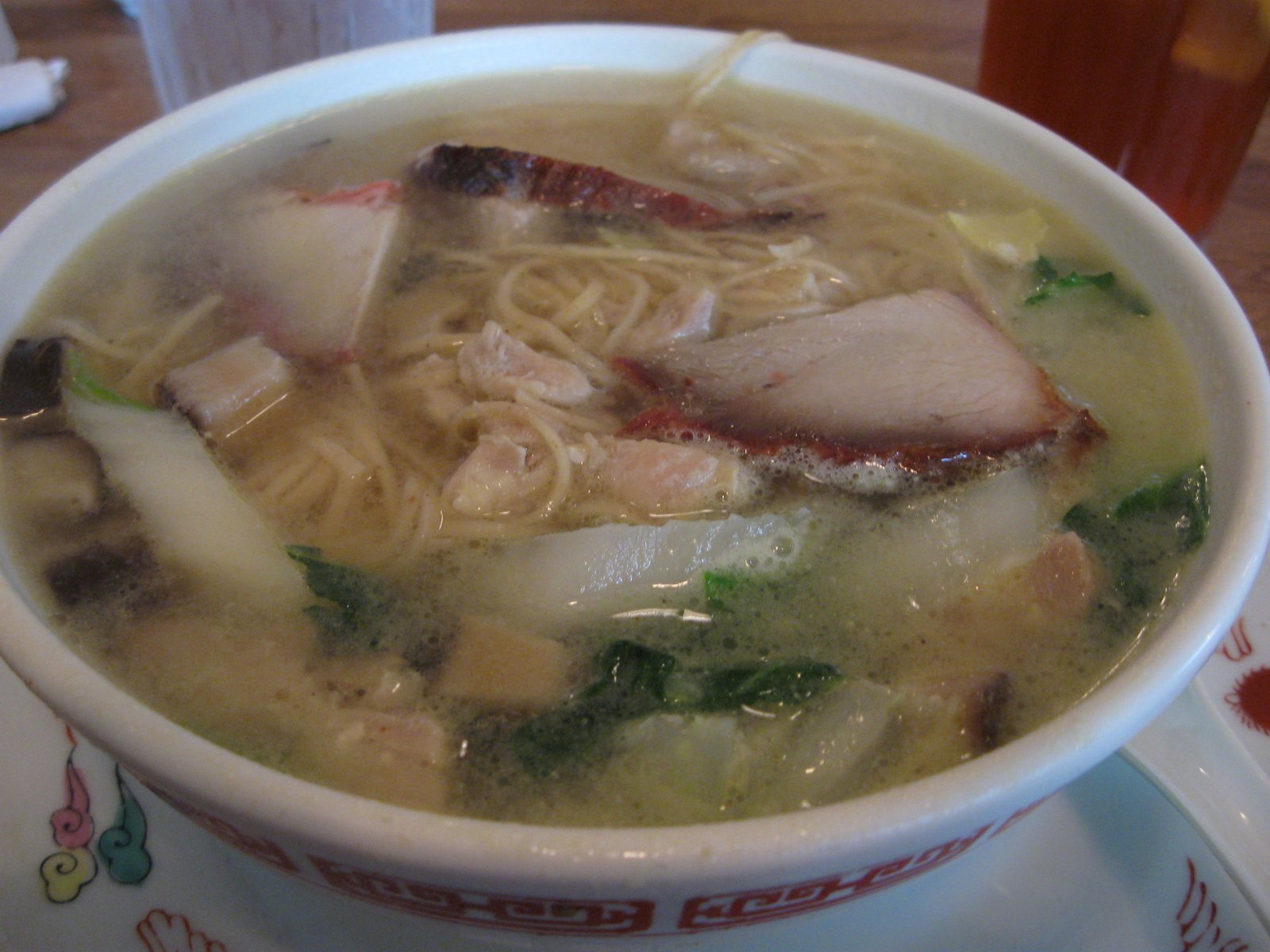
On my first visit to the very nicely decorated new eatery, I got lucky and ordered one of the lunch specials, the Wah's Up Today Noodle Bowl ($7):

IMG_0203

This was really good, much better than any picture can convey. The broth was densely flavorful and rich. The chicken and barbecued pork were adequate as were the plentiful Chinese cabbage pieces and chopped Chinese mushrooms. The real highlight of the dish, even better than the outstanding stock, were the noodles. They had a perfect chew to them, with great mouthfeel and good flavor.

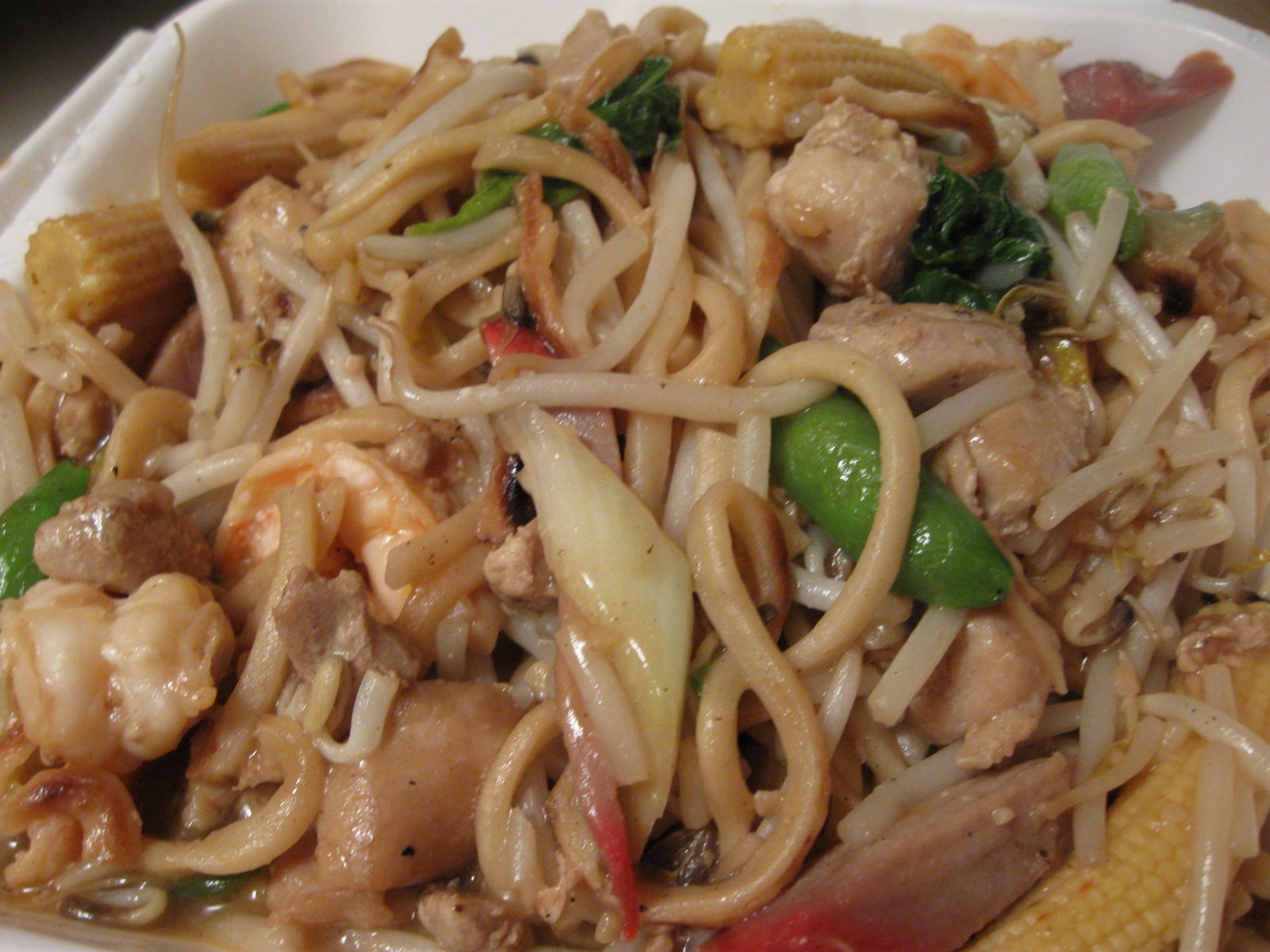
In fact, noodles seem to be one of the strong points of the restaurant. I recently ordered Gene's Cantonese Panfried Noodles ($11) to go:

IMG_0706

Again the noodles were toothsome and flavorful. Notice the plentiful wok hay. The vegetable selection was also good. In addition to the usual suspects, there were sugar pea pods and plentiful crunchy baby corncobs. The only bummer in the entire dish were the shrimps. While their flavor was unexceptional, I never realized that it was possible to cook a shrimp to the point where it was as tough as sirloin steak. As tough as it is to believe this, that's how tough those shrimps were.

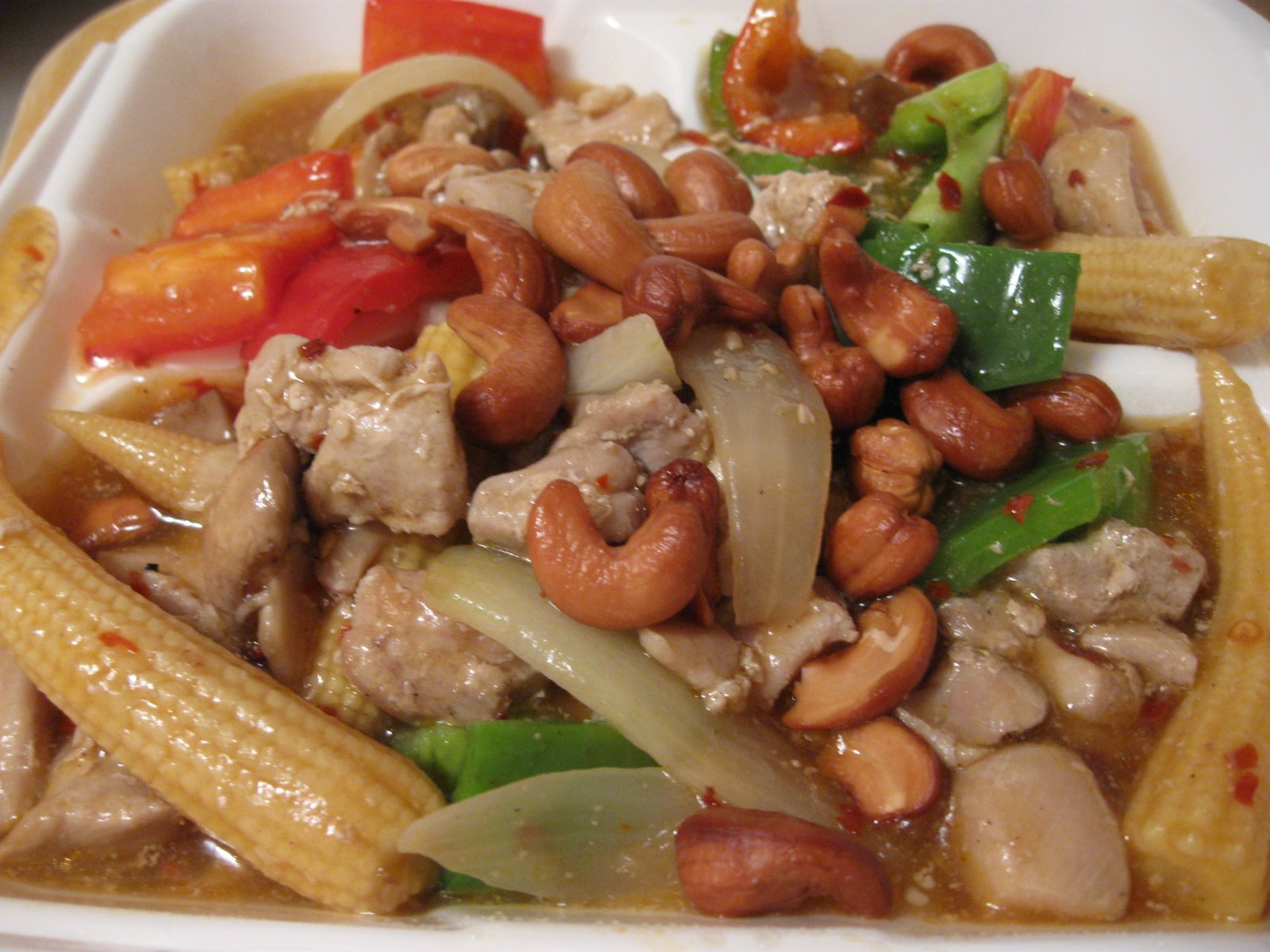
I also have picked up their version of Kung Pao chicken ($9.50):

IMG_0703 

The dish was good. I appreciated the plentiful topping of cashews, and the amount of chicken was generous as well. Providing texture and flavor contrast were more baby corns, onions, red bell peppers, and some type of mildly spicy chopped green pepper. As the picture shows, this dish was not super picante, but the red chili flakes and the chopped green chilies did provide a one/two capsicum punch.

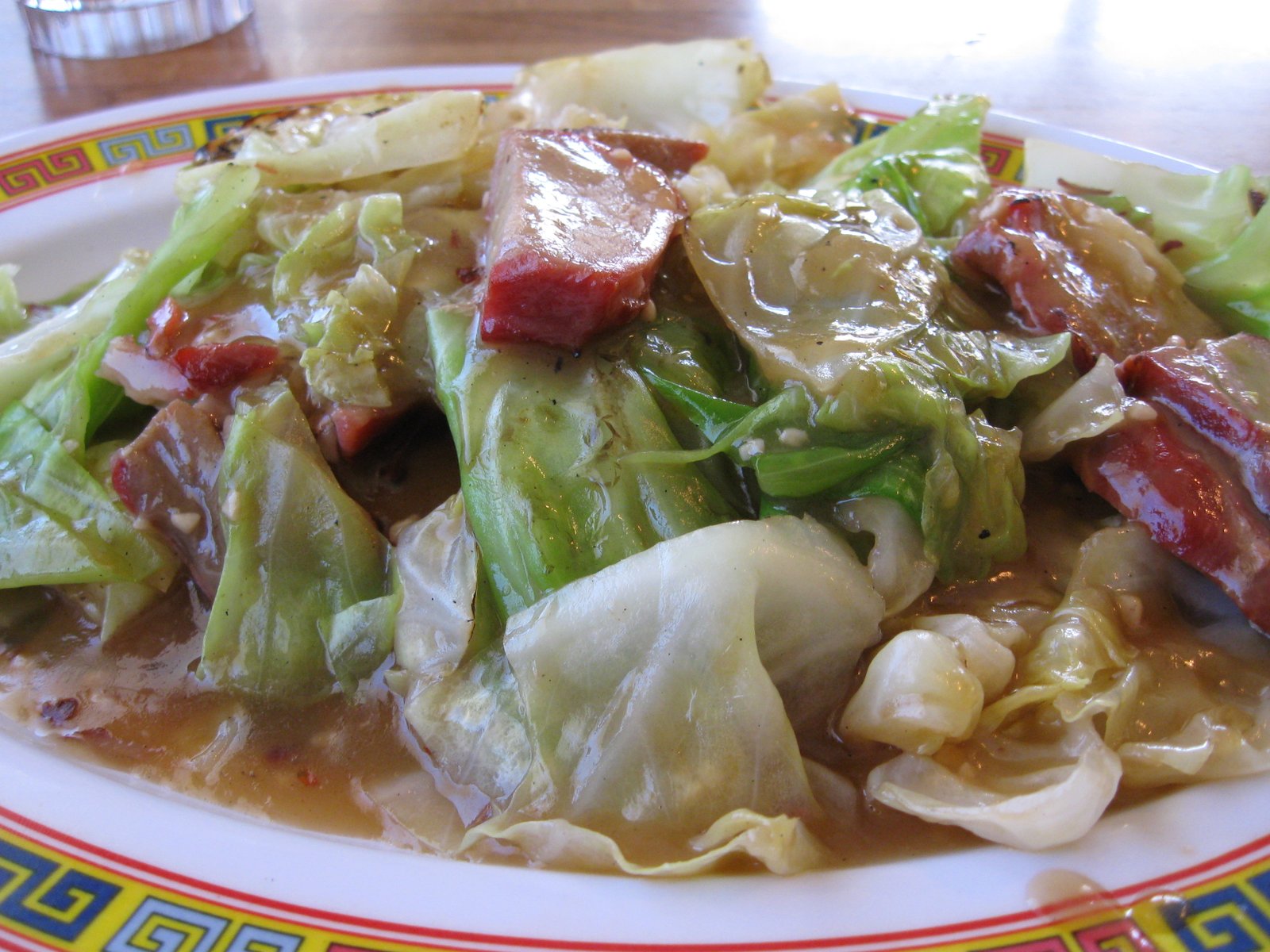
Perhaps because of my central European roots, I love various combinations of pork and cabbage. At Jeannie Wah's, I was pleased to see double cooked pork on the menu ($8.50). And of course, I ordered it on one of my first visits to the restaurant:

IMG_0364

The version here is very basic, but certainly adequate. Compared to the dish at Mandarin Palace (my favorite version in town), this one was very simple — just cabbage, barbecued pork, and chili flakes. The pork here also lacked the fatty richness that makes the rendition at Mandarin Palace so outstanding. Nonetheless, I could eat this again happily.

I'm glad that this restaurant opened. This is such a wonderful change from the Chinese buffets that dominated the Asian food scene here in Yuma just three or four years ago. Prices seem fair, and portions are generous. Istill need to explore more of the noodle dishes here, as they seem to be a real strength of the place. Nonetheless, Jeannie Wah's is not going to replace Yummy Yummy as my favorite local Cantonese place, nor does the menu offer the diversity of Mandarin Palace. Still, it fills a very flavorful niche out here in the desert.

Jeannie Wah's Chinese and American Bistro, 1360 4th Ave (actually off 14th St close to 5th Ave), Yuma AZ, 928-783-0080

Kaito Sushi in Encinitas: The Exciting Conclusion

Kirk and Cathy eat sushi too, but today ed (from Yuma) is going to be eating sushi right in front of your eyes.

In the first installment of this report, I mentioned the spare interior of the Kaito Sushi. In fact, aside from two beautiful and subtle pieces of Japanese calligraphy on the walls, there seemed to be no other decoration. Originally, I thought the place didn't even serve alcohol, because no advertising on the walls was coaxing me to try this beer or that sake. After I realized my misapprehension, we ordered a couple of bottles of Yebisu, a full malt Japanese beer, and a glass of good cold sake.

The only somewhat odd note to the atmosphere at the sushi bar was the background music, late 60s Beatles tunes. Although the music was certainly pleasant and in no way offensive, it struck me as an odd choice for such a focused restaurant.

The next fish to show up in front of us was kohada, also known as gizzard shad. I remember that this fish was conventionally listed on those plasticized placemats from the 80s and 90s that pictured various nigiri sushi and usually advertised some Japanese beer. If I had ever actually eaten this fish before, it was so long ago that I have lost any memory of it. I was impressed that it was available at Kaito, and so I had to try it:

IMG_0409 To be honest, however, I was underwhelmed by the fish. It is not that it was unpleasant or past its prime, but I found the flavor to be basically fishy and to my palate undistinguished. Perhaps that is why I have rarely, if ever, encountered it before.

On the other hand, the next seafood served was outstanding. The Kumamoto oysters were fresh, delicately flavored, and simply outstanding. Two of them were lightly touched with ponzu sauce:

IMG_0412 Two others were topped with some fermented fish guts — no doubt because I had mentioned my love of shiokara to the itamae:

IMG_0415 While certainly unusual, I actually preferred the simpler Ponzu preparation, the fish innards striking me as salty and to some extent overpowering.

After asking us if we liked hand rolls, Morita-san gave Tina and I each a small hand roll filled with diced fatty tuna of some kind:

IMG_0417 This was an outstanding item, Tina's favorite from the entire evening. The richness of the tuna was truly outstanding, but I was also impressed by the flavor of the nori, the seaweed wrapper. Normally the wrapper in a hand roll does not draw any of my interest unless it is exceptionally tough and hard to bite through. In this case, however, the flavor of the seaweed actually contributed to the overall taste of the roll. It was another mark of the restaurant's quality.

The food had been so good that I was looking for more, and I mentioned both octopus and sea eel. The chef suggested that the eel would make a better conclusion for the meal, so tako was next:

IMG_0421 I can recall only one other piece of octopus (from Sakura) that was as good as this one. Morita-san explained that this piece of cephalopod had never been frozen, and therefore, was not rubbery. Indeed he was correct. The edges of the piece had a slight crunch, but the interior was all about a nice soft chew. Excellent textures and tastes.

Also part of the flavor of this mollusk was the touch of wasabi that exploded in my mouth. And it needs to be pointed out that the wasabi at Kaito is based on actual wasabi root, not horseradish powder with food coloring. Although Morita-san does not grind his own, since he finds the quality of the cultivated wasabi from Oregon to be inconsistent, the flavor of the wasabi paste that he uses is full of the real thing. Between dishes, I kept dipping my hashi into the little mound of wasabi, just because it was soooo good.

The last dish we tried was the anago, sea eel. Much like kohada, this is an item that I have seen much more on placemats than in sushi cases. Touched with a bit of the sauce that would be used on regular eel, unagi, this fish provided a slightly sweet finish to the meal:

IMG_0423 In taste, this sea eel, anago,  was more subtle and basic than unagi. I understand now why it is less common in sushi bars since it lacks the mouth filling richness of freshwater eel.

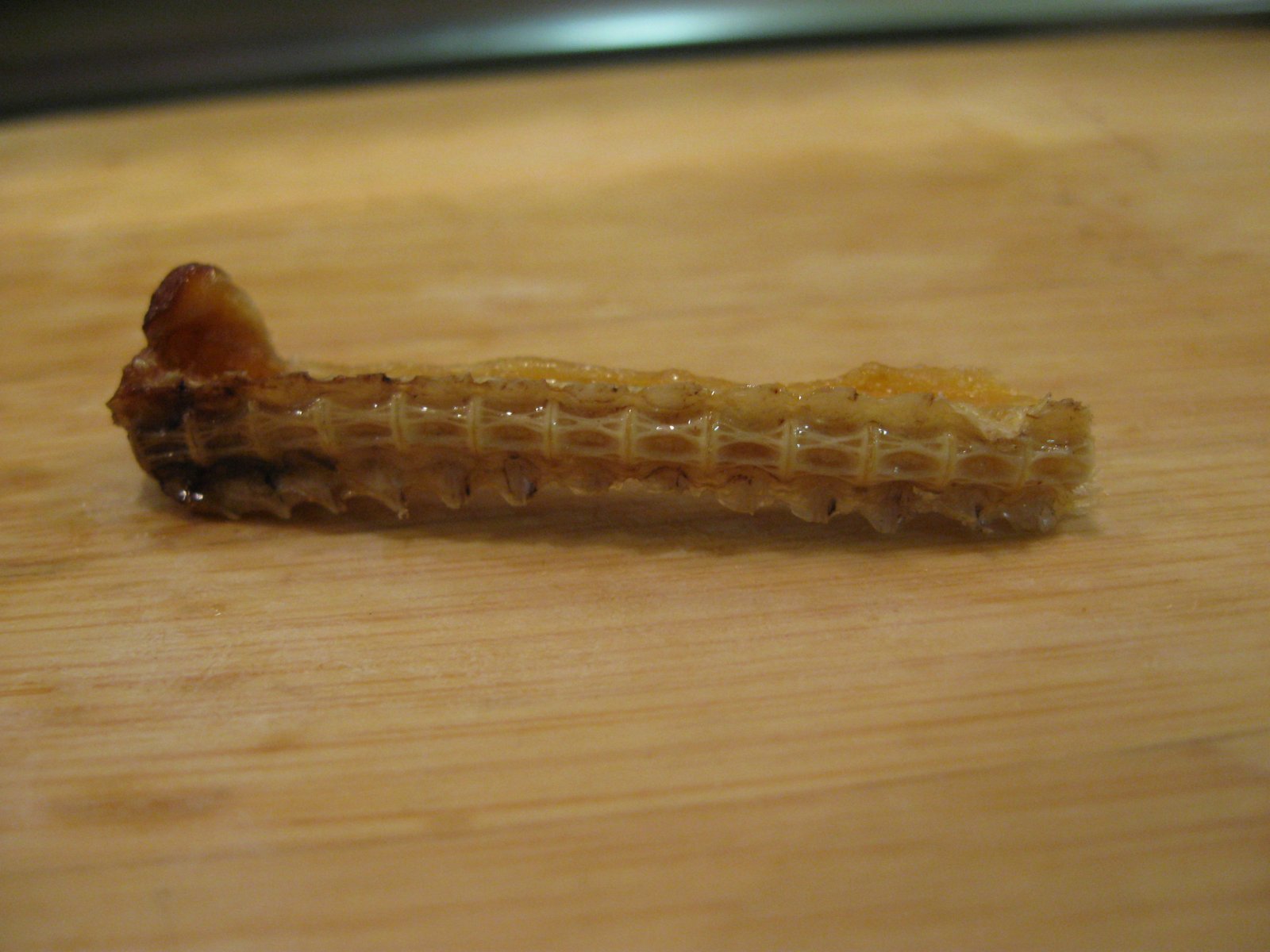
For dessert, we munched on deep-fried eel spine. The piece was originally longer than it is in the photograph because I started eating before I began shooting:

IMG_0427 I am certainly not qualified to say whether Kaito is the best sushi bar in the San Diego area; but it is certainly very, very good. Morita-san, also called Kazu or Kaz, is a skillful chef. He can access some excellent fish. He is also friendly, modest, personable, funny, kind, and warm. Although I was a new customer, I was treated like a regular. He showed the same kindness and consideration to those eating exotic sushi as he did for the  people ordering rainbow rolls, California rolls, and shrimp tempura rolls. In fact, some of those rolls looked damn fine.

In addition to Tina and I from Arizona, there were people from Los Angeles, San Francisco, and Berkeley, as well as Encinitas, in the restaurant. Throughout our meal, locals kept coming in for various dishes to go. Clearly, this man of the sea (the meaning of Kaito) casts a wide net for customers. At the risk of changing metaphors in mid ocean, I must say that I am hooked.

Kaito Sushi  * 130-A N. El Camino Real   *   Encinitas, CA 92024   *   (760) 634-2746

Website

Kaito Sushi in Encinitas

As usual, Cathy and Kirk are eating, thinking, and writing, but today ed (from Yuma) wants to serve up some sushi from Encinitas.

When Tina first asked me if I would like to go with her to a gigantic fabric store (a fabric store?), I was initially skeptical – to say the least. When she added, "and you know it's not far from that sushi bar in Encinitas you've been wanting to try," suddenly, it made great sense.

Once one locates Kaito sushi, it seems unlikely that this little unadorned strip mall location on El Camino Real houses what some people think is the best sushi bar in San Diego County:

IMG_0429 Soon after we were seated and began a brief discussion with Morita-san, an appetizer of shredded krab and sliced celery was placed before us:

IMG_0391 This was a simple and tasty start to the meal, the celery providing flavor and crunch. The old-school bowl added a nice touch as well.

The sushi chef recommended the monkfish liver, ankimo, as a starting dish. As this picture shows, this housemade pâté was remarkably smooth. In the mouth, it felt wonderfully creamy and melted on the tongue — the mild liver flavor was subtle and perfect:
IMG_0393 I have never tasted better ankimo. It really didn't need the help from the condiments it was served with:

IMG_0394 In fact, I appreciated that the flavorful slices were presented au naturel, not drowned in sauce or goop.

Next came halibut that had been lying on seaweed – though I must confess I couldn't taste the kelp. Nonetheless, this fish showed much skill. Each rice ball had been daubed into finely diced shiso leaf before the hirame covered it. If you look carefully, you can see bits of the green leaf shading parts of the translucent fish:

IMG_0397 I have always enjoyed the halibut/shiso combination, but this way the flavorful shiso did not overwhelm the delicate fish. Nicely done.

Another outstanding item arrived in front of us next. Although I have been eating sushi for over 25 years now, I have never seen mackerel with such a beautiful dark red color:

IMG_0401 The chef explained that he flies in fresh mackerel direct from Japan. Each slice was redolent of pure mackerel flavor. All other saba I have ever eaten has been dominated by the flavors of its preparation. Here that taste lay in the background, illuminating but not dominating the main flavor of the fresh fish.

Another unusual item appeared next. I believe it was called big clam, perhaps aogai in Japanese (?), again something I had never been served before. As you can see, a generous portion of East Coast clam had been lightly seared (or briefly steamed ?), leaving the interior sweet, crunchy, clammy, and raw:

IMG_0405 While not quite as much to my taste as mirugai, this provided enough claminess to balance the other seafood that evening.

At the same time that Morito-san was preparing the clam, he was marinating tuna slices in shoyu. When the rather ordinary looking nigiri arrived, I was unimpressed:

IMG_0407 As I tasted the maguro, however, I understood the reason for the marinade; the light soy flavor married perfectly with the taste of the maguro. This was another display of the chef's skill — in this case taking an ordinary piece of tuna and raising it up to a higher level.

I need to mention that we were visiting the restaurant on a Monday night, so we were not expecting the full range of exotic items that I have read are often available. Nonetheless, I got to taste several things that were new to me. I was also very pleased with the skill, the service, and the attention to detail of the itamae. In fact, everything was so good that we continued our feast further into the night, but to see and read about what else we ate, you are going to have to check back with mmm-yoso for the exciting conclusion of this episode.

Kaito Sushi   *  130-A N. El Camino Real   *   Encinitas, CA 92024   *   (760) 634-2746

View Larger Map

More from Salvador: Cabañas Four

Who knows what Kirk and Cathy are eating today, but ed (from Yuma) is writing about a place he eats at almost every week.

*** I am saddened to write that Pupuseria Cabanas is no more. One of the few cases of a restaurant doomed by its success. At least as I have heard it, the landlord was getting complaints from the towing/repair shop next door that there was no place to park during the day because the pupuseria had too many customers. Lucia was not allowed to be open weekdays, and then on Nov. 1, the restaurant was empty with no sign about another location etc. I will update if (I hope, when) she has relocated ***  :-(

I know some of you were wondering why Pupusaria Cabañas all the way over in Yuma, Arizona, is worth another post (for previous post, click here) at mmm-yoso. All I can say is that this little family restaurant serves some of the best and most interesting food of any kind in town. And this is food made with love.

While only a few dishes (like pupusas and chicken tamales) are available every day from the small kitchen, the variation of specials hroughout the week provides a lot of choices for us hungry locals. One example is a great new dish sometimes featured on Fridays, tortitas de camerones. First, about the name. Few words have more and more confusing meanings across the range of Spanish speaking countries than torta and its dimunatives, such as tortilla and tortita. Just to take an example. We all know what a tortilla is in Mexico (or in the United States). On the other hand, in Argentina it is like a thick patty or cake made with eggs and potatoes. Kind of like an omelette, but not like an omelette all. The sort of staple dish that an Argentine like Jorge Luis Borjes  missed even when he was visiting Paris. You can see the Salvadoran tortita is closer to the Argentinian dish:

IMG_2333 At Cabañas, this a savory egg patty is brimming with tender, juicy shrimp. The exterior crust contrasts nicely with the soft eggy interior. I much prefer this version to Mexican tortas de cameron, which are egg patties made with salty dried shrimp, a dish redeemed (to my taste) only by the red chili sauce and strips of nopalitos that cover the dish. 

 Another Friday special is often sopa de pescado, a fishy flavored broth with vegetables and sizable fillets of catfish:

IMG_0136 Recently on a Saturday, I revisited the beef rib soup, and found it even better than previously, as the beef is now perfectly tender and complements the savory broth and numerous vegetables well:

IMG_0088 Wednesdays feature bean soups of various kinds. Every one that I have tasted has ranked as one of the best bean soups I have ever eaten, and I have made and eaten many bean soups in my lifetime. The last one I ate may be the best of all:

IMG_0185 The name for this wonderful concoction is sopa de frijoles rojo con costilla de puerco, red bean soup with pork ribs. The broth was as deeply flavored as it is deeply colored. Pork ribs make a muy rico soup stock as well. In addition, this soup was served with two tortillas and a plate of various sides:
IMG_0191 I am not sure what specials happen on Mondays, but Tuesdays seem to feature chicken soup and Sundays are graced by sopa de pata, Salvadoran Menudo accompanied with cow hoof. Trust me, this favorite of mine tastes so much better than it sounds and is full of tendon, tripe, and vegetables:

IMG_2327 As business has picked up, and it has, more items have been added to the regular menu. Most days, beef stew, called here carne asada, and guisado de pollo (chicken stew) are featured. While the chicken is not always cooked to disintegration, as it was the afternoon I took this picture, the guisado always has a rich tomato flavor and is accompanied by decent rice and a tomato and salad garnish:

IMG_2047 Although the agua fresca ensalada (mixed fruit drink with chopped fruits) is the most common homemade beverage here, I have also had excellent tamarindo and the slightly sour arrayan water. The horchata, here spiced with nutmeg, is especially good, thick, and rich:

IMG_2369 One other beverage option exists. The nice folks at the restaurant allow customers to bring beer or wine to enjoy with dinner. While there is no stemware available, there is also no corkage fee, so we winos can enjoy our favorite beverage with outstanding Salvadoran cuisine, all at a bargain price:

IMG_0130 One small note — in one post I mentioned that I could taste banana leaf in the wonderful chicken tamales, but then saw that the tamales were wrapped in tinfoil for steaming. It was only when I later saw the banana leaf inside the tinfoil that I understood why my eyes and my taste buds were conflicted.

Anyway, if you are close to Yuma and hungry, and if it isn't Thursday when the restaurant is closed, let me recommend a trip to Pupuseria Cabañas. Your mouth will be happy.

Pupuseria Cabanas reopened in September 2009 after being closed for a month. They have new hours: Open breakfast to dinner Saturdays and Sundays, and open at 5 PM all weekdays. Don't know if this is just temporary, but that is the schedule for now. I missed this place for a month

Pupuseria Cabañas, 3405 8th St, Yuma AZ, (928) 782-1874

Sakura on a Budget?

Hope you all are enjoying the holidays. Kirk, Cathy, and others post here regularly, but today ed (from Yuma) wants to share a dinner with you at one of his favorite places in San Diego, a sushi bar that is on Kirk's rotation.

Living out in Yuma is not easy for a sushi lover. Last time I checked, channel catfish sashimi is on no menu anywhere. That's probably a good thing.

So on most of my visits to America's finest city, I stop by that little temple of izakaya cuisine, Sakura. But with the economy, I am thinking more these days about my personal economy, such as it is, and I warned Kazu as soon as I sat down that a Chirashi was going to be the centerpiece of my dinner. "But start out," I said, "with a couple of other things first":

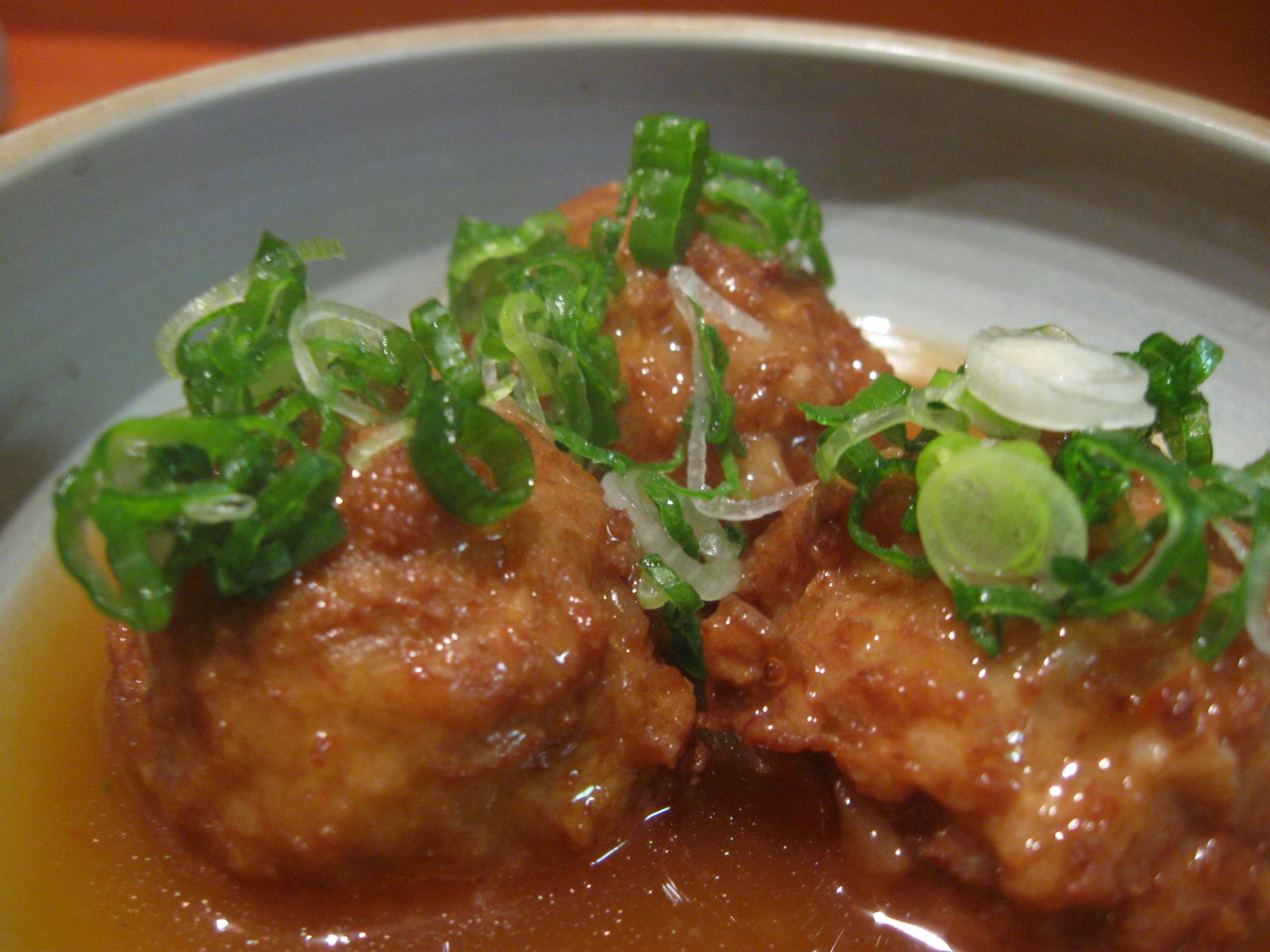
IMG_0292 I have to admit, I wasn't expecting three rounded pork balls garnished with scallions first thing. But these were a fine start to the meal. Not too dense, and rich with porcine goodness, these bite sized treats  were complemented by the slightly sweet sauce spicy with ginger.

The next thing set before me was more outstanding and more complicated.
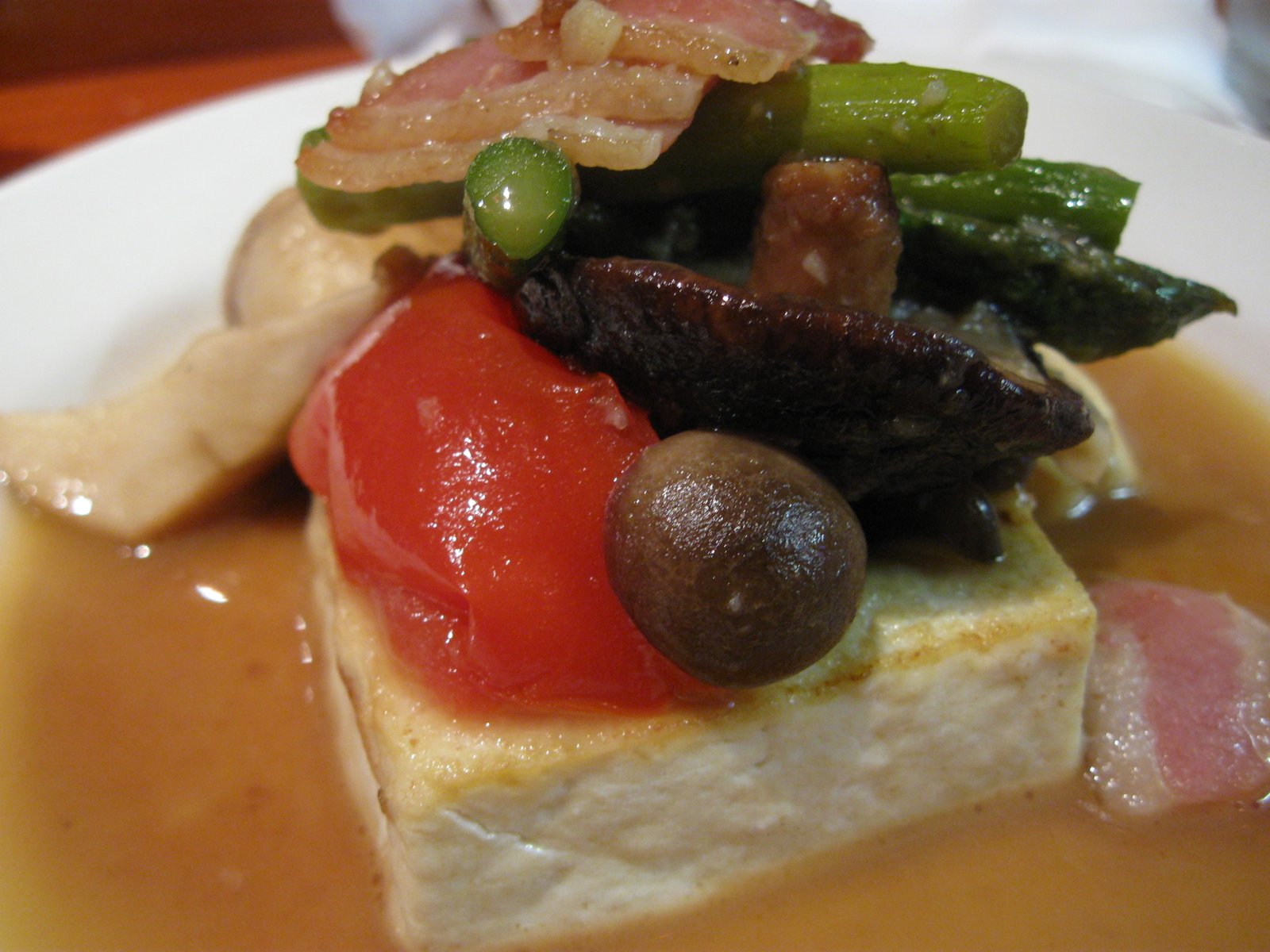
The first thing I noticed and smelled was smoky bacon. Ummm bacon:
IMG_0294 After further review (it is football season, after all), I noticed a couple of perfectly cooked asparagus spears chopped and lying akimbo on the top of a tower composed of a small tofu slab covered with mushrooms:

IMG_0295 When I rotated the little bowl, I noticed a single wedge of cooked fresh tomato. Deconstructing the dish, I realized that four different mushrooms had been combined here — a cluster of brown capped enoki mushrooms (perhaps bunashimejis?) lay directly on the tofu, largely hidden by the shiitake cap in this pic. Two normal button mushrooms and a large chunk of some giant mushroom (help anyone?) also sat in the broth:

IMG_0297 My mouth got happy quickly. The bland soft tofu played an ideal background that allowed the various soloists to make good music together. And, truth be told, bacon, mushrooms, and asparagus are a few of my favorite things (whether you are now thinking  "Julie Andrews" or "John Coltrane" or "say what, dude?" says a lot about who you are).

Then my main course arrived:

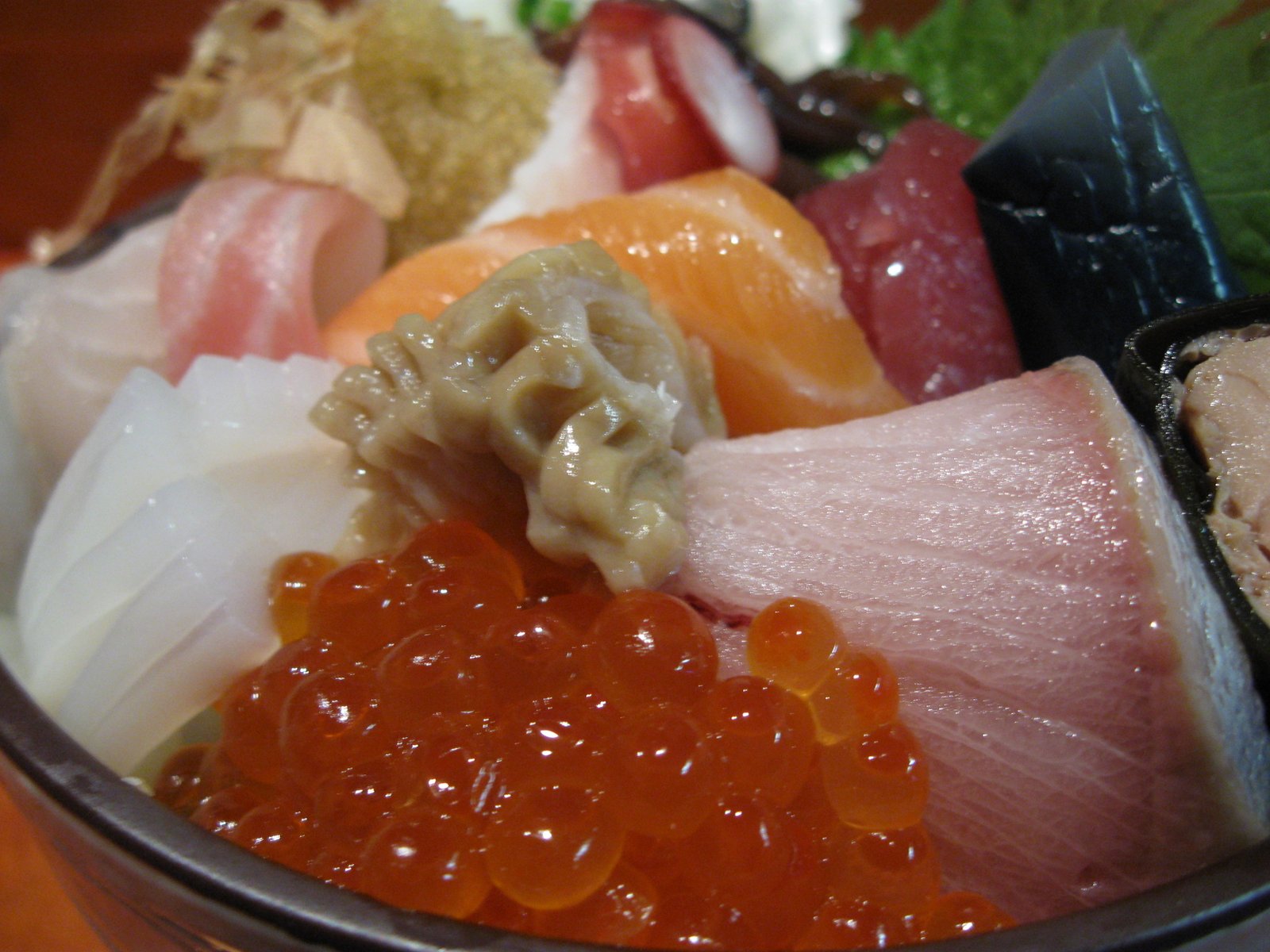
IMG_0299 A Chirashi is wonderful for sushi lovers on a budget. Instead of having each piece of fish sit on its own handmade rice ball, a Chirashi is a scattered arrangement of sashimi and related items on top of a bowl of sushi rice.

As always, the fish was first rate; you can see the quality in the pictures. The salmon roe, in particular, is a so good here that I often eat the little eggs one by one, popping them on the roof of my mouth. The yellow tail and salmon were especially rich and flavorful this day as well.

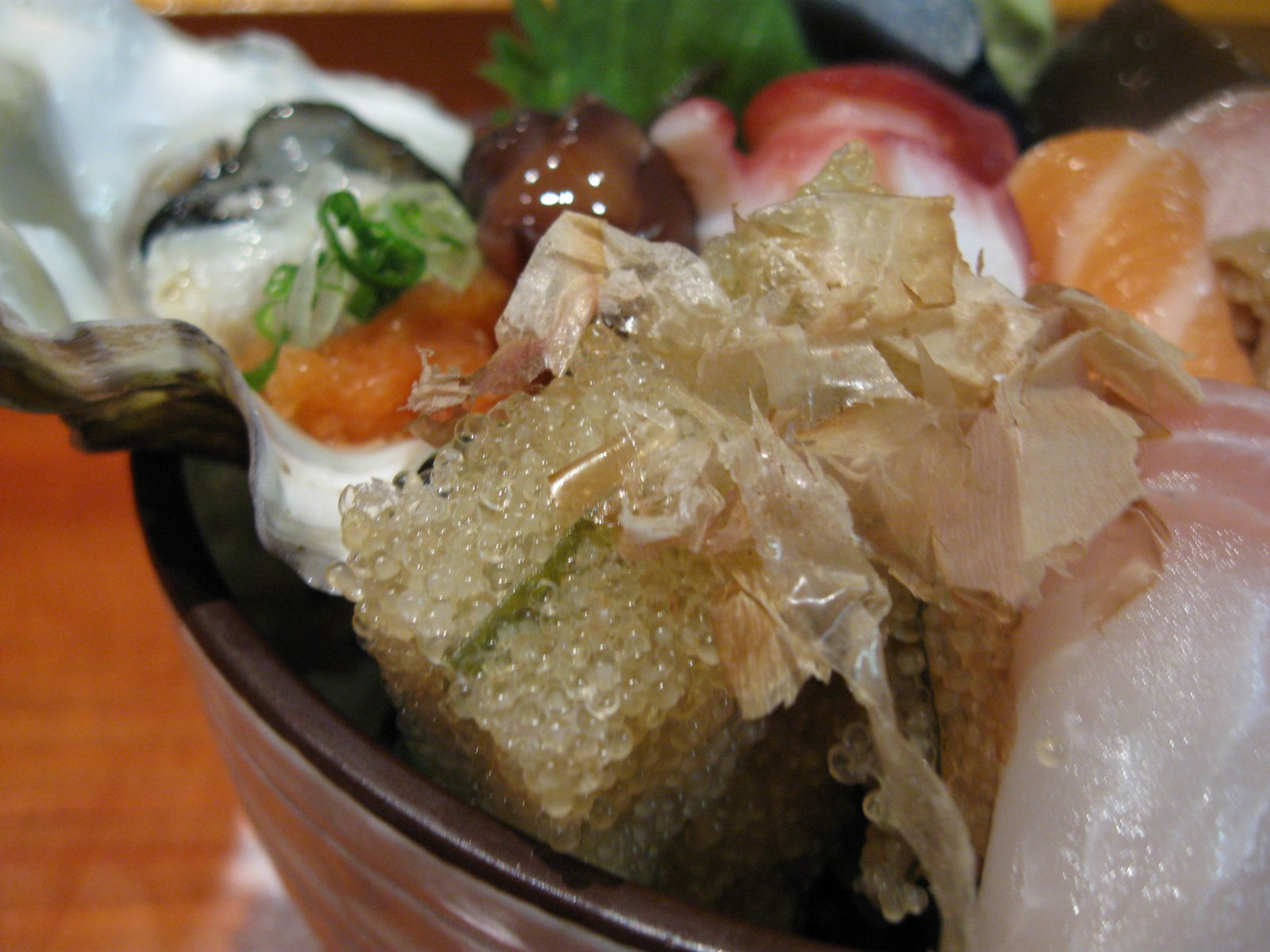
A good Chirashi will also reflect the season and perhaps include something unusual. This one did. In the foreground of this picture you can see one of the two chunks of herring roe that adorned the bowl:

IMG_0302 The chunks had crunch and more crunch, but the firm fisheggs were not salty or too strongly flavored.

My other surprise was this little guy:

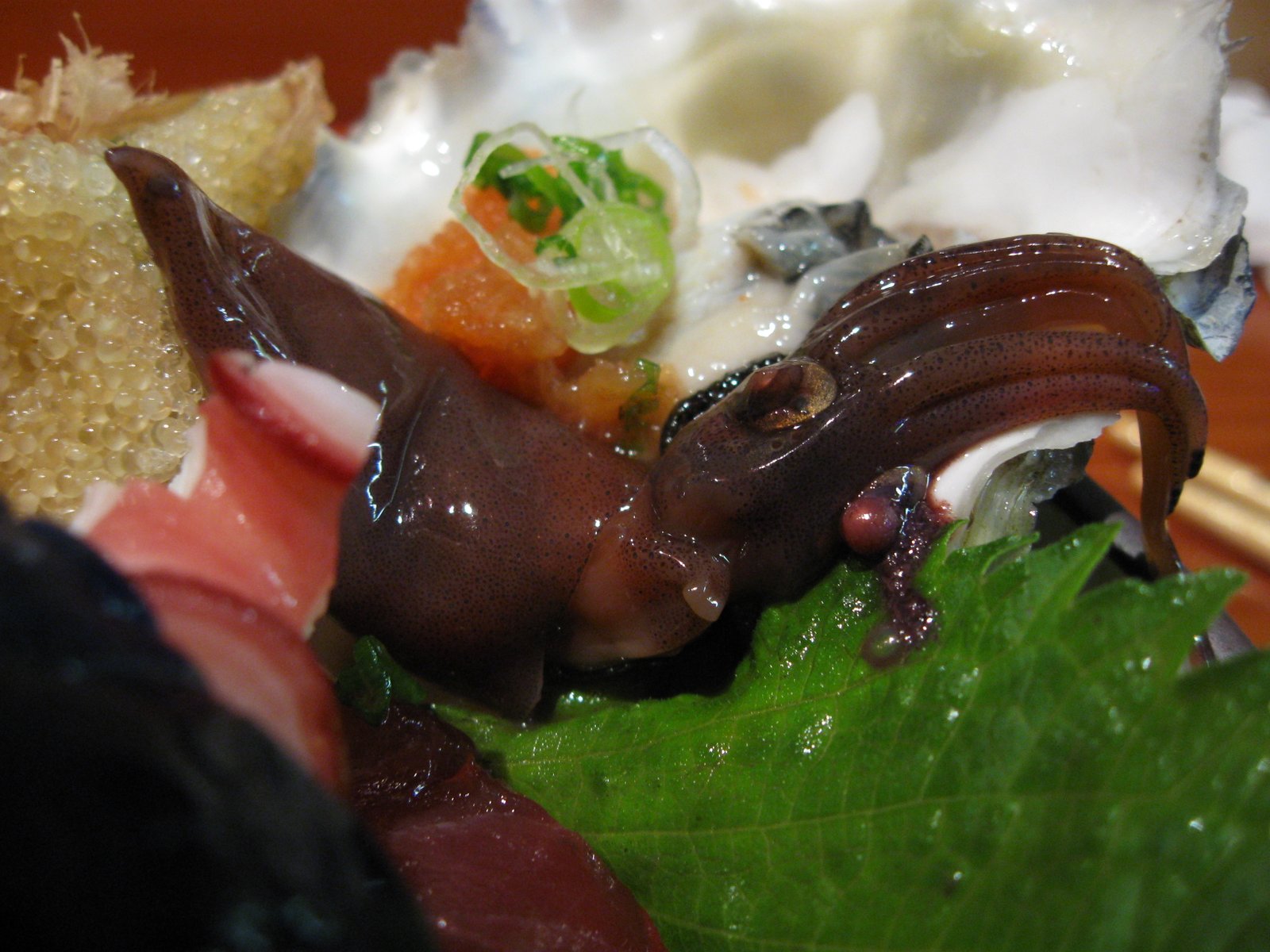
IMG_0305 This tiny fermented squid was reminiscent in flavor of a good shiokara.

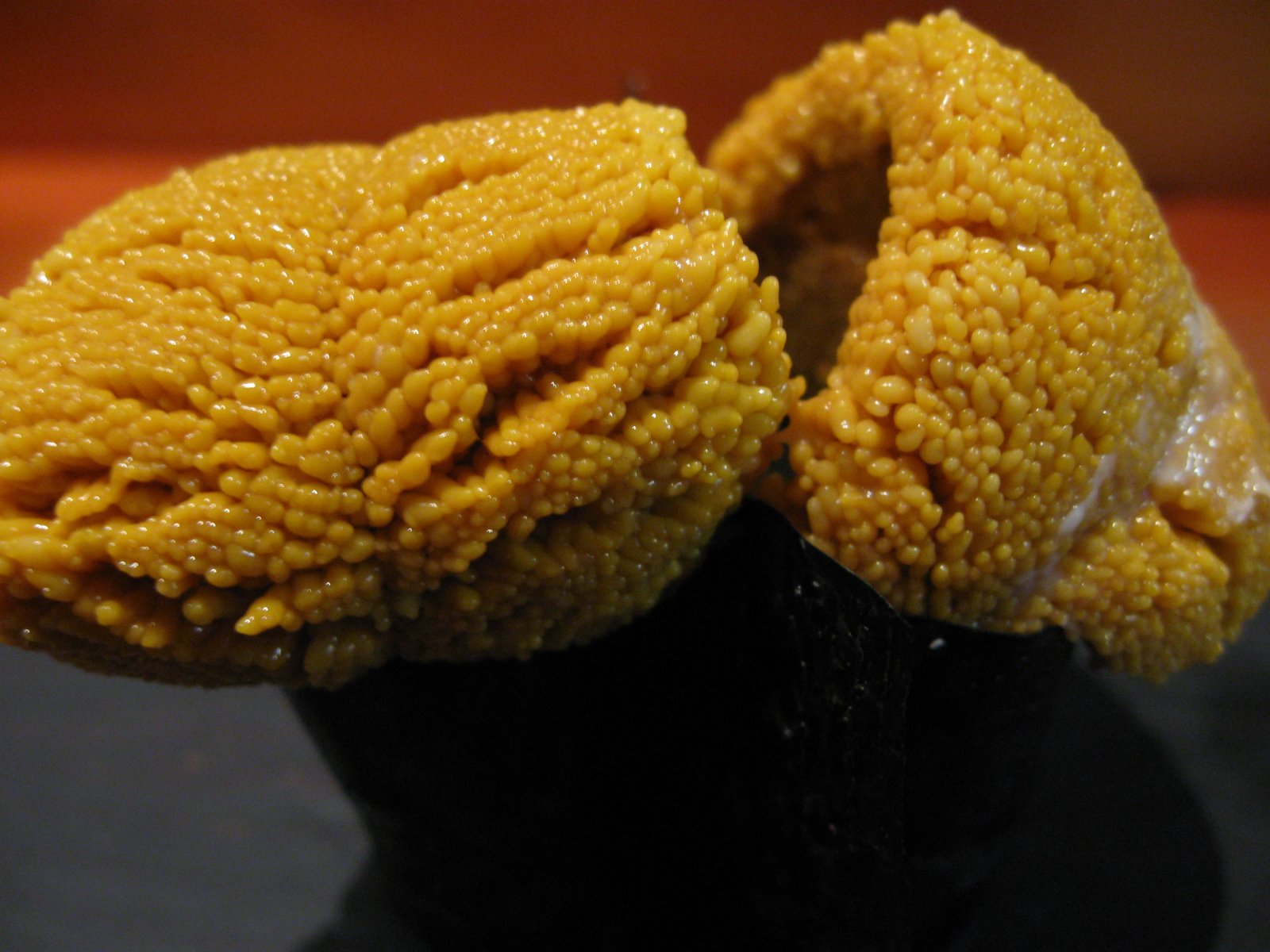
As always at Sakura, I ate well, and I was staying within my budget until Kazu mentioned that he'd forgotten to put uni in the chirashi. A cynic might think that the omission was deliberate, as I cannot stop at Sakura without tasting the uni. Anyway, here is a picture of dessert:

IMG_0307 Some things are more important than budgets!

The Better Half: Stressed Economy Special

Kirk and Cathy, as always, are eating and thinking about sharing their meals with you. Today, however, it is ed (from Yuma) discussing a recent meal he had in San Diego.

[The stressed economy wasn’t special for this place – sadly, it’s now closed.]

After a few days of eating Thai Vietnamese Korean sushi (no, not at the same time), I was looking for something different. I also had discovered that The Better Half was offering, between 5 and 7 p.m., a stressed economy special, three courses for $15.

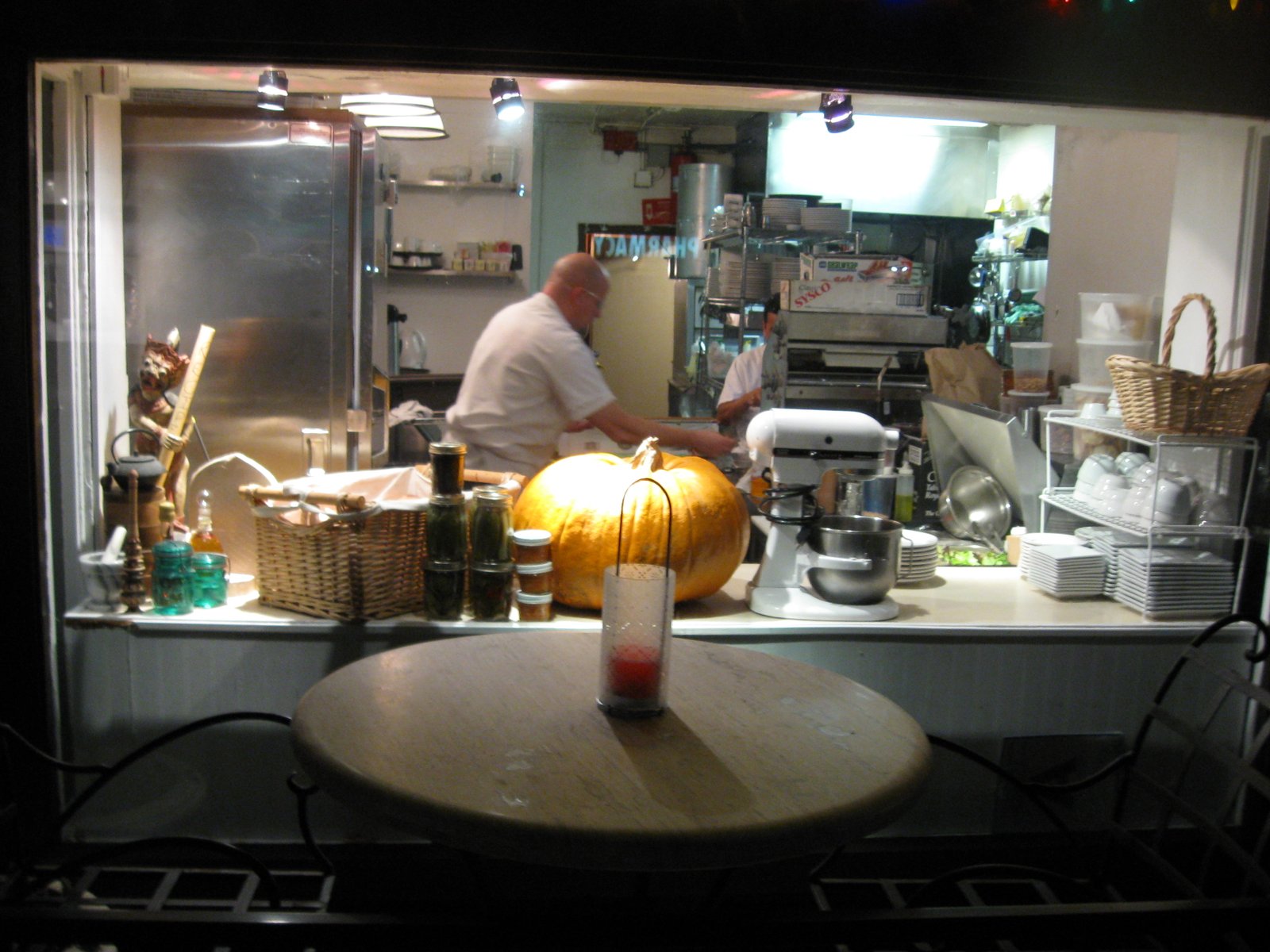
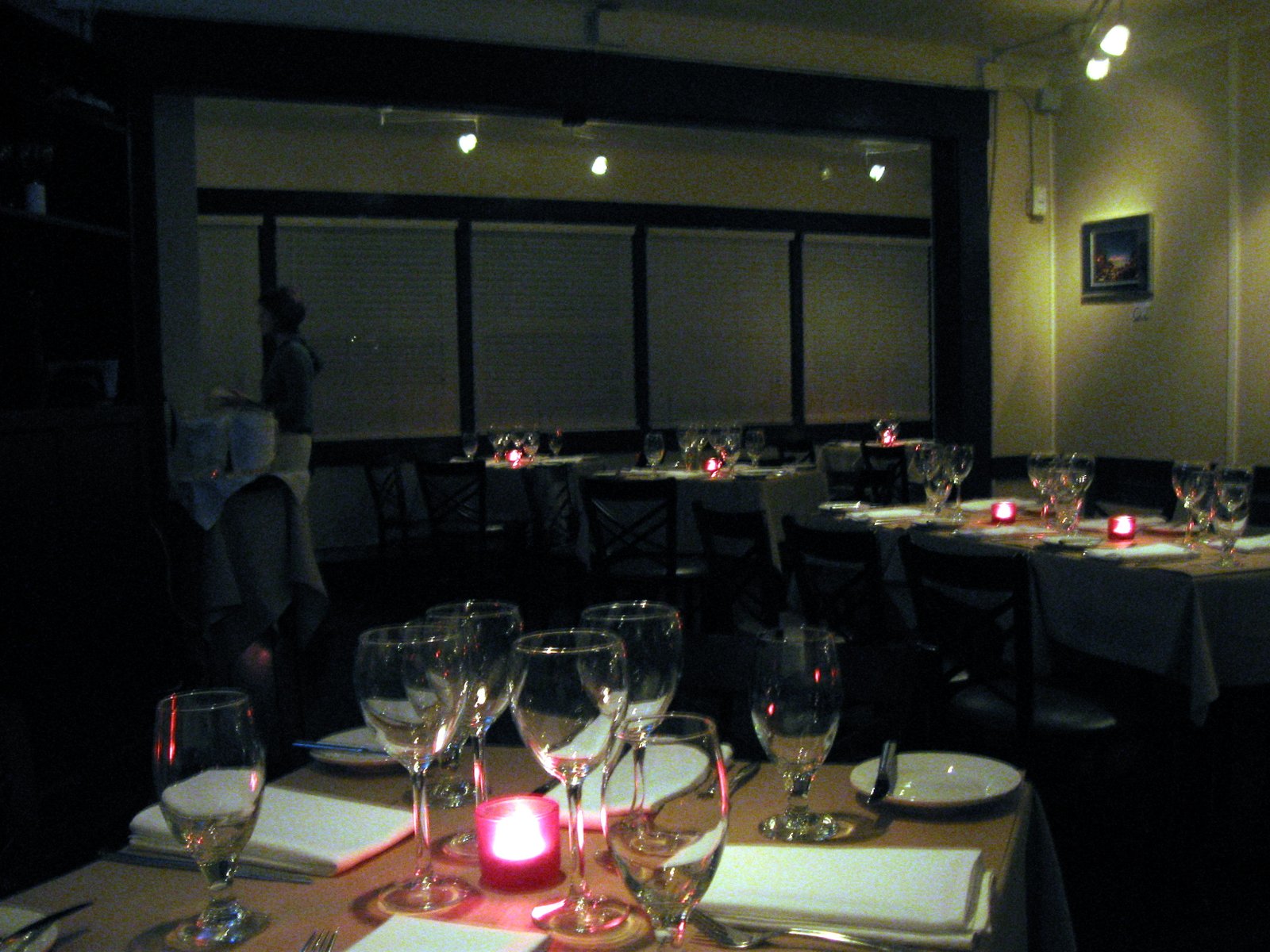
The restaurant actually occupies two buildings linked by an outside patio, which is where the hostess greets customers. On the left side is the small kitchen, visible from the street, which offers a view of the chefs working hard on their preparations:

IMG_0361 On the right is the two-room dining area:

IMG_0360 It is modestly, but tastefully decorated, and the track lighting allows small lamps to focus on each table top:

IMG_0339 (2) As you can already tell, this tasteful lighting does not make for the best photographs, so let me apologize in advance for the quality of the pictures in this post.

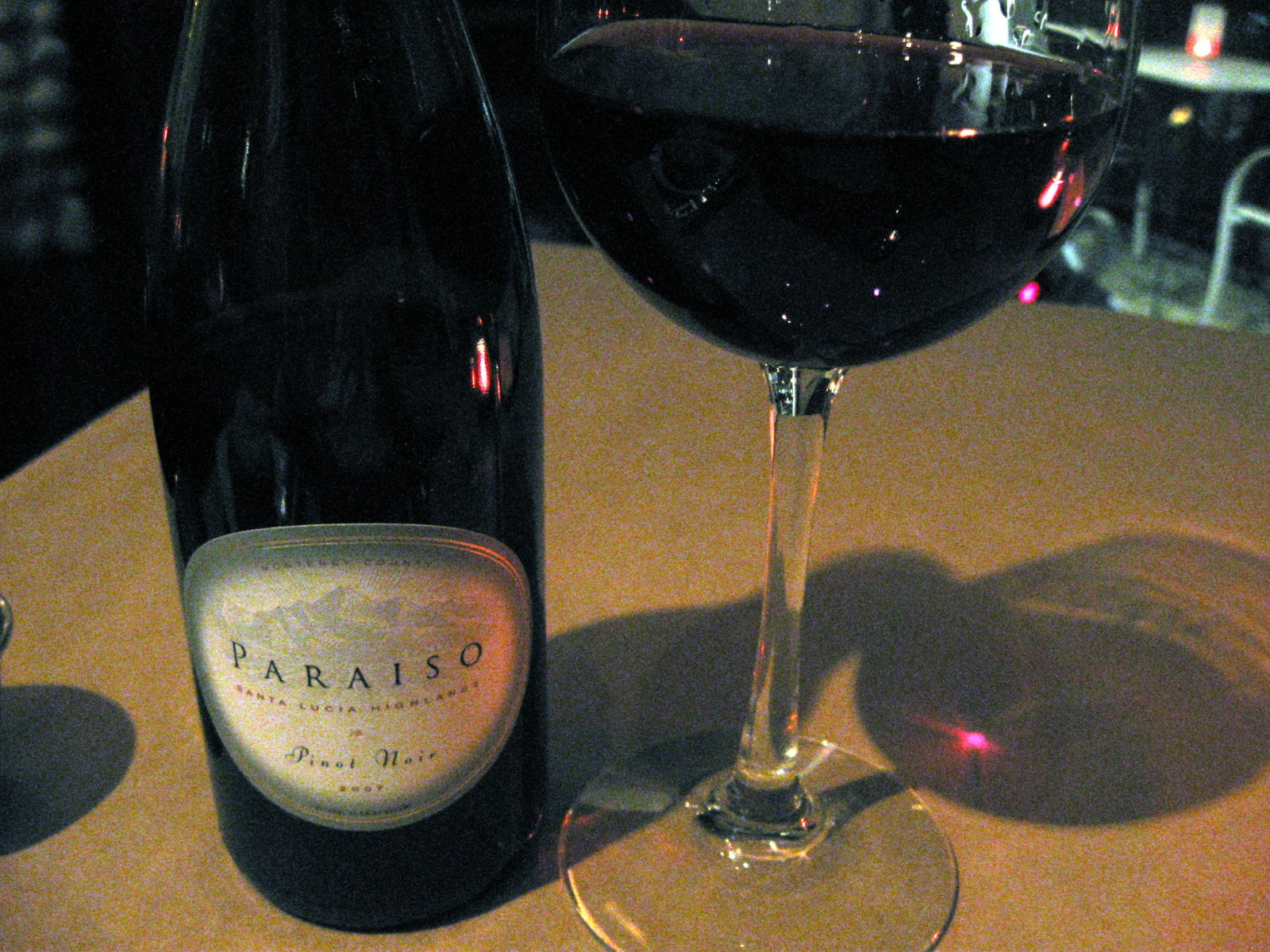
I had another reason for this visit. I was in San Diego by myself this trip, and the thought of having dinner and a half bottle of wine (The Better Half specializes in 375 ml bottles) seemed inviting. In fact, I was very impressed with the wine list; I had no idea that such a wide variety of excellent wines were available in smaller bottles. Wines on the list ranged from $14-$91, with many choices between 15 and 25. I settled on a Pinot Noir from Paraiso Vineyards ($22), located in the Santa Lucia Highlands area in northern Monterey County, a winery that I was already familiar with from my days in Monterey:
IMG_0345 (2) I had already looked over the standard menu and was prepared to order the fruit stuffed quail, accompanied by a wild mushroom risotto, if nothing on the special menu was inviting. But the economy menu insert offered all sorts of tasty dishes, a choice of salad or wild mushroom soup as a first course, grilled mahi-mahi in cilantro sauce, wild game meat loaf with mashed potatoes, or Cornish game hand hen with rice pilaf for a second choice, and some tasty desserts for the third. I could have eaten any of the choices happily.

After I ordered, a large whole-wheat and fig dinner roll was brought to the table. I could smell its arrival as the aroma of warm bread filled my nostrils:

IMG_0340 (2) Accompanied by lightly herbed whipped unsalted butter, this was a perfect start:

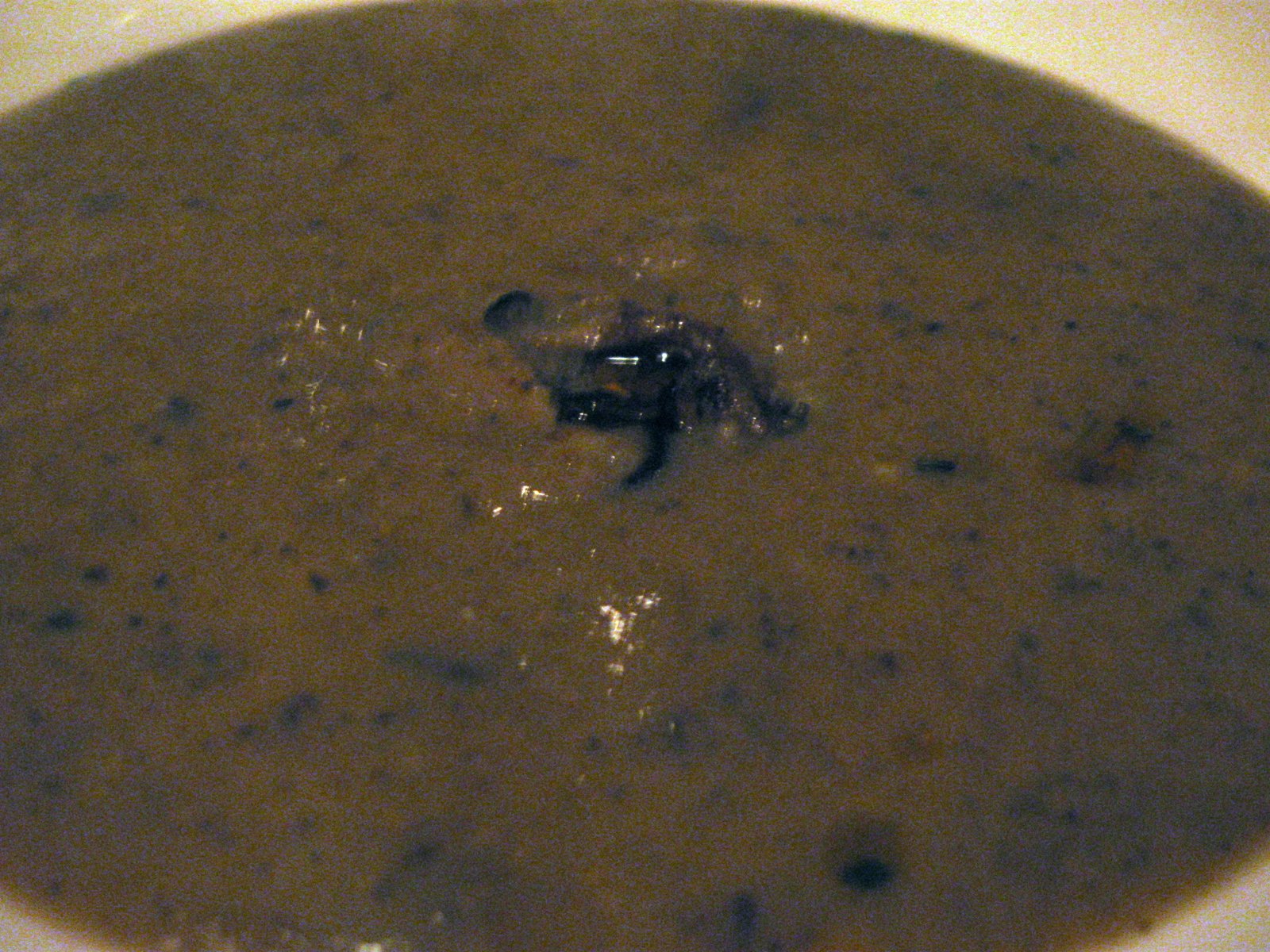
IMG_0342 (2) Soon my wild mushroom soup arrived. Okay, to be more accurate, a soup plate arrived with a small pile of sliced sautéed wild mushrooms sitting by themselves on the bottom of the dish. For a moment I was puzzled — this was like no soup I had ever seen before — and then the friendly and helpful waitperson poured a dark grayish brown liquid from a metal teapot into the bowl. It looked like this, only much more inviting:

IMG_0348 (2) Perhaps the best mushroom soup I have ever eaten. The sautéed wild mushrooms added a bit of texture to the creamy broth. The primary flavors were Portobello and wild mushroom, accented perfectly by the flavor of sherry. The wine note served much like a squeeze of citrus into a rich soup, complexifying the savory breadth of the overall flavor.

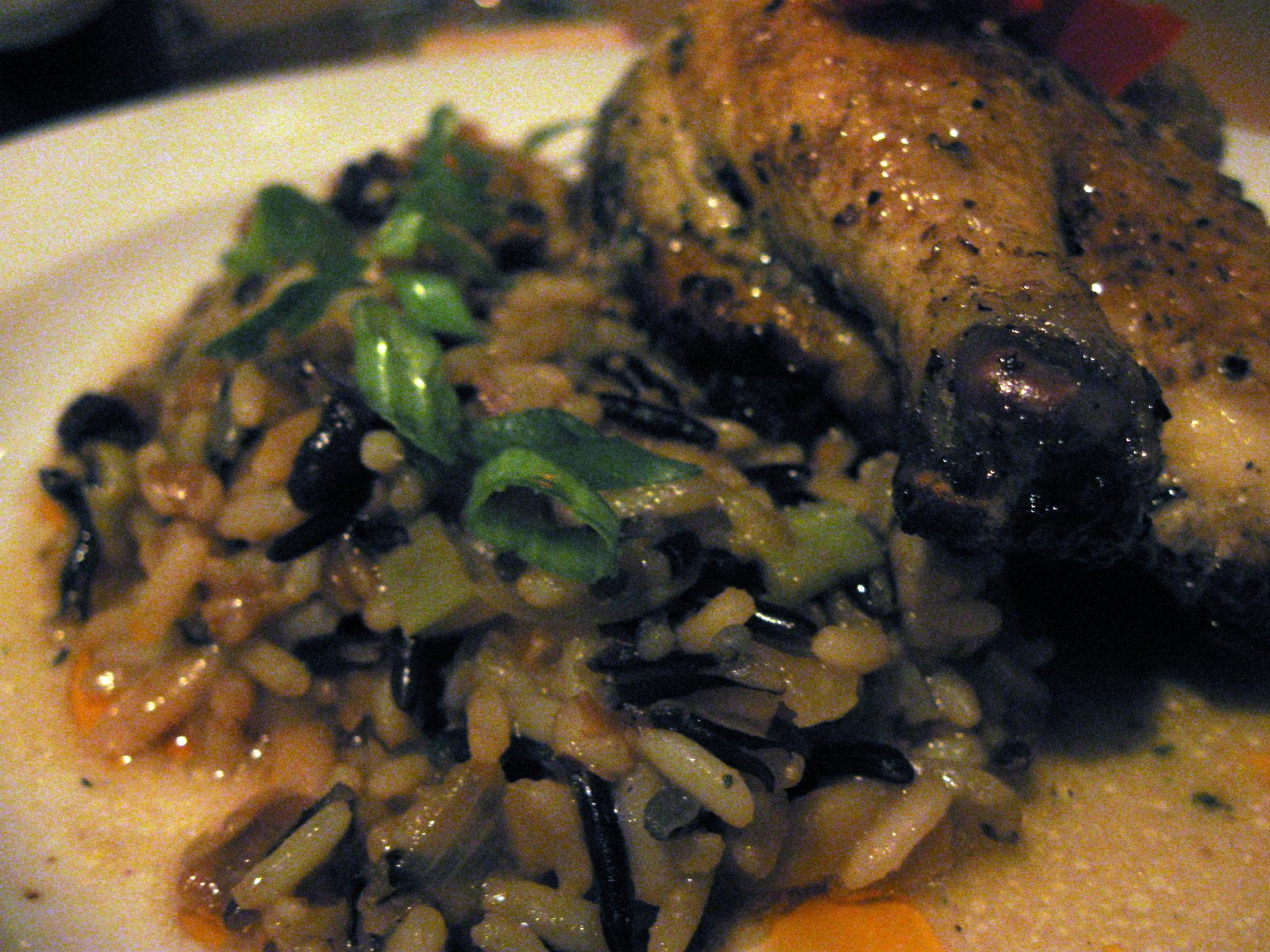
Soon after I finished with the soup, the main course arrived. I had chosen the game hen with the pilaf:

IMG_0353 (2) The bird was roasted perfectly, still wonderfully moist and tinged slightly pink at its innermost joints. The flavor was straight forward without many herbs or any marinade. Good basic roast fowl.

The pilaf was the star of the plate. The flavor was rich and deep. I could taste both the wonderful stock in which the pilaf was cooked, as well as the flavors of the grains. The range of textures was amazing. The white rice and orzo (rice shaped pasta) were soft; the wild rice and wheat berries were chewy; and the sliced almonds added a perfect touch of crunchiness. Some chopped scallions added color:

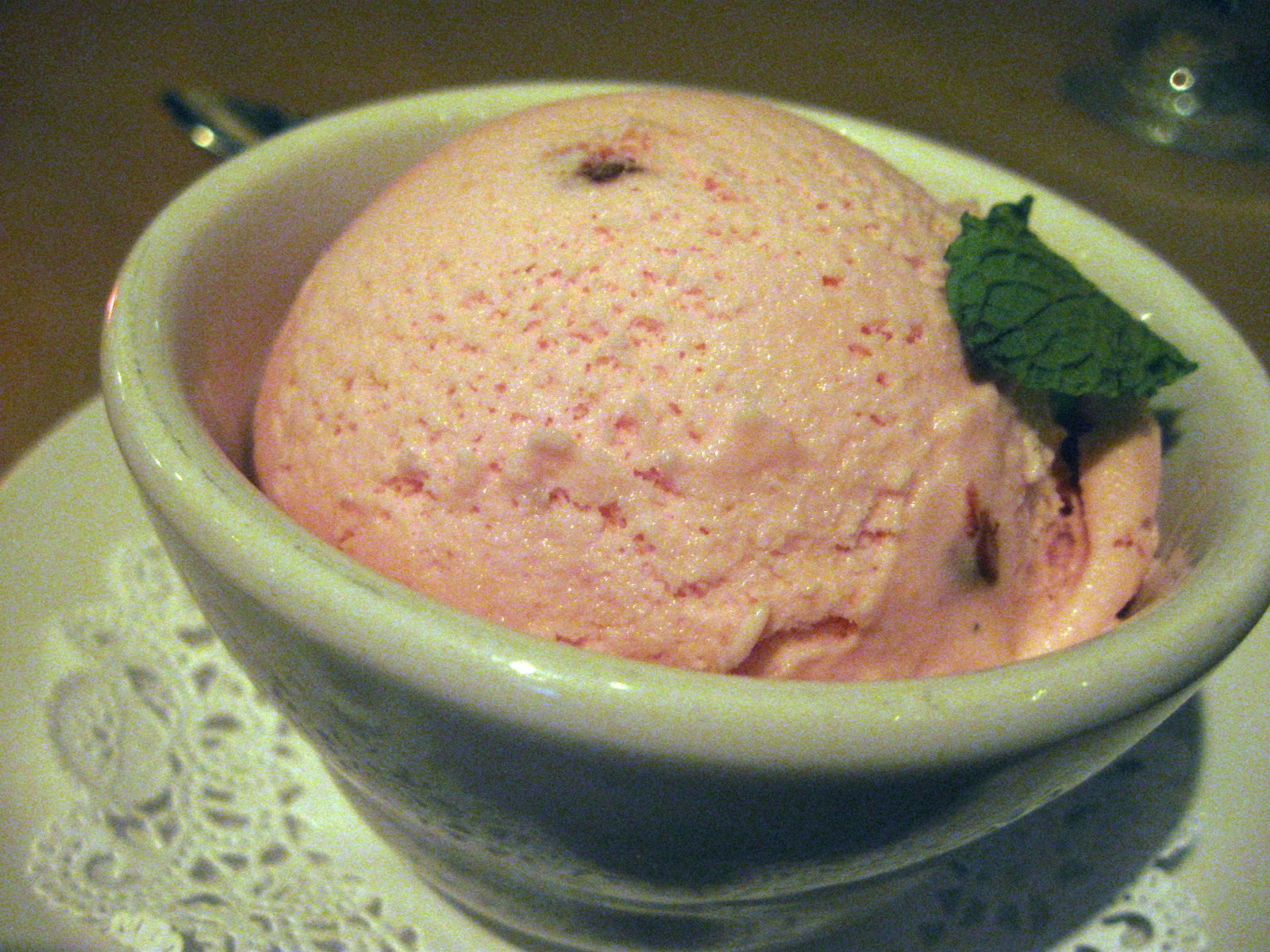
IMG_0352 (2) The meal ended with a large scoop of excellent strawberry ice cream accompanied by mint leaves:

IMG_0357 (2) By the standards of a pho house this was an expensive dinner. But for fine dining, and this truly was fine dining by any standard, the meal was a bargain. And truth be told, I have spent far more than this at Sakura. Far more. Kirk will no doubt remind me that the meal would have been extremely cheap if I had drunk water instead of Pinot Noir (and The Better Half has a nice choice of bottled waters as well as tapwater). Oh well, if price were the only issue, I would be chomping down at McDonald’s Dollar menu. 🙂

The Better Half, 127 University Ave, San Diego, CA 92103, (619) 543-9340

2nd Annual Somerton Tamale Fest – 2

Kirk and Cathy will be back posting soon. But today, as promised, ed (from Yuma) is finishing up his report on the Somerton Tamale Festival. It will begin with the following line: 

I mentioned in the first part of this post that well over 5000 people must have attended this year's event. And it seemed like all of them were standing in one line — the line leading to last year's favorite meat tamale:

IMG_0250 The line went straight forward and then turned right toward the vendor. Yes, the guy in the red cap with his daughter, the young lady scratching the back of her pink sweater, the follicly challenged gentleman in brown, and everyone in front of him were all part of the line. And this picture doesn't show the very front of the line or those poor souls standing behind Tina and I. Notice also that the line is two and three people wide for its entire length.

One of the many great things about attending an event like this with a friend is that standing in line (even for over an hour) did not mean that we were required to go hungry.

I soon showed up with a tamale de pollo:
IMG_0254 While not as rich and good as the chicken tamale at Pupuseria Cabanas (yeh I'm plugging my favorite Yuma restaurant – again), it did have a nice chicken flavor and good green chili spice. It also kept us from focusing on the very slow-moving line.

So a few minutes later, I was back with another beef tamale, from a vendor recommended by a friend:
IMG_0255 It was typically rich and beefy (there should have been a table with a cardiologist at this festival). Since I had spooned some tangy salsa from the same vendor beside the tamale, it added a slight sour note that contrast with the overall flavor:

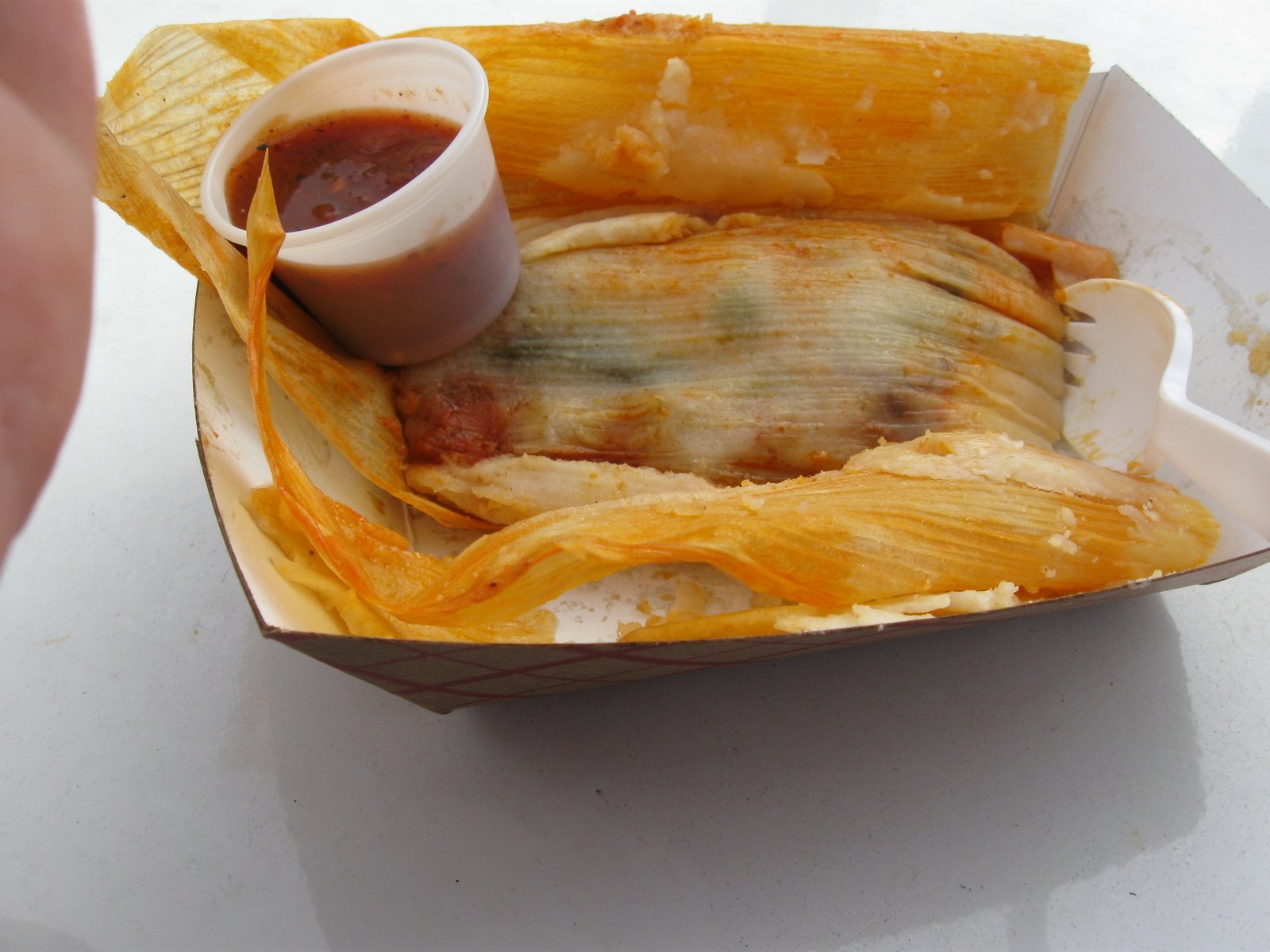
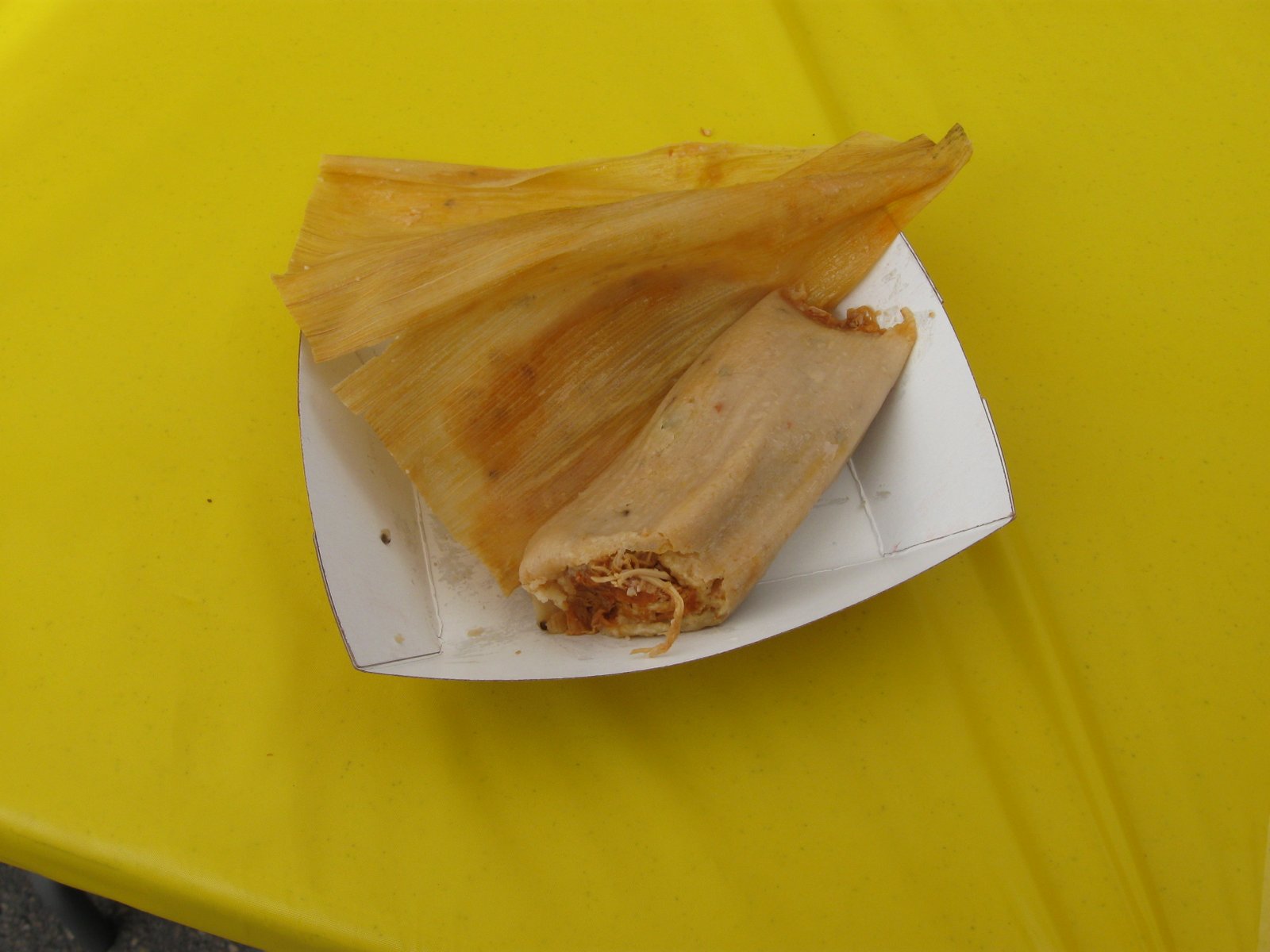
IMG_0257 Luckily our long wait in line was not in vain (and yes, we did have visions of them running out just as we got to the head of the line). When we got back to the table and opened up the tamale, this is what greeted our eyes:

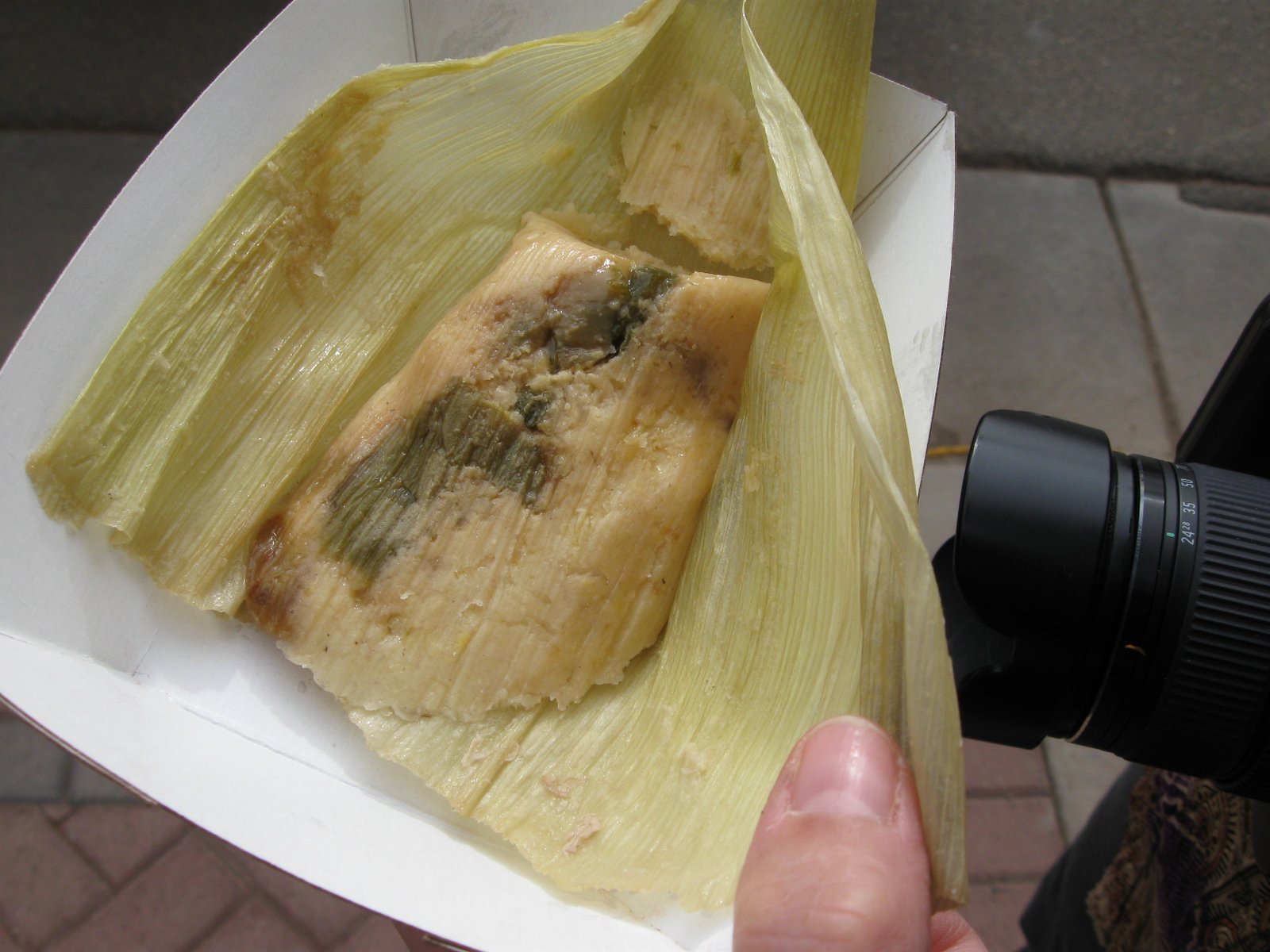
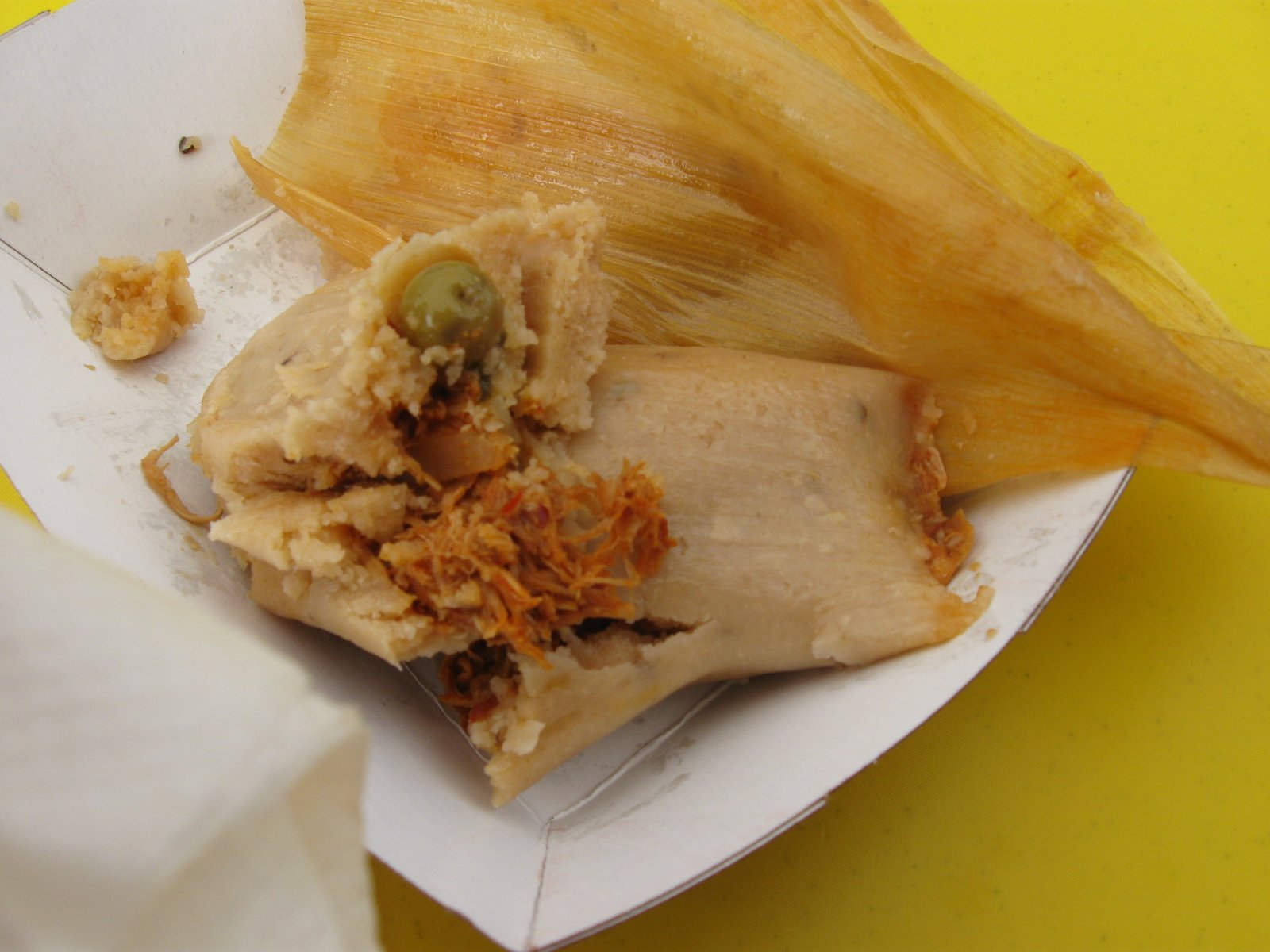
IMG_0259 Okay, we learned quickly that it didn't win last year's award because of its looks. The darn thing was more ugly and lumpy than I am. When we opened it up, we began to realize that it truly was a winner:
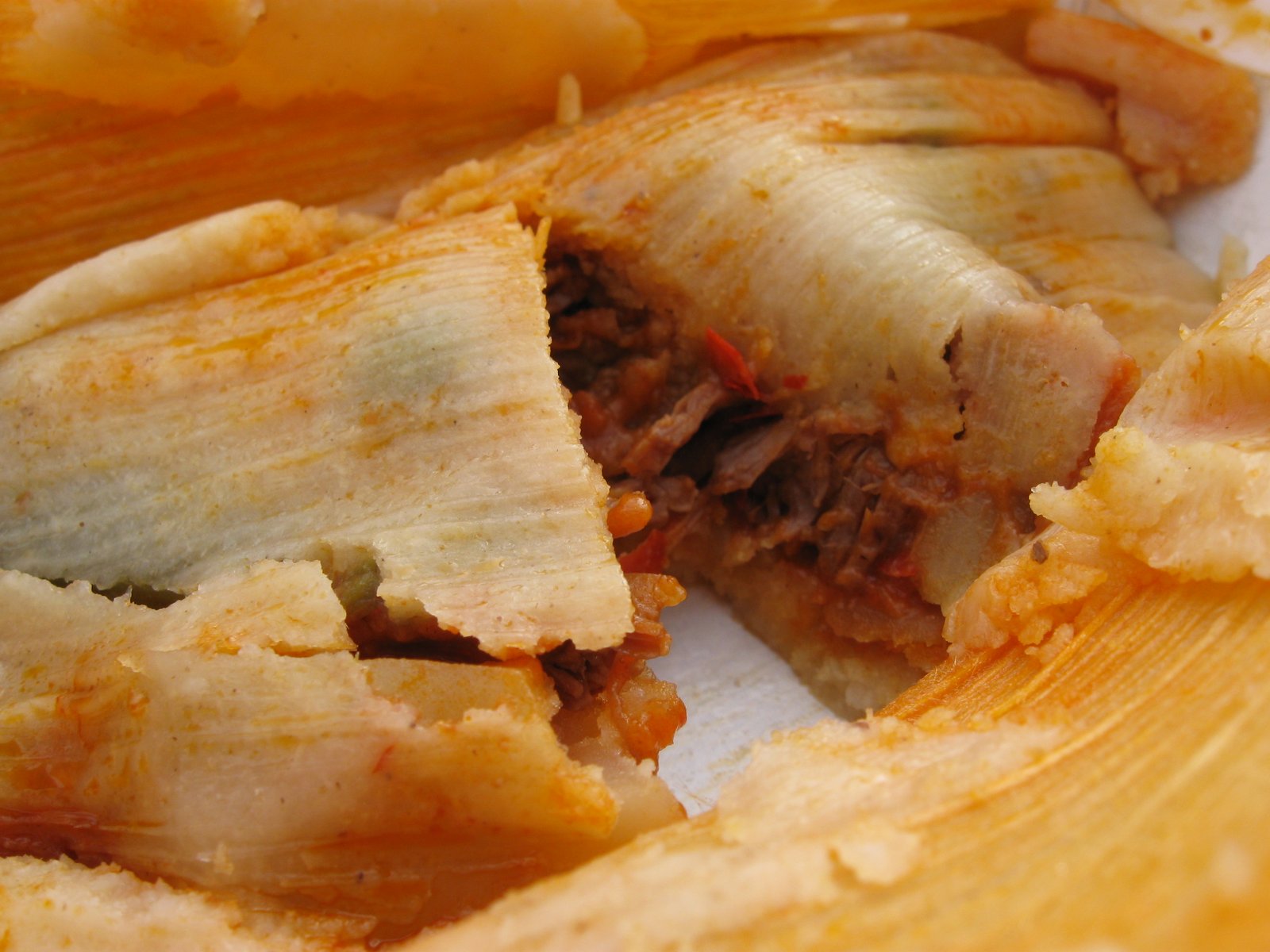
IMG_0262 In addition to all that rich flavorful beef, there was abundant green chili and the obligatory olive as well:
IMG_0265 And surprise, pickled carrot slices:

IMG_0267 Yeah, that's a good tamale.

We saved for last the tamale of the wonderful woman whose picture at last year's festival has become a key part of the festival's website. Just as I remembered it was good and beefy:

IMG_0269 What else can I say? The tamales were $1.50 apiece. Plates with beans and salad were also available. It may look like we tried them all, but we didn't even make it to a third of the vendors – and many vendors had more than one tamale choice. We were also too full to finish with a desert tamal – such as pineapple or chocolate.

The Somerton Tamale Festival is truly festive. And flavorful. And muy rico. Next year, you be there too!

2nd Annual Somerton Tamale Fest 1

We already warned you regular readers that this blog was going to the Somerton Tamale Festival, so here is ed (from Yuma)'s report:

Contrary to predictions of stormy winds around Somerton on December 13, this year's tamale Festival was graced with more good southwestern Arizona winter weather – though it might not have made it above 70°.

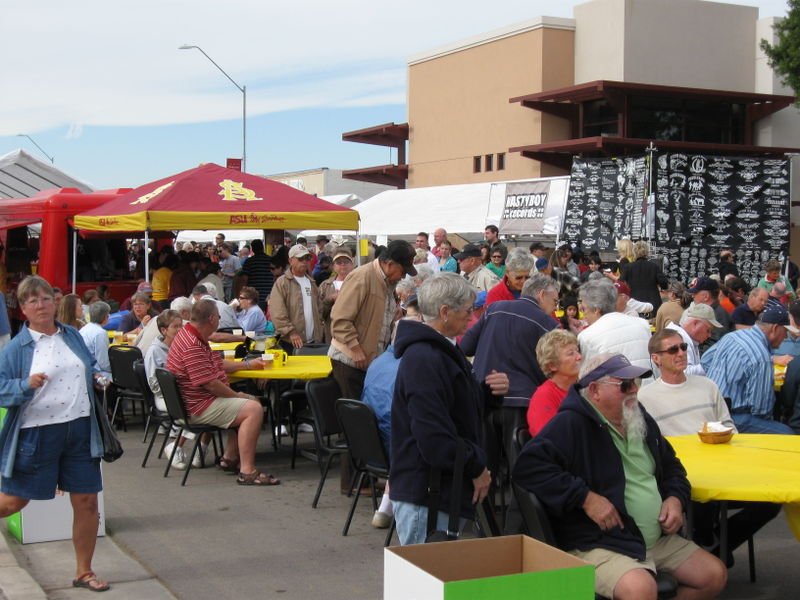
The festival has grown from 22 to 36 vendors in just one year. I'm sure the turn out exceeded last year's showing of 5000 people:
IMG_0224 In addition to the worlds greatest collection of homemade tamales, those people also enjoyed the live musical entertainment, such as this spirited mariachi band:
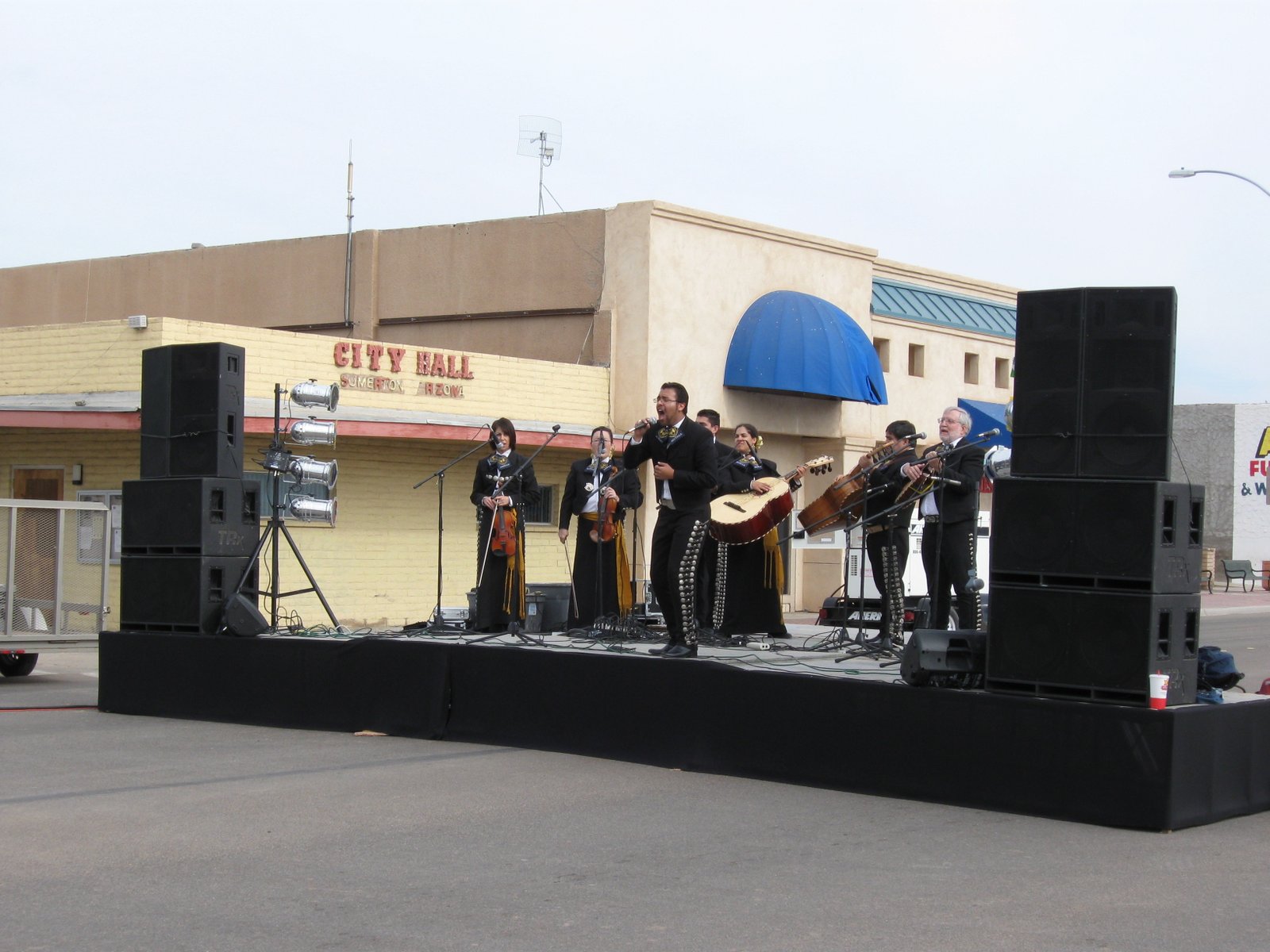
IMG_0223 Tina and I decided to start with a turkey tamale (de pavo):

IMG_0225 As we started eating, we were struck by the spicy mild turkey flavor:

IMG_0227 Our main criticism was that it was not as rich as some other tamales we ate that day. But then again, one doesn't order turkey if one is looking for the richest tamale.

Next we decided to have a green chile, cheese, and sweet corn tamale:

IMG_0228 Its name said it all. The chili flavor was intensely green and spicy. That was perfectly balanced by the kernels of sweet corn, which also contributed to the texture. The cheese added richness. This was one of our favorites from the day.

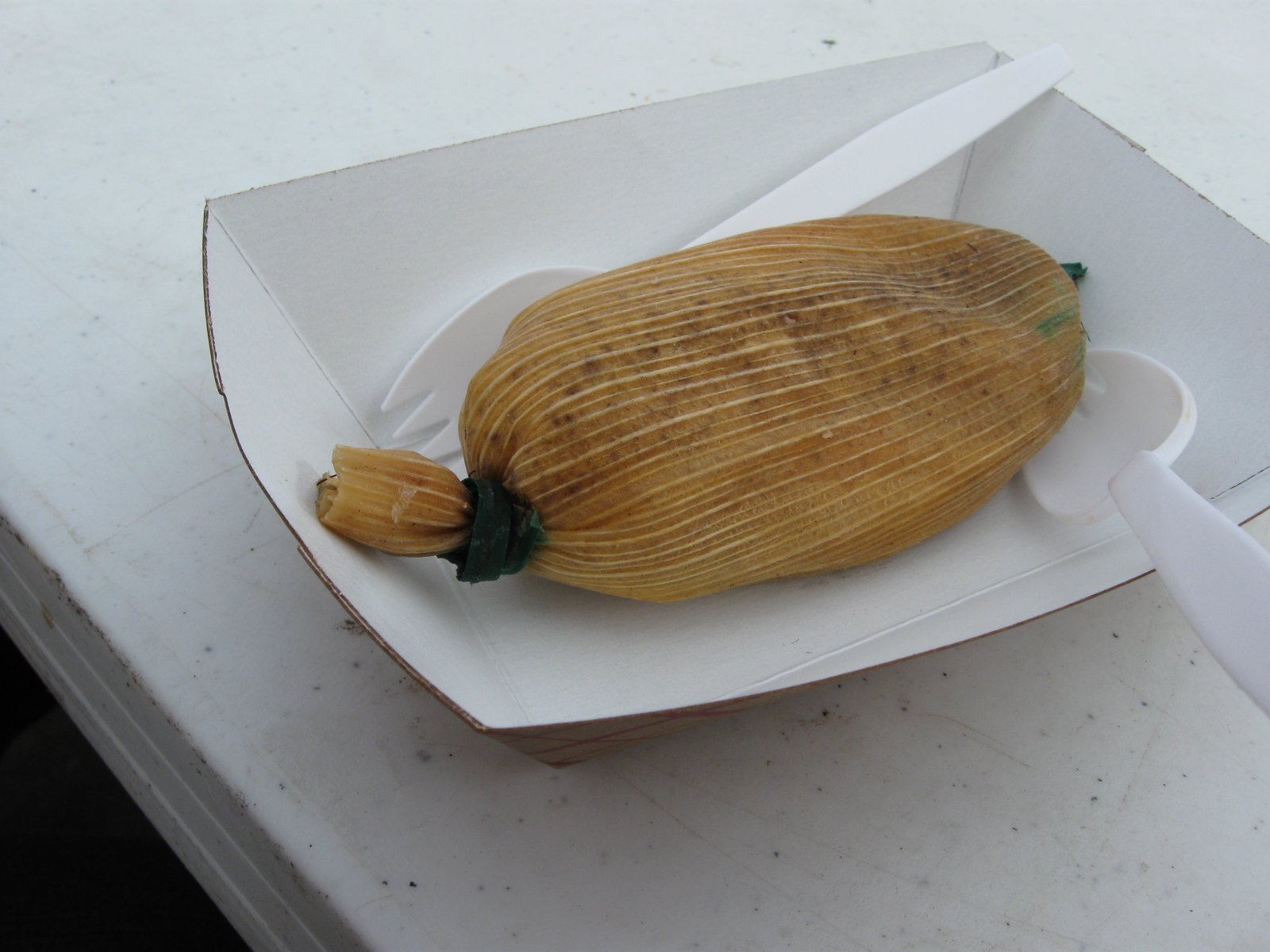
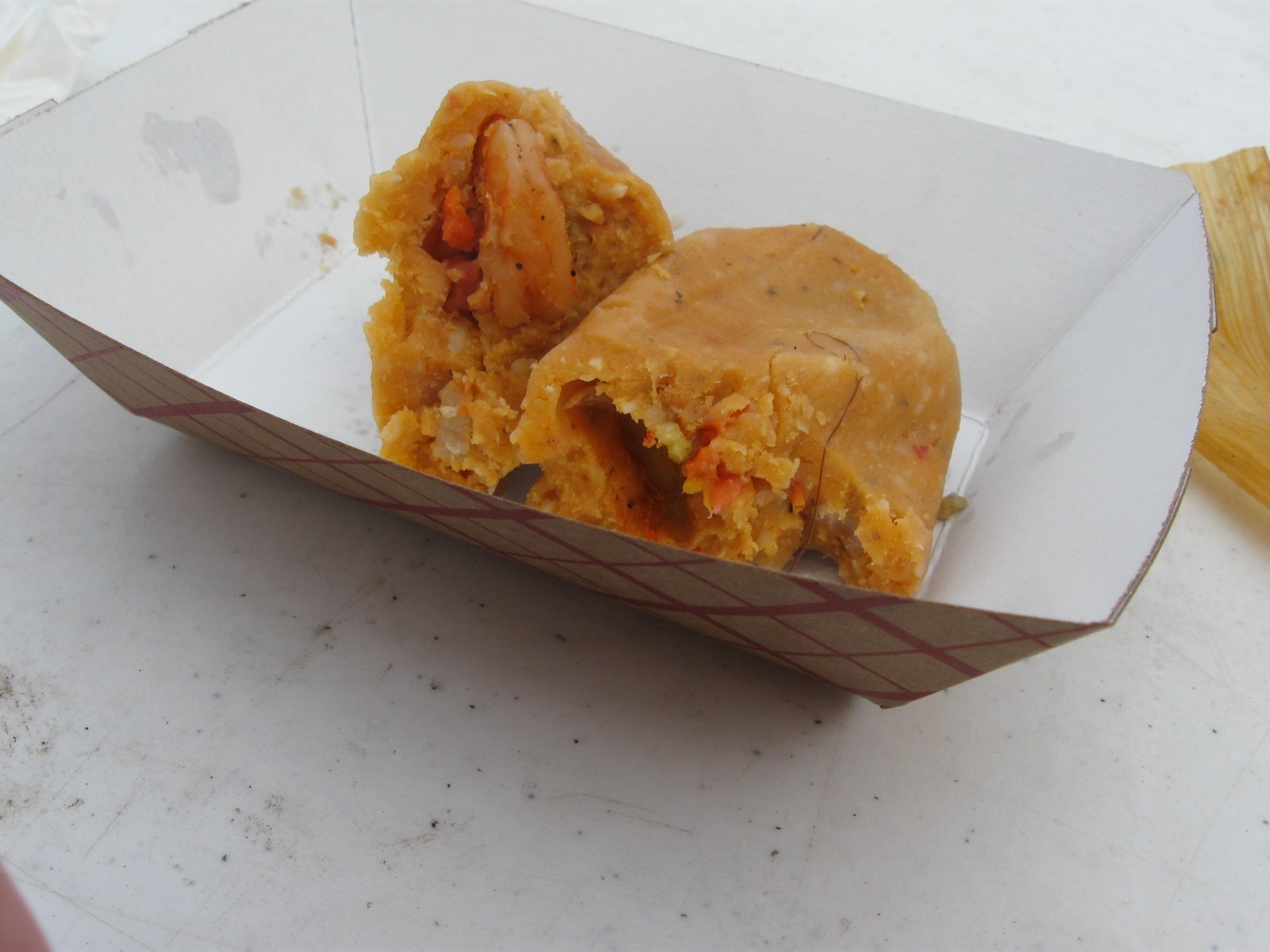
We couldn't resist the thought of a shrimp tamale. Its appearance was unusual in two ways — it was very round and the husks were held in place by green twist ties:

IMG_0231 The flavor was lightly fishy and slightly shrimpy. Good and different:

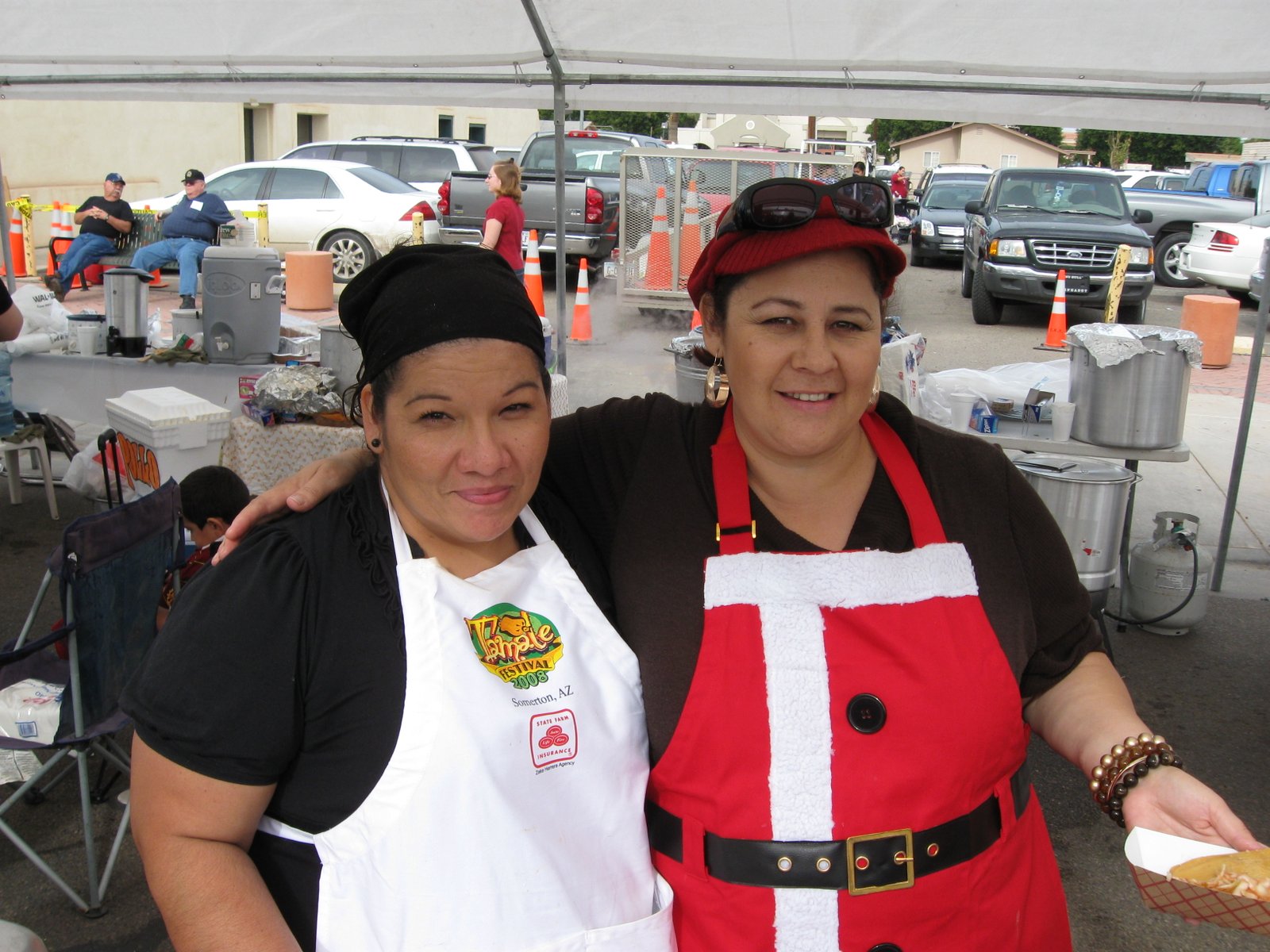
IMG_0234 As usual the vendors were happy and friendly:

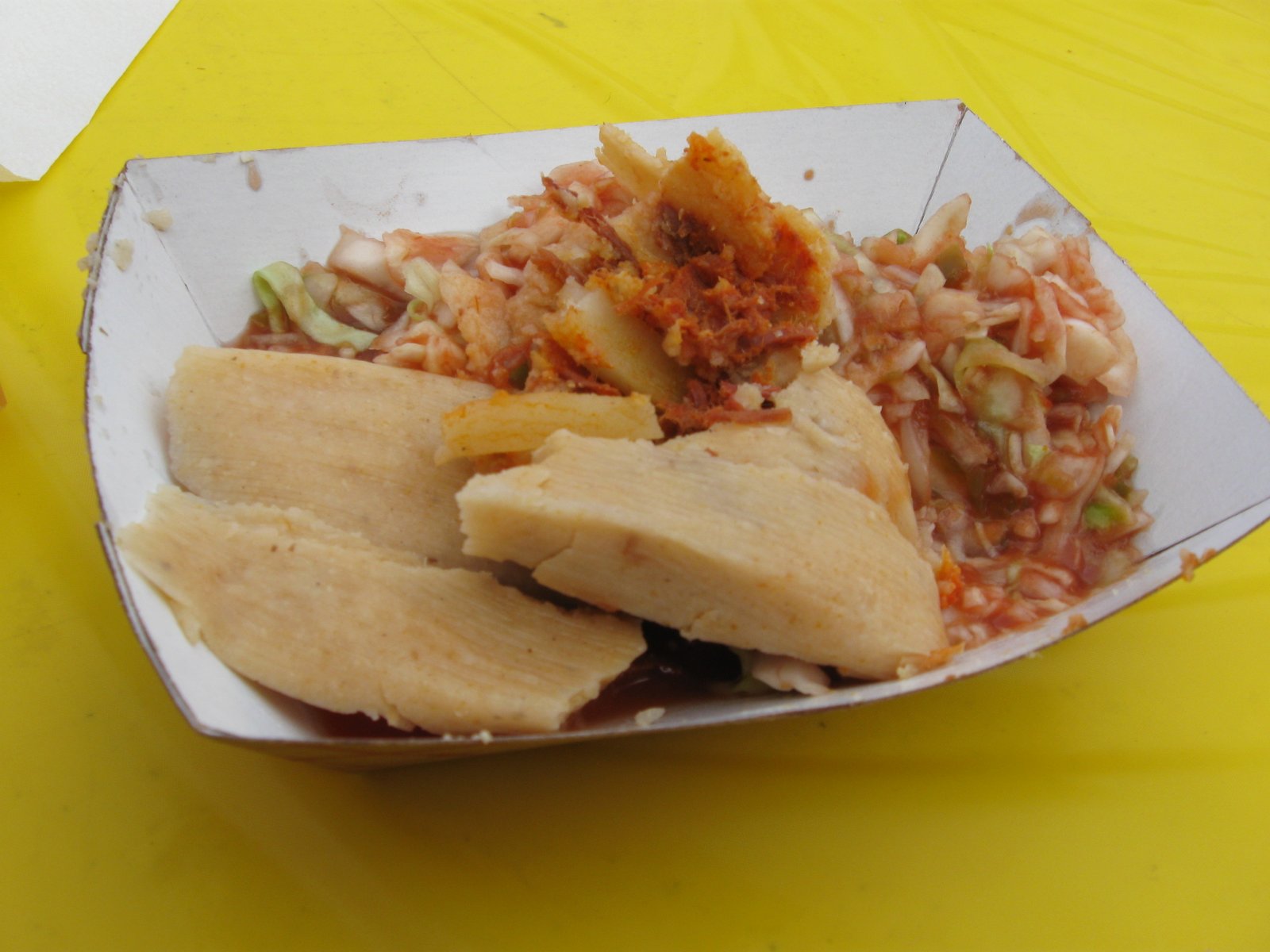
IMG_0236 These wonderful two ladies proceeded to talk us into trying their tamale de res. It was unique in being accompanied by cabbage salsa:

IMG_0238 
The spicy salsa dominated the flavor of the combination. This was the most fiery blast to hit our mouths all day long. The tamale itself contained more potato than average and mild flavored beef with a good chew. In a way, the tamale was a very good match for the salsa.

Since we had been pigging out, it now seemed appropriate to tackle a tamale de puerco:

IMG_0241 This vendor was voted most authentic the previous year. We loved its spicy and porky flavor. Perfect, except the masa was just a little too dry. Of course, it still beats any Mexican restaurant tamale I've ever eaten.

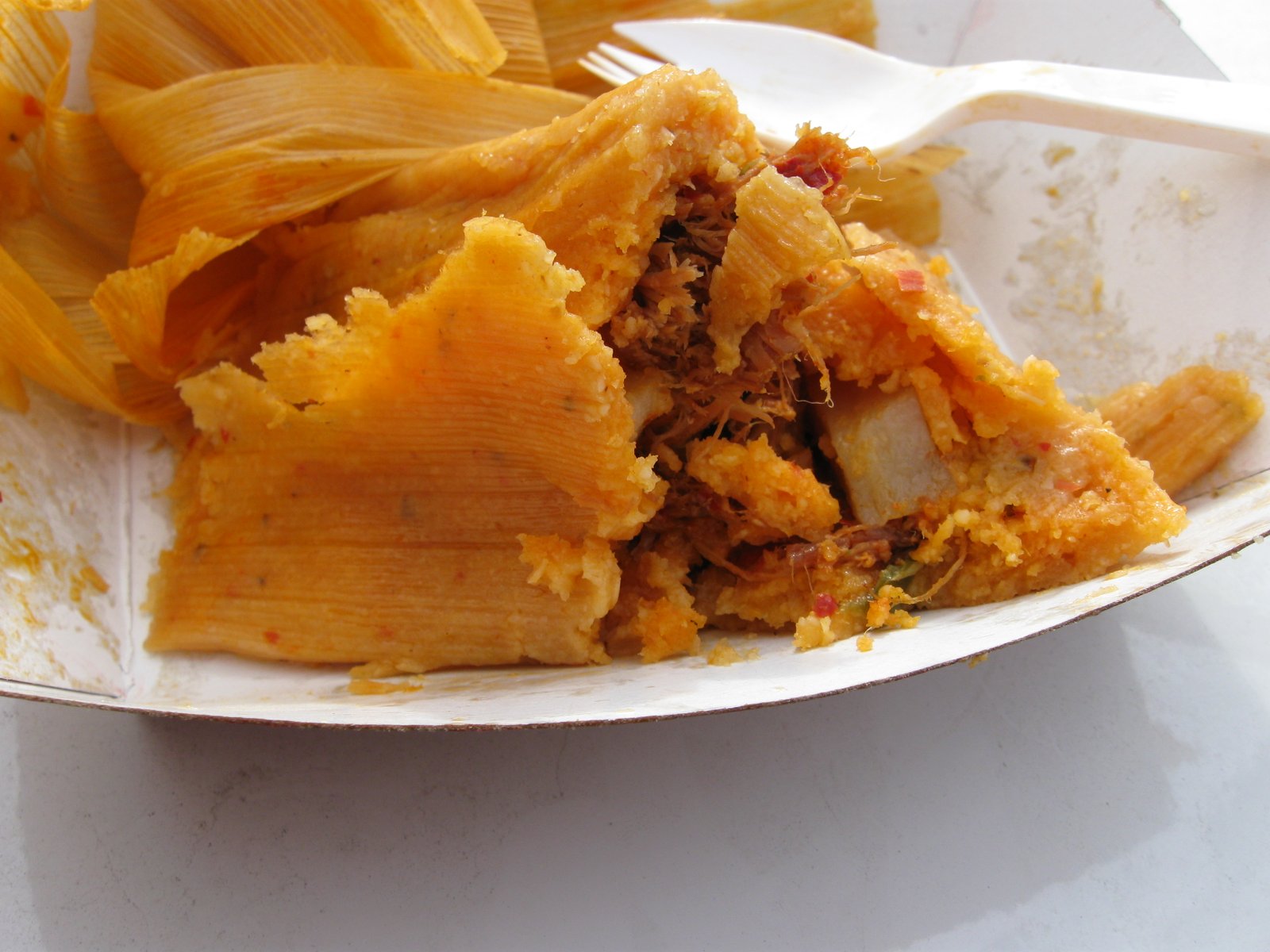
The next tamale we had was probably our favorite from the day:

IMG_0247 We loved the large quantity of chewy and flavorful beef. The plentiful green chile strips (oops, not in picture) added a nice contrast to the red chili sauce with its abundant chili flakes. Needless to say, it was "muy rico":

IMG_0249 I was planning on doing this report in one post, but right now, this post is already taking a long time to load, so I will have to continue in a second post later.

Is there a tamal worth standing in line for over an hour? Check out part two and find out!