Peng’s Homestyle Bean Curd

05072008_011

You may be asking, "who the heck is Peng, and why is this bean curd dish named after him?" Well, Peng Chang-Kuei(彭長貴) is a famous Hunan Chef who fled to Taiwan when the Nationalists were on the verge of defeat to the Communists in 1949. He is credited with creating what could possibly be the most well known "Hunan" dish in the Western world, which in fact was not a product of China; General Tso’s Chicken. Fuchsia Dunlop tells the story here. Or even better for more stories, as well as the commentary on this recipe get a copy of her book on Hunan cooking; Revolutionary Chinese Cookbook: Recipes from Hunan Province. I found most of the recipes in this book to be easier than those in Land of Plenty.

Just like Barbara Fisher, who made a version of this dish, and documented it on her wonderful blog05072008_009  Tigers & Strawberries, we love the simplicity of this dish. I took a few liberties with the published recipe. For some reason the Missus wanted a vegetarian dish, so I excluded the sliced pork and stock. Because of this, I increased the amount of garlic and dark soy sauce. Also, after cooking a few dishes from the cookbook, and reading Fuchsia Dunlop’s commentary, I added a touch of sugar to the recipe. According to the book, Hunan tastebuds are not fond of combining sweet and savory in their dishes. Adding just a bit of sugar seemed to open up the flavors a bit. I use only enough Sesame Oil to add a faint fragrance, and not over-power the dish. One more thing, if you’ve ever eaten in a good Sichuan or Hunan restaurant, you’ll notice that black beans(do not soak) are never crushed, but cooked whole. This explains what seems like the huge amount of black beans in the dish.

05072008_007

Peng’s Home-style Bean Curd

1 Block Firm Bean Curd, Drained
1 Tb Shaoxing Wine
3 Scallions – Green parts only
1 Red Serrano Pepper
3-4 Dried Red Chilies
3 Tb Minced Garlic
3-4 Tb Chinese Fermented Black Beans
1 Tb Dark Soy Sauce
1 1/2 Cup Water
Salt to taste
Sugar(if desired) to taste
A light drizzle of Sesame Oil to taste
Chili Oil to taste.
1 Tsp Potato Starch mixed with 1 Tb cold water
1 1/2 cup Canola Oil for Frying

1.Cut the block of bean curd in half diagonally, than lengthwise. Place bean curd on a folded paper towel, place another paper towel on top of the bean curd. Place a plate on top of bean curd with and top off with a few cans. I do this to remove excess water out of the bean curd.

2.Rinse the Black Beans(do not soak) and set aside.

3.Thinly slice the scallions and seed then thinly slice the Serrano Chilies. Tear the Dried Chilies and remove seeds.

4.Remove the bean curd from plate and paper towels and cut into 1/2" by 1" cubes. 05062008_008(The Missus found that She enjoyed this "size", more than the oblong cuts)

5.Heat Canola Oil in a wok to approximately 375 degrees. Fry bean curd in batches until golden  brown. (And form your own little "Dofu Xi’an Army")

6.Drain bean curd and set aside.

7.Drain oil from wok, reserving 3-4Tb. Clean wok, dry, and reheat over high heat until smoking.

8.Add the dry chilies and scald. Add garlic, black beans, and Serrano Chilies and cook until fragrant.

9.Add water, bean curd, and dark soy sauce, and bring to a boil.

10.Reduce heat to a simmer, taste, and adjust flavor – add salt and sugar if desired.05062008_012

11.Add potato starch mixture a little at a time, until the desired thickness is reached.

12.Remove from heat and stir in Sesame Oil and Chili Oil. Top with scallions, and have at it.

I hope everyone has a great weekend!

Bac Ha: Dinner at Ngan Nga, and Other Stuff

Bachanight01 I was beat after boozing and eating it up at the Can Cau Market. Returning to Bac Ha, I was ready for a nap as we arrived at our hotel for the night, Toan Thang Hotel. All of the hotels in the area have basically the same set-up, a multi-functional lobby area that is used as a combination check-in, lobby, restaurant, bar, and basic hang-out area. This hotel was interesting, there was an "old" wing, complete with corrugated metal roof, and a brand new building with a faux Euro-Asian design attached to it.

Bachanight02

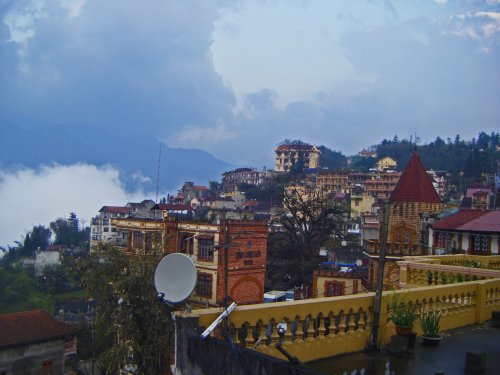
In a way, this was a perfect example of what we saw in Bac Ha, a village in transition, growing quickly, a convergence of the old and new. You’d as soon see a sleek, modern mini-bus and motorbikes(with the requisite horn honking) going in one direction, and this going in the other.

Bachanight03

Some of the streets were just dirt paths, but right outside the city, major work was taking place. The roads were being widened, and fresh asphalt was being laid.

But at the time, I had something else on my mind. Specifically, a nice leisurely nap. Unfortunately, the prospect of a visit to dreamland was to be put on hold. The Missus had caught Her third, or was it Her fourth wind, and was ready to go. I was still trying to summon up my second, or even hoping for my first wind, and perhaps some fumes. Off we went, trading my leisurely nap, for a not so leisurely walk. It’s not like you can get lost in Bac Ha, it seems that all roads end up in the same place. And it was an interesting seeing the "new" Bac Ha:

Bachanight04

Right across the street with the "old".

Bachanight05

Yes, folks, Bac Ha is going places….where she stops? Nobody knows.

After taking a short walk we somehow, unintentionally, ended up back at our hotel. Like I said, all roads in Bac Ha, lead to the same place. I decided to stop by the "lobby/restaurant/bar" to purchase some water, and have some tea. Here’s where I ran into(no pun intended) a bit of a gastro-intestinal "blip". I was sitting at one of the tables, drinking my bottled water, when the really nice Woman who ran the place decided to scurry to the back room and grab me a glass. The glass looked like there was some residue on it, and perhaps a good layer of some unknown detritus, which I tried to discreetly wipe off. But, I couldn’t insult her by not using the glass, so I poured water into it and had a sip. It definitely tasted a bit off…and one sip was all it took. For a few hours, my stomach made sounds like the HMS Titanic sinking into the Atlantic, I contributed to global warming in a very unpleasant manner, and there was a toilet paper shortage in room 301. Lucky for me, it was just a passing(again, no pun intended) thing. Furthermore, there was no way I was going to miss dinner! And so with the help of a few "pepto", and the stuff being sold from this pot:

Bachanight06

I was fixed up in no time. The pot contained sugar cane simmering in ginger water. The ginger had me back in no time.

Bachanight07

Yes, boys and girls, I hope you see the irony….I was cured by street food! By the time we met Thinh for dinner, I was ready to go…no, not there…I was ready to eat.

The restaurant selected was where we stopped for a break on our way to Can Cau Market the previous day. Like many of the places in Bac Ha, this was another Hotel/Restaurant. In this case, named Ngan Nga.

Ngannga01

We took a table outside and were handed menus. Going down the page I read, "omelet, Pho, fried noodleNgannga04s, fried rice, french fries?" Say what! I didn’t make a miraculous recovery from death’s door to eat french fries! Thinh just laughed and said, "one minute, I’ll order the food." After a few minutes Thinh returned, and by that time, the Nuoc Mam Cham arrived, along with…….guess what? Salt&Pepper-Ground Chili(this one was really good)-Lime, of course.

Ngannga03_2

The first dish to arrive was a plate of blanched than sauteed Chinese BroccoliNgannga02(Gailan), which I was told was called Cải Làn (pretty close) in these parts. It really wasn’t anything we haven’t had before, except that this version used both soy sauce and fish sauce.

The next dish that arrived was a cold chicken dish. In this case the simmered chicken was chopped, and topped with thinly sliced kaffir lime leaves.

Ngannga05

As I enjoy cold chicken dishes much more than the Missus, I was fine with this. The chicken was on the chewy side, as wild, roaming chicken should be. The flavor was 100% true chicken; the lime leaves added a nice citrus-sour flavor, and a dip in the chili-lime-salt concoction helped out as well.

A plate of simmered pork arrived next, mildly flavored, and leaner than what wNgannga06e had for lunch. The chopped pork was combined with a herb that had a basil-cilantro type flavor. Thinh wasn’t able to tell us what was used. The Missus, still recovering from the pork at lunch, passed on this one.

The next dish made the dinner a success. According to Beach, this is called Cha Com:

Ngannga07

These are fried patties or fritters if you will, made with minced pork and green rice. Man, this was good! The pork added a nice richness as only pork can; the green rice added some crunch, along with a mild nutty sweetness.Ngannga08 Oh man this was good.

The last item was steamed, vegetable spring rolls, which we found to be on the bland side. Still, this was a pretty good meal. Of course, we had started in on the Ruou Nga(Corn wine).

Which brings us on to the next part of the night. You know by now, that magical things happen when Ruou is in the picture. At the end of dinner, our driver Mr Thang made an appearance. Already hitting the Ruou with the other driver and guides(they all know each other), he kept apologizing. Of course, this meant anNgannga09other refill of Ruou! Soon enough, the other drivers and guides drifted to our table, as if some unseen signal was being sent. And the Ruou was flowing! As the sun set, our loud and raucous laughter started drawing the attention of the tourists having dinner in the restaurant. But none of them wanted to have a drink with the "crazy Asians". It didn’t help when Thinh actually lit a cup of Ruou with his lighter to show us "what it was made of". With tongues loosened by the corn wine(most of these guy weighed less than 50-55 kilos – it didn’t take much), we started getting the "real dirt" on these normally serious and stoic drivers. Thang, who was to married in a few weeks, met his wife to be when he almost ran her over. They got into an argument which continued when they later saw each other in Sapa later that day. A few days later, Thang saw her teaching a class at a school….and was smitten, I guess it was love at third sight. One of the guides, who was one of the larger Vietnamese guys I met at 75 kilos(guess my weight was a popular drinking game), was appropriately named the equivalent of "Hero" in Vietnamese, and enjoyed flexing his muscles, Hulk Hogan style.

Ngannga10

It seems that drinking with a female was foreign to these guys; this manifested itself in some fairly strange and humorous ways. Several times, the Guys raised their hands and asked the Missus, "madam, may I go to the WC(water closet)?" Ruou fueled regression? And then came the high lite of the evening. One of the drivers told us he had three wives! You read that right; three wives! Thinh was beside himself, almost rolling on the ground. He’d known this driver for several years, and didn’t know the guy had three wives. And no, polygamy isn’t legal in Vietnam. Apparently, he has a bus route that takes him to some far flung villages, and so things just kinda happened(yeah right). All was well now, for they all knew about each other….they even get together and go out to dinner once in a while(I’d love to see that)! No wonder this guy was so skinny! Since this story couldn’t be topped, we decided to call it a night. It was fun seeing this bunch of guys hanging out, and acting, well…like any group of young men. Some things are universal. Our dinner, and at least 4 refills of Ruou ran 220,000 VND( a bit less than $14/US). We staggered our way back to the hotel, where we were greeted by the Owners and staff, who asked us to have dinner, and (of course) some Ruou with them. I went upstairs and shared the last of  the snake wine, and we had a few toasts before calling it a night.

It had been a full day……

And we needed to get up early in the morning!

Bac Ha/Can Cau: Can Cau Market

The morning after our hike, we rose early(still jet-lagging), walked around a bit and had our Banh Cuon and Bun Cha breakfast. At 700 am we settled our tour and room tab and met our Guide for our over-night trip to the village of Bac Ha. Many people make the Sunday day trip to Bac Ha, but it's 3 1/2 (100+ kilometers)hours each way, so we thought we'd be able to miss the tourists by going a day early, and staying over night in Bac Ha and hitting the market before the crush of tourists. And we'd be able to visit the Can Cau Saturday Market to boot.

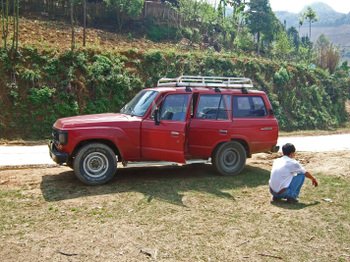
We met our guide, an amiable and very friendly young Man named Thinh, and our Driver, a very quiet(at first) young man named Thang. Meet our chariot:
Roadtobacha01

We had gone the private guide and driver route. Our car was a diesel Toyota Land Cruiser, with a dead suspension, and the fumes sometimes almost got the better of us. But it was fun being able to stop whenever we wanted, and to have Thinh's vast knowledge to ourselves. We got much more out of  our trip by going this route.

Once we left Sapa, and passed through Lao Cai, the road got a bit, well, rougher. Luckily, the previous night's rain hadn't been very hard, otherwise the road to Bac Ha would be washed out, and our trip canceled. We saw major road construction during several stretches of our trip, soon enough you'll be able to make the trip over nice smooth asphalt. Funny, but I think the trip will lose some of it's charm, though your spine and other internal organs may appreciate the modernization.

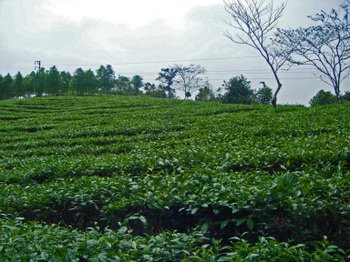
We passed some sparkling green tea growing(we bought some on the way back) on the hillsides:
Roadtobacha03

And rice paddies in the valleys:

Roadtobacha02

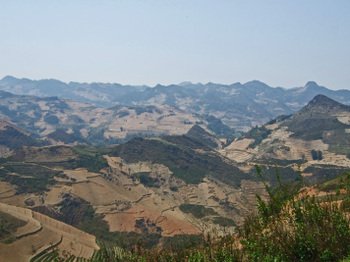
After a kidney crunching 90 minutes, we reached the steep and winding road up the Bac Ha Mountain range. A new road is being built, but was only one-fourth complete at the time of our trip. The weather had changed significantly as we drove through the mountains, and some of the views were spectacular.
Roadtobacha04_2

It was much drier around here. Soon enough, we skirted more road construction and arrived in sleepy, dusty Bac Ha Village. Remember this photo, and compare it to the same shot in a future post.

Dustybacha01

After a short "break", we made our way to Can Cau Market. We passed the terraced mountains:

Roadtocancau01

Except in Bac Ha it's corn, not rice, that is king. Can Cau Market is approximately 20 kilometers North of Bac Ha, and we had to pass through one "bird flu" inspection/disinfection station on the way to market.

Stepping into the market at Can Cau is like being instantly immersed in a different world. The market itself occupies several "levels" of an hillside. Food stalls occupy one level:
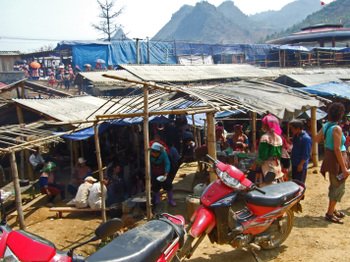
Cancau02

Dry goods, hardware, herbs occupy another:

Cancau01

And livestock can be found in the valley below:

Cancau17   

As we walked past the "food court" and up the stairs, dodging "tipsy" older men walking on unsteady legs, we passed  the vendors selling them the treasured local moonshine Ruou Ngo(corn wine). You can see the plastic gallon containers in this photo.

Cancau03

There was one vendor who caught the Missus's eye:

Cancau04

This lady was selling Indigo dyed rice. The Missus wanted to try it out, and with the help of Thinh purchased some. The Missus only really wanted a taste, and had Thinh try to explain that to the woman, but she insisted on giving the Missus her money's worth!
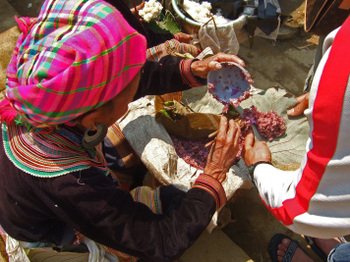
Cancau05

Indigo rice is eaten for good luck, and really doesn't have much additionaCancau06l flavor. It was very pretty though.
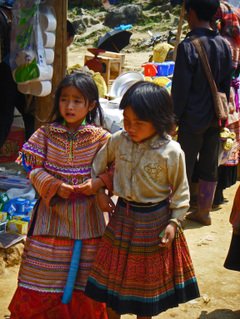
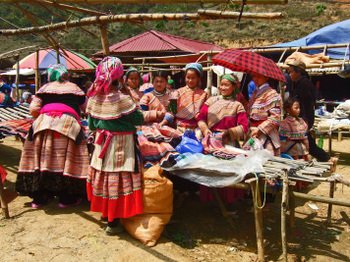
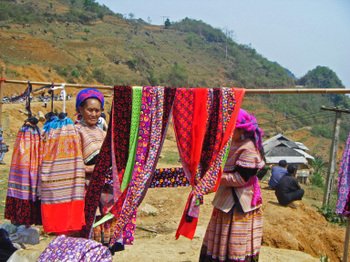
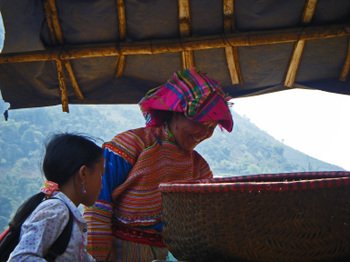
Speaking of pretty, as you probably notice in the photos, the attire of the Flower H'mong is distinctly colorful and vibrant. Flower H'mong scattered in villages in the area all come to the Saturday market. Another thing we noticed is that compared to other "markets" Can Cau is relatively "quiet".

You can't help but be enchanted by the bright colors of the Flower H'mong:
Cancau08

It's not only the Flower H'mong who stand out. Blue(Green) H'mong women are also easy to identify, by what else, their bright blue embroidered skirts, leggings, and tunics.

Cancau09

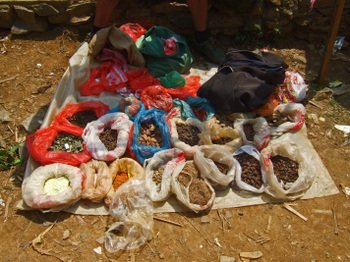
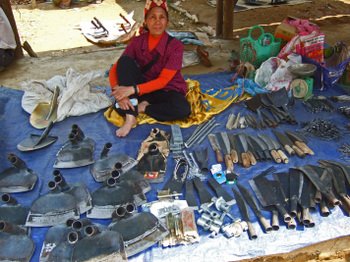
Since Can Cau Market is close to the Vietnam-China border, you'll run into Chinese vendors selling items like herbal remedies.
Cancau14

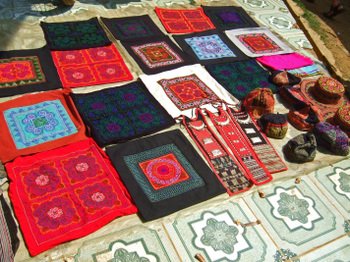
And of course many of the H'mong sell brightly colored textiles.
Cancau11

Cancau12

It seems that you can get any of your necessities at Can Cau.
Cancau15

Cancau16

Of course, not everybody was happy to be here. This little piglet wanted nothing to do with any of the proceedings. I really don't blame the little critter……

Cancau18

We had noticed that all of the tourists had cleared out by this time. It had gotten pretty hot, and most of them had headed back to their buses. But for us; it was lunch time. We had made it very clear to Mr Thinh, that we didn't do the "tourist eating" kind of thing. And he guided us to the eating area, low benches(after sitting on those little stools in Hanoi, I was getting good at this squat-sit kinda thing), on a patch of dirt shaded by tarps….just like we wanted…..

Cancau19

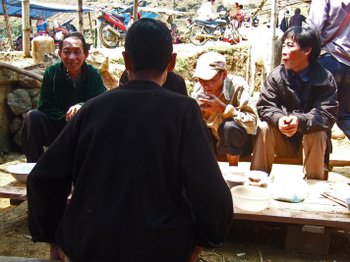
Directly to our right, the lounge lizard crowd was going strong. This was their "Friday Happy Hour", and they were sure hitting the Ruou pretty hard.
Cancau20_2

Thinh told us to wait, and got up to grab our food. I did tell him one thing; to please skip the Thit Cho. It really, ahem, didn't look very tasty. Thinh told me, he doesn't care for it anyway.

Cancau21

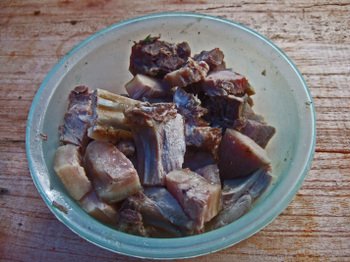
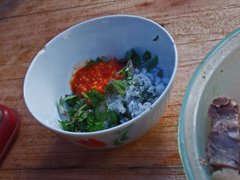
Thinh returned with a bowl full of simple boiled pork(he couldn't find any Thang Co – Horse meat stew).
Cancau22

Cancau23 Along with a bag of sticky rice, and the standard issue chili paste-lime-salt-herb dip, this was a simple, yet fatty dish. I enjoyed the mild chewiness, and thought the fat parts had some pretty decent flavor. The Missus was kinda grossed out over the look of the dish. This is free range pork, with a decent fat content, it is not the "other white meat".

We also got a piping hot bowl of soup; a clear broth with a strong white and black pepper flavor. The hand cut noodles were a nice al dente, though this pork was on the tough side.

Cancau24

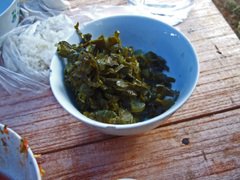
When it comes down to itCancau25_2, I'd take this over Northern Pho any day of the week. The one item that came with the soup that the Missus loved were the simple pickled mustard greens. Salty and sour, the Missus said it reminded Her of childhood.

Now this is where it gets interesting. We had noticed that people were starting to pay more than a passing amount of attention to us. After a few minutes; 2 gentleman of the Giay people spoke to Thinh. Thinh came back to us and said; "they told me that they want to have a drink with you, because tourists never eat with them. They are very happy and proud that you would eat the same food". What can you say? Of course, we were obligated to. So we had first one, than another, than another round. I had Thinh get them a refill of their Ruou(at 8,000 VND – 50 cents, it's a bargain). Ruou Ngo is pretty smooth with a mild finishing bite. After a few more rounds, everyone became less inhibited, and the conversation(with Mr Thinh's translation) flowed. We were told that "they don't believe you're American. They say that you cannot be American, you don't look like Americans. Americans rarely come here, and those that do are afraid of the food, and won't drink with them. They take their pictures and leave right away." This was a common theme for us through the trip, "no, no, you cannot be American, Australian maybe?" In the end, we settled for, "ok, tell them, I'm Japanese, and the Missus is Chinese." About this time, the Missus asked if She could try and have a smoke with one of the men's bamboo smoking pipes(Diếu Cày). The crowds started gathering, I guess the show was about to start.

Cancau26

Thinh prepared the tobacco(Thuoc Lao), and the Missus sucked harder than an Oreck VacuumVacations2008_096  Cleaner, and you could hear the water in the bottom of the pipe start to gurgle. And then it was; "cough, cough, choke, gasp, gag, blech" and a whole range of gagging and gasping noises(In her spasms, the Missus accidentally blew a smoke ring!). The Mucous's Missus's beet red face told the whole story. "Whoa, that was strong." By now  the Missus had become a real novelty(an Asian no less) in this conservative society where women don't smoke, nor drink in public. In celebration of the Missus's (lack off) smoking prowess we had a few more rounds. Because I was starting to enjoy the Ruou a bit too much, I knew it was time to leave. We paid our tab (30,000 VND – just under $2 US), and as we were leaving the proprietor of the pork stall came by with the standard issue used plastic water bottle filled with Ruou. Thinh explained that he wanted to have a drink with us. He made aVacations2008_097 toast which Thinh translated, "to Vietnamese and Chinese, we are brothers and neighbors, and brothers sometimes fight, but in the end we are still brothers".
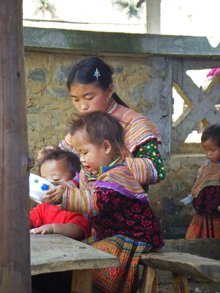
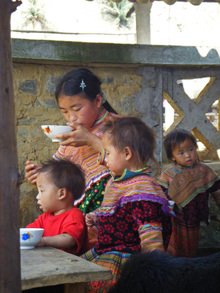
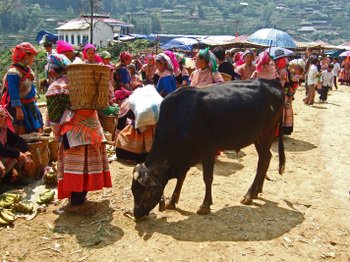
We were told an old joke about Can Cau Market. "In the mornings, the people arrive, the husband is walking, and the wife rides the buffalo. In the afternoon, the people leave, the wife is walking, the husband is sleeping, laying across the buffalo." Well, this "husband" really needed an afternoon refresher by now.
Cancau27

Cancau28_2 This had been one of the more memorable experiences of a trip full of memorable experiences. Can Cau Market seemed a million miles away from Sapa; still unspoiled, the people work hard during the week, and enjoy life on Saturday at the social center that is the Can Cau market. These are good country folk, tough, sincere, and under the hard earned calluses, warm and generous. It was hard for us, and is still difficult for us to fathom. The exotic market, the colorful people of the Hill Tribes, eating, and drinking firewater with the locals. These are the things you read about, that happen to other people, to have lived it ourselves made us feel blessed. Days like these make it all worth while…….
Vacations2008_100_2

I realize this humongous post may be a bit hard to digest, but I hope you enjoyed it!

Cali Baguette Express – A First Impression

I noticed that a new, bright and shiny restaurant opened in the former location of El Metate Mexican Restaurant on El Cajon Boulevard. I thought the logo looked a bit familiar…….

Baguetteexpress01

And after a look at the menu, I was pretty sure.

Baguetteexpress03

With sandwiches like the Cajun Shrimp and Turkey with Pesto, this appeared to be a new location of Baguette Express. I’ve eaten at the location Valley Boulevard in San Gabriel. I can tell you this, the place is already pretty popular.

Baguetteexpress02

Baguetteexpress04 There’s a section selling grocery items, and stuff like baguette "ends" which are pretty good for croutons. Why are the ends trimmed? Well much like the mega-chain Lee’s, or San Diego’s own K’s Sandwiches, BE uses the extra long bread, and I figured the sandwiches would top 10 inches.

I placed an order, and after a short wait….well, it was a bit of a long wait, it looks like this place is still trying to get all the pieces in place. I received my sandwiches.

I ordered the Dac Biet(special – $2.99):

Baguetteexpress05

Baguetteexpress06 And yes, here it is. The bread is about 10 inches, and is much more "stuffed" than the usual Banh Mi. As with my previous visit at the LA location, the pickled veggies edged toward the sweeter side, and cross-sliced cucumber was added. The bread is lightly crusty, which is good, but overall, the Banh Mi doesn’t have much flavor or chew to it. I do think it is better than K’s bread, which sometimes ends up on the mealy/crumby side. Thin slices of routine Cha Lua and moist and mildly flavored BBQ pork were layered on the top and bottom of the sandwich respectively. The head cheese was tasteless, with hard, inedible bits that reminded me of toenails. There was a decent, unobstrusive amount of mayo on the sandwich. Mediocre overall, but it will really fill you up.

For some reason, I ordered the Xiu Mai (pork Meatball – $2.69) Banh Mi:

Baguetteexpress07

In retrospect, I should’ve ordered something else, perhaps the Cajun Shrimp, whBaguetteexpress08ich I rememebred being pretty good, or the Nem Nuong. This was a really terrible mishmash of flavors, think mushy, mealy, sour, mystery meat. It was also a bit too heavy on the mayo.

In spite of this, I’ll probably be back. I enjoy the menu, which you can think of as K Sandwich with attitudeBaguetteexpress09 . Items include Banh Mi Ca(sardine), Banh Mi Trung(egg), in addition to even Bun Bo Hue(not sure I’ll try that though). And it looks like this place is going to have a drive-thru. I can just see Ed from Yuma grabbing a coupla Sardine Banh Mi’s, extra Peppers on the his way out of town!

Cali Baguette Express
5215 El Cajon Boulevard
San Diego CA 92115

Website here.

Sapa: The Matra – Taphin Death March, But at Least There’s Lunch!

When I left off, I mentioned sitting down with the Tour Director of the Mountain View Hotel, and putting in our requests for various tours. The Missus had given me a list of items, and I went through each, and ensured that all our requests were clarified. The Missus had wanted to do something called the Matra-Taphin "trek", which I didn’t really know anything abMatrataphin02out, and frankly didn’t pay much attention to….I just went ahead and paid for it. 15 minutes later, we met our guide, Mai, a friendly young lady of the Black H’mong group. Black H’mong women are easily recognized by their indigo dyed, hemp clothing. As we were walking to the Van that would be dropping us off, I was reminded that the hike would be about 15 kilometers or so. 15 kilometers! Yes, just what my sleep deprived mind and body needed, a "little" 15 kilometer hike……

We were dropped off about 8 miles outside of Sapa, walked down a short dirt road, and started on our way.

Matrataphin01

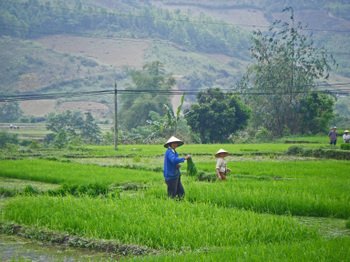
And I must say, the rice terraces lulled you into a kind of pastoral peacefulness.

Matrataphin03

I took my time, and snapped photos while the Missus’s grilled Mai, with all kinds of questions…"why do you where leggings?" "What happens if a Black H’mong marries a Red Dzao?" And on and on….Mai took it all in stride.

Matrataphin04

Growing rice in Sapa is not an easy task; there is only one crop a year, and a short window for planting. And this year’s window was extremely short. The winter had been cold, long, and dry, and many Water Buffalo, key partners in the tilling process had died, and so much of the planting was taking place without them.

Matrataphin05

The beautiful landscape belied the fine tightrope that the people who worked the land walked.

Matrataphin06

The harmony between man and beast was quite apparent, as the free roaming livestock paid us no heed.

Matrataphin08

And spring had brought on the birth of offspring of those that survived the winter.

Matrataphin09

Well, most of the livestock paid us no attention. This Water Buffalo seems to be a bit irritated at having his photo taken; as if to say "whatta you lookin’ at?"

Matrataphin10

As we approached the Black H’mong village of Matra, we saw more and more children. This kid was pretty talented.

Matrataphin11

He was bawling his head off, and tightrope walking on the dike at the same time!

Matrataphin12

These are the plants that yield the Indigo Dye that the Black H’mong use to color their clothing.

Matrataphin13

Matrataphin14 Hemp is the textile most used by the Black H’mong, many other types of cloth will not "hold" the indigo dye. The indigo plant is processed and made into a powder. It is then made into a liquid that will "hold" to the hemp, often using urine and rice wine, among other additives. The whole soaking process can take up to 2 months. A nice post can be found here.

As we approached the village of Matra, we started seeing many more children. The first thing I noticed, was in spite of the very rural conditions, many of the homes had satellite dishes……after all, you gotta have television, don’t you?

Matrataphin15

Matrataphin16

We were really enjoying our walk; learning a lot about life in these villages from Mai, when it happened…..The Attack of the Red Dzao.

Matrataphin17

Now, we’re not adverse to people trying to make a living, and frankly it comes along as part of the package anytime you travel, whether it’s Peru, Cambodia, Vietnam, you name it. But I don’t think I’ve ever felt more like I was being held hostage(well, perhaps other than having to attend a time-share presentation years ago), than I did on this stretch of trail on the way to Taphin. This gal would not take no for an answer, and even got a bit nasty at the end. "I walk all this way, with baby….you have to buy something! Have to!" And the tough thing was, she invited three of her other close friends.

Matrataphin18

At least after this experience, we knew what the standard script was. In order, this is how it went every time:

"What your name?"
"Good name, good name!"
"Where you from?"
"How long you in Sapa?"
"You buy from me ok?", followed by "Why you no want buy from me?","If you buy, you only buy from me. ""You have to buy from me." And so forth.

It seems like only the Young Dzao Women are this persistent; the Older Women are funny, on our way back to Sapa we picked up a group of them who looked like they needed a ride. They where having a heck of a time in the van. And though they tried to sell us stuff, they weren’t nearly as aggressive as the younger Red Dzao women. When I returned from vacation, I was reading one of Vietnam guides, which mentioned how "shy" Red Dzao women are…. Hmmm. Luckily, Red Dzao women are pretty easy to pick out by their bright red head-dress and their shaved eye brows. The also shave the front potion of their scalp.

This put Mai in a very tenable position, she could see that we were being aggressively accosted, andMatrataphin23  we’d been stuck to for over 2 kilometers, with no sign of a let-up. The village of Taphin is also a Red Dzao village, and there was the potential of picking up even more folks trying to sell us stuff. On the other hand; though Mai told us that this isn’t a very popular hike, she does bring tourists this way, and needs to keep up a good relationship with everyone. Her solution soon became apparent, she took us off the regular trail, and we ended up skirting the valley. And we were thankful, not only for the chance to enjoy some peace, but for the views this afforded.

Matrataphin21

The area around the building you see in the background was where we were headed; Taphin.

Matrataphin22 

Eventually, we came across a concrete "road" where we saw a few tourists on motorbikes, and entered into the village of Taphin. Don’t let the more modern looking path fool you; life here is still quite hard.

Matrataphin25

Matrataphin26 

Matrataphin27 

Matrataphin28 One of the concrete paths ended at this cave. The Missus read the sign in Chinese next to it, and told me it was the "Dragon Cave". According to Mai this large cave is where many of the villagers hid during the war. After a short rest to soak up the cool air, we decided to head on over to the lunch spot.

As we turned back and headed down another path, where we came across 2 girls trying to chase down some runaway goats. Their giggling was infectious. And if you enlarge the photo(click on it), you can get a peek at a man sitting on a water buffalo watching on in amusement.

Matrataphin29

Matrataphin31

We stopped at the end of the path for lunch. you could tell that this was the place by the motorbikes. And if that didn’t tell you that this was the place to stop, the Water Buffalo parking sure did.

Matrataphin30

Matrataphin32 At this point we sat, and Mai disappeared. Only to reappear about 10 minutes later with plates of veggies, fruits, and Banh Mi.

Matrataphin33

And some really nicely fried eggs(and don’t forget the laughing cow cheese)…when it dawned on us; Mai had carried this stuff in her back pack, than prepped and cooked everything for us.

Matrataphin34

We felt kinda bad….and we mentioned this to Mai, who told us, "oh no, sometimes I have to carry and make lunch for 10 people, that is heavy." The lunch was deceivingly filling and refreshing at the same time. During lunch we got to know a bit better, She has been a guide for 1 1/2 years, and is only 19 years old! And here’s the kicker, Mai has been working her whole life, whether helping in the fields, or caring for one of her 8 siblings and was never able to go to school, and thus is not able to read or write in her own, or any language. Mai’s English was excellent, so we were wondering how she learned English. Mai told us that she picked up English from tourists. Talk about being resilient…

After lunch, we made our way to our ride, and back to Sapa. In addition to being bushed, I was in need of a shower. We had learned much from our hike, and much of it was due to Mai. If you’re ever in Sapa, maybe you’ll consider getting a local guide, we think you’ll be glad you did. Thanks Mai!

Matrataphin35

That evening, still strangely full from lunch, we had some street food(that is another post all together) and dodged raindrops back to the hotel. We sat on the balcony watching the lightning, and staring in amazement as we watched the wall of fog move up the valley envelop us. All while sipping on the wonderful Snake Wine from Le Mat. Life was good!

Saturday Stuffs: Oven Shoyu Chicken and Fresh Mangosteen in San Diego

Just a few Saturday Stuffs:

Oven Shoyu Chicken:

04112008_002

This is one of the first things I made after our return from vacation. It is an easy dish that everyone cooks "back home" in Hawaii. Though most times it’s simmered on the stove top, and the sauce thickened with cornstarch to make a gravy after the chicken is cooked. Being kinda lazy, I did the oven version. The origin is without a doubt; Chinese, but the addition of more sugar, and the "shoyu"(the Japanese word for Soy Sauce) indicates the Japanese influence of the dish. And to make things even more confusing, I threw in a coupla tablespoons "Kochujang" to add a Korean flavor to the whole mess.

2-3 Lbs Chicken Thighs(Whole with skin)
1/4 Cup Shoyu(Soy Sauce)
1/4 Cup Dark Brown Sugar
1/4 Cup Chicken Broth (or water if this seems too salty for you)
1/4 Cup Canola Oil
2 TB Sake or Shiaoxing
2 Tsp Finely Minced Garlic
1 Tsp Grated Ginger
Other flavors as desired – in this case I added 2 Tb Kochujang, but I’ve often added 5 spice powder, star anise, more garlic, chili paste, more ginger, miso, and whatever I feel like…

1 – Preheat Oven to 350
2 – Combine Marinade
3 – Line a baking pan with foil
4 – Pour Marinade into pan
5 – Place thighs skin side down into pan
6 – Bake for 30-45 minutes, or until juices run clear, turning the chicken 3 times.(04112008_003End with skin side  up)
You may also turn the oven up to 450 and bake the chicken skin side up for the last 5-10 minutes.

You can make it "fancy" by adding sesame seeds, some finely chopped scallions, whateva’……

04112008_005

"Fresh" Mangosteen in San Diego:

I apologize for deleting and misplacing the email asking me about the availability of Fresh Mangosteen in San Diego. 05022008_012 

You can read the New York Times Article here.

*** And an even more updated article here (Thanks "user").

The specimens to the right were seen at Lucky Seafood in Mira Mesa, I found it in the front portion of the market, right when you enter. I can’t vouch for the flavor, as the price of $6.99/lb was a bit steep for me. But there you go, fresh Mangosteen in San Diego.

Lucky Seafood Supermarket
9326 Mira Mesa Blvd
San Diego, CA 92126

Sapa: Banh Cuon and Bun Cha from Cho Sapa(Sapa Market)

Sapa lies to the Northwest of Hanoi, close to the Chinese border, in Lao Cai Province. Much of Lao Cai Province is dominated by  the Hoang Lien Son Mountain range and Mount Fanispan(the highest peak in Vietnam). It is a region dubbed the Tonkinese Alps by the French, who first settled and started to develop Sapa in the 1920's. And though both Jesuit Missionaries(in 1918) and the French(in 1909) claim to have "discovered" or "settled in" Sapa; the area has long been populated by the "Hill Tribes", called the Montagnards("mountain people", "from the mountains") by the French. In and around Sapa, the 2 main ethnic groups are the H'mong(most notably Black Hmong) and the Dzao("Zao", mostly Red Dzao). Sapa is also known for the mild weather; I was told it hardly ever gets warmer than 30 degrees Celsius(about 85 F), and it does get down to as low as 4 C(about 40 F), this year had been especially cold, and there had been some snow! Some of these facts might have gone through my head(my mind has been called a "cesspool" of useless information), had I not been so tired and hungry. We had been dropped off right at the bottom of a street called Cau May. We decided to shop around and see what prices and rooms were like, and many places will let you check out the rooms before making a decision. We eventually chose the Mountain View Hotel, not because of the price(rooms $10-$15/ night), nor the rooms, which were run down, shabby, and had an "outhouse-ish" smell to them. But because of the view.

Mountainview01

And the Missus had some "plans" in mind, where we'd really only stay here for one night.

You can see why they call it the Tonkinese Alps…….

MountainView02

Sapabanhcuon01 By now, I really didn't care what fiendish plan was simmering in the Missus's head(to my chagrin…..more later). I was just plain hungry. Now in every city, town, or community there seems to be a "central market", you can call it "Mercado Central", A Farmer's Market, or whatever; it is, in most basic terms, a gathering place for the community to shop and socialize. And these markets usually includes a few places serving food. In the case of Sapa, it was simply named "Cho Sa Pa", Sapa Market.

And in the middle of the bustling market, were the food stalls. Heck, call it a food court if you will.

Sapabanhcuon02

One section served soups, one section fried items, in this section, some major heat was on display.

Sapabanhcuon03

And the Husband and Wife team specializing in two dishes. The Husband manned the grill(it's universal, isn't it?), cooking the ubiquitous "meat on a stick". You could smell the Bun Cha from quite a distance.

Sapabanhcuon04

His Wife, slaved over the large pot of boiling water, covered with a metal frame with linen, making Banh Cuon, those wonderful thin sheets of rice floor noodle/crepe.

Sapabanhcuon06

A scoop of batter was poured and spread over the base.

Sapabanhcuon07

Covered, than folded with minced pork and cloud ear fungus.

Sapabanhcuon08

Sapabanhcuon09  So naturally we had to have one of each. All of the classic garnishes and accompaniments were provided; pickled papaya, a warm fish sauce based dipping sauce, the runny-sweet-mildly spicy hot sauce that I've come to miss, and of course herbs and greens.

Sapabanhcuon10

Tons of fresh mint, and the Missus, for some reason, really liked the lettuce(?).

The Banh Cuon(15,000 VND – just under $1/US) arrived first, steaming hot.

Sapabanhcuon11

The Bahn Cuon was topped with fried shallots, and Pork Sung, what we call "Rousong"…..basically dried shredded pork. Not my favorite thing in the world, but in this case I wasn't bothered too much by it.  This Banh Cuon was much more delicate than the version I had in Hanoi, and it had a nice bit of stretch to it. Not as much filling as that version, but I enjoyed it more.

The Bun Cha(3 skewers – also 15,ooo VND) arrived soon after.

Sapabanhcuon12

Sapabanhcuon13  While the Husband was setting the plate of pork down, his wife ran over to one of the booths just outside of the eating area, and came back with a plate of Bun. This was the best Bun(Rice Vermicelli) we had on the entire trip, just the perfect combination of slightly sticky, and very mildly chewy. The dipping sauce was like almost every other we had, basically a fish sauce "broth". The Bun Cha was "jerky-ish" but tasted very good. Lemon Grass and Fish Sauce were the prevailing flavors, with just a hint of citrus, onion(I'm thinking shallot), and sweetness. We enjoyed ourselves so much, we returned the next morning!

The couple who ran this stall was very nice; the Husband was the more outgoing and social of the two. Somehow, on our second visit, through gestures, we figured out that his Mother ran the stall next door. Looks like the family business is going strong! And though his wife, the quieter of the two, was in constant motion, whether cleaning, or doing some other task, sometimes with their infant on her back. On our first visit, she noticed the Missus's interest in the Banh Cuon contraption. Yep, you guessed it, a Buon Cuon lesson was in order. First she demonstrated.

Sapabanhcuon14

Now it was the Missus's turn. Can you tell that she's a bit concerned, perhaps about the Missus burning Herself, or maybe seeing their profits being wasted?

Sapabanhcuon15

Actually, with a bit of help, the Missus did Herself, and me proud. Not a bad job overall.

Sapabanhcuon16

Yes, Banh Cuon so good, the Hmong eat there…..

Sapabanhcuon17

After the meal I was ready for a nap, but that was not to be. The Missus had other plans in mind. We returned to see the Black Hmong getting ready for a busy day of "selling".

Vn200802_067

Still in a bit of a stupor; I sat down with Mr. Phuc, and went through what we wanted to do in detail. I really didn't pay attention to what I requested for this morning………

Hanoi: Bun Cha Dac Kim, and We’re Off to Sapa

Leaving Hanoi without trying some Bun Cha would have been criminal, we just could not do it. The mere thought of Bun Cha is enough to send me into full blown salivation mode. We decided to go with the highly recommended(by at least a half dozen people) Bun Cha Dac Kim(aka #1 Hang Manh). By watching the constant stream of motorbikes parking and leaving, and the foot traffic, you knew that this was the "right" place.

1hangmanh01

An SRO(Standing room only) crowd of customers, wedged elbow to elbow, on 4 floors no less, speak to the popularity of the place.

1hangmanh08_2

All this activity going on in one small space. Check out the cooking/prep area. Somehow, when I read about restaurant designers discussing "Open Kitchens" I don’t think they have this in mind. Check out the heavy duty wristband on the gal manning the "fry station".

1hangmanh02

You’d better bring your "A" game, when ravenous customers are practically looking over your shoulder!

1hangmanh07

1hangmanh04

1hangmanh03

As good as this Young Lady was, she had nothin’ on the gal assembling the Bun Cha.

1hangmanh05

Twisting, turning, moving, at a high rate of speed within tight quarters, she had more moves than Richard Simmon’s stunt double!

1hangmanh06

After waiting for a short while, we were guided up the narrow stairwell that reminded me of the time I toured a submarine, and ended up on the third floor. They managed to squeeze us in at the end of one of the tables, and I sat; "half cheek" style. We placed our orders, well, this place serves Bun Cha and Nem Cua Bể(Fried Crab and Pork Spring Rolls) so there’s not much "ordering" to be done. There was one Woman who ran the floor, with 3 "runners".

And blam-blam-blam, everything arrived in a flash. Fresh herbs and lettuce.

1hangmanh09

What seemed to be the standard Bun(Rice vermicelli) in Hanoi, mushy and sticky.

1hangmanh10

A mild fish sauce with pickled papaya.

1hangmanh11

And the star of our show, the meat! All to complete the ubiquitous Bun Cha, classic street food gone good….

1hangmanh12

As the grilled ground pork meatballs and thin slices of grilled marinated pork covered in broth arrived, it hit me. Here I was, having what I consider to be one of the 2 or 3 "classic" Northern Vietnamese dishes, what I’ve often times ordered as "Bun Cha Hanoi" on various menus….in Hanoi! Reality was a bit different. The meat was a total polar opposite of what I’d thought it would be. Going against character, the meatballs were very, very soft, like Mom’s best meatloaf, . The slices of pork were much more tender than anticipated as well. The broth and Nuoc Mam Cham(fish sauce based dipping sauce) were very mild, almost borderline bland.

The Nem Cua Bể were nothing like any Cha Gio I’ve ever had.

1hangmanh13

The very thin rice paper was light and crisp, and without any hint of oiliness. The filling was light, like an airy crab mousse. The Missus dumped all Her meat into my bowl, and went to work on the Nem Cua Bể……

1hangmanh14 While eating we noticed something that we saw repeatedly in Vietnam and Cambodia; greens and vegetables were eschewed. More than half the people left all the fresh herbs and lettuce untouched. This was explained to us later; "we are a poor country, most times our standard meal is vegetables and rice. When we go out, we want meat." Duh(smack to my forehead)….I shoulda been able to figure that out myself.

Total for the meal 80,000 VND(approx $5 US). This was the most stuffed I felt in Hanoi.

Off to Sapa we go…..

After a full day visiting the  Museum of Ethnology and Hoa Lo Prison(aka "The Hanoi Hilton"), we had to head off to catch our train to Sapa. Banh My in hand(that’s a whole ‘nother post) we were dropped off at the train station. As we walked toward the station, the Missus heard me humming:

"What are you humming?"
"He’s leaving, on the midnight train to Sapaaaaaa…"
"Ugh"
"How about…. When my Baby, When my Baby smiles at me I go to Sapa…"
"Just stop it, Okay!"

Roadtosapa01

And this is where our next "adventure" began. We entered the train station, and could find no indication of trains headed to Sapa.

Roadtosapa02

I had remembered reading that there was a separate station for destinations North of Hanoi, so I went outside to look around.

Roadtosapa03

And to the right of the main building stood the "Hall of Passengers Before Entering Into Railway Station for Northern Lines"(what a mouthful). So we walked into the waiting area. We had been told that we needed to "exchange" ourRoadtosapa04  tickets for "real" tickets, but couldn’t figure out where. Finally, we saw a group of tourists enter, and their Guide (Danny from Saigon) explained the process to us. Before the train leaves, the Ticket Agent will man the "counter" and exchange our tickets for boarding passes, and he told us he’d give us the "high sign" when the time was right. Just as always, after some confusion, everything worked out. (Thanks Danny…) About a half hour before boarding time, we got the sign….but no one was at the counter! Danny pointed at the stairs:

Roadtosapa05

And there She was, motorbike helmet and all, our Ticket Agent, sitting on the stairs handing out boarding passes. Now here’s where Beach had really helped us out again; even thoRoadtosapa06ugh reservations were tight, he had arranged for us to have an entire 4  berth cabin (all the 2 berth cabins were sold out) to ourselves. Thank God! It seems that all Vietnamese Males like to chain smoke, drink, and talk really loud. And for some reason, our cabin kind of reminded me of something I saw earlier in the day.

Roadtosapa07

Happily, our cabin did lock from the inside, and I wouldn’t have to be worried about getting "shivved" in the night, nor anyone getting "too familiar" with me….. In fact, water was provided, and the bedding smelled like bleach, which in this case, we were happy about. Just be glad none of the photos of the "WC"(No, not that "WC") came out……

Due to the noise factor we didn’t get much sleep, so we were ready to go when we arrived and people were being roused at The Gulag Lao Cai at 5am.

Roadtosapa08

As we had experienced before, the arrival was controlled chaos. It was pitch dark at the Lao Cai train station, and we were herded onto mini-vans for the hour-and-a-half drive to Sapa.(30,000 VND, just under $2/ US)

Roadtosapa09

We had not made plans for Sapa, other than what Beach had done for us. And we could see nothing in the darkness as we drove. We would just be dropped off at a destination of our choosing in Sapa. Would things work-out for us?

Would it be worth the effort?

Well, here’s the view from our $15/night (versus the $10/night – no view) room in Sapa:

Vn200802_030

What’s the verdict???

Pupuseria y Taqueria Cabañas 2: Yuma

Kirk still has tales of Southeast Asia. Cathy is roaming about looking for food in San Diego, but today ed (from Yuma) finishes his discussion about the best Salvadoran restaurant in Yuma.

*** I am saddened to write that Pupuseria Cabanas is no more. One of the few cases of a restaurant doomed by its success. At least as I have heard it, the landlord was getting complaints from the towing/repair shop next door that there was no place to park during the day because the pupuseria had too many customers. Lucia was not allowed to be open weekdays, and then on Nov. 1, the restaurant was empty with no sign about another location etc. I will update if (I hope, when) she has relocated ***  :-(

When I walked into Cabañas for my second visit, my idea of Salvadoran food was pupusas and tamales. Okay, I'd also eaten some fried plantains at a couple of other Salvadoran places, but I didn't find those interesting enough to consider going out of my way to eat them again.

On that second visit, I was hoping to try some tamales, but it seems that the restaurant only has tamales on the weekend. After some linguistic misunderstandings, I ended up ordering soup – though I wasn't sure what kind of sopa it was going to be. When the soup arrived, accompanied by a hand made corn tortilla, it looked pretty much like most soups look:Img_0839

With the first taste of the broth, I realized that this was very different. Rarely have I tasted a broth with such depth of flavor and width of complexity. Perhaps the original stock was a chicken flavor (perhaps), but all I could taste was the intense flavor of a multitude of vegetables with a hint of shrimp.

My first bites were of those tasty vegetables. There was onion, carrot, zucchini, potato, and some other squash like vegetable. All of them had contributed to the incredible broth. Hiding underneath the surface of vegetables were numerous fresh tasting pink shrimp:

Img_0840

The shrimp was perfectly cooked for shrimp in a soup – tender and juicy.  Also, please notice the rich golden color of that broth. That deep color matched the deep flavors of the soup. I'm not making this up folks; this was ultimate soup.

Since that visit, the soups have become the main attraction of the restaurant for me. Each broth is intensely savory and complex. My culinary heritage tends to be west central Europe, and the standard vegetables that go into most of my traditional soups are onion, celery, and carrot (and cabbage when appropriate). At this restaurant, squashes (and/or squash like items) make a major contribution to the breadth and depth of the flavor. This makes some primal sense as squashes were the very first domesticated crop in the New World – around 10,000 years ago. So these Salvadoran soups have an ancient heritage as well as a great taste.

This is well illustrated by what they call "chicken soup." The soup itself is a rich chicken broth that tastes primarily of zucchini squash. The bowl is full of zucchinis cut into inch and a half slices. There is not a single piece of chicken in the bowl:Img_0885

The nicely roasted chicken, along with rice and an undressed salad, is served on the side:

Img_0890

The leg and the thigh were mildly seasoned and have a nice crusty exterior. The insides of each piece were juicy and tender:

Img_0893

I advised Tina to dump her rice into the bowl with the stock and the zucchinis, as I usually do when I am served rice with a Mexican soup. The more I think about this dish, the more I believe that the chicken also could have been broken up and put into the soup. That would have intensified the chicken flavor of the stock (as if that broth needed any help) and added nicely flavored chicken bites to it. It also would have been a real chicken soup that avoided the boiled chicken texture and flavor that sometimes mars caldo de pollo.

The least wonderful of the four soups that I have tried at Cabañas was the beef rib soup. You have heard of damning with faint praise; this is praising with a faint damn. It was very good, but just not quite as good as the others.

When I asked about what soup was available that day , the young man said "beef rib soup," but then he had to turn and ask  the cook a question, and I suspect that he was asking whether the soup was ready because he was answered with an affirmative and then he assured me that they had the soup.

The bowl was packed with the range of vegetables (potatoes, squashes, and carrots being most predominate) and two huge chunks of beefy rib meat:Img_0946

Compared with most caldo de res that I have had in Yuma, this was a good soup. The beef was rich and flavorful, with just a bit of fat:
Img_0963

My only complaint (and that is too strong a word, really) is that the soup would've been better with a little more cooking. The beef was tender, but not falling apart. My spoon couldn't break the two huge chunks up into bitesized pieces, so it became finger food. The stock had a nice beefy flavor, but it was the least intense of any of the soups I have had at the restaurant. Maybe another hour on the stove would have changed that.

One interesting note about that soup was the unusual vegetable that I found hiding in it:

Img_0959

Do you have any idea what this is? At first I thought it might be some sort of marrow bone since it had an obvious ring around it. Then I took a small bite and realized that this was indeed a vegetable of some sort, but I had never seen such a thing before (or so I thought). When I asked the young man what it was, he said it was a male banana – whatever that is. Perhaps he meant plantain. In any case, after I popped the piece into my mouth and started chewing, the flavor of savory banana was apparent. Nonetheless, I was totally amazed to have a chunk of banana, skin and all, in a beef rib soup. Another sign that this place is different from anywhere else I've ever eaten.

I have saved the best for last. One day they offered cow hoof soup. When I ordered it, I was warned that it had tripe as well as a cow hoof in it. Rather than deterring me, that excited me. As with many of their other soups, this one didn't immediately look at all strange (though in this pic it does look fuzzier than in real life):Img_0886

Like their other soups, squashes and potatoes were evident throughout, but a major element in the flavor of the broth was tripe. And the bowl contained numerous pieces of flavorful and chewy cow stomach:

Img_0889

At first, I noticed that this was a different tripe from the little pillows of tender joy that I am used to in menudo. This had more chew – though it was by no means tough – and a good tripe flavor. But then I discovered that the great tender joy of this incredible soup was resting on the bottom of the bowl, a cow hoof:
Img_0902

Having never encountered such a thing before, I wasn't sure what to expect. What I found was a mass of bone covered with the most tender and delectable soft tendon. These gelatinous emanations were just at the edge of melting into soup. This is as close to a religious experience I can have while eating. The words that come to mind are etherial, ephemeral, diaphonous, luxurious, transubstantive. This is how the flesh of angels would taste. Oh my god, what a textural delight.

Up to this point I had not understood why the tripe was the chewy kind, but now I realized the essential contrast that underlies this wonderful bowl of joy. The mouth feel of the various vegetables, the chew of the tripe, and now this miraculous cow hoof covered a gigantic range of pleasurable textures. In my reverie, I involuntarily began the mmm-yoso dance, eyes closed, arms bent, swaying side to side in my seat.The only down side was that I had to explain the mmm-yoso dance to Tina, who was probably wondering if I was having some sort of a seizure.

It seems somehow appropriate to end this post which began with me searching for a tamale with a tamale. Since I have been so blown away by the soup at this restaurant, I have had only one of their tamales – a sweet corn tamal that made a perfect dessert for a meal:Img_0900

As you can see from the picture, the masa is full of chunks and flecks of sweet corn. What you can't see from the picture is that the tamal came with wonderfully sour crema. With the balancing of sweet and sour, this was a perfect treat. Tina said that she had eaten similar things at fancy restaurants. Of course, she added, then they cost a lot more.

Someday I will have to try more of their tamales, but right now, it would be hard to go there and not order another bowl of soup, particularly if there was a cow foot in it.

Last Sunday, Tina and I pulled up and the place was CLOSED. I almost cried. I stopped by today, and they were open – just had some church festival last Sunday. Woo-hoo! Sometimes life is good.

Pupuseria y Taqueria Cabañas, 3405 8th St, Yuma AZ. Open every day except Thursdays and special days at church. Open for lunches and dinners.

Santouka Ramen – San Diego

*** An updated post can be found here.

I had been hearing about the possibility of a branch of Santouka Ramen opening up in San Diego for quite a while. I had heard that Santouka would be opening in the Mitsuwa Marketplace; but after Kayaba opened it's doors; or to be more precise, drew back its curtains, there was no activity for for over a year. But soon enough, word got around that Santouka was opening on April 14th. "Finally, good ramen in San Diego" was the first thought that went through my mind. And though the first few days after opening was a bit too crazy for me, it was just a matter of time before I wanted to inhale some good ramen!

Santoukasd01

I placed my order, and watched the automated green onion slicer go to work. I dunno, they had 5 people working, do they really need a machine to cut green onions? And just the fact that the Young Man running the contraption stood and fed the scallions one by one through the machine, made it seem somewhat Goldberg-ian!

Santoukasd02

I usually will just get a Shio or Shoyu Ramen, but on this day, I decided to go for the gusto and ordered the Shio Ramen – Chashu Rice set ($9.48). Which was ready in no time.

Santoukasd03

Santouka's ramen is a favorite of many food bloggers, from The Rameniac to Miss Oishii-Eats and Daily Gluttony, who made sure to attend Santouka's grand opening in West LA. Recently, "RT" doing a guest spot on The Delicious Life, called it "liquid crack". And having had a few bowls myself, albeit at the Torrance and Costa Mesa locations, I'd be more than happy to join in, singing praises…..

I approached my bowl with eagerness, and that's where the problems started.

Santoukasd04

The shio(salt) ramen, which according to Rameniac owes it's flavor to the combination of pork bones(done in the classic "Tonkotsu" style) as well as shellfish. For me, there is one key thing about the broth I enjoy; a good oil content. The shiro at Santouka is not as rich as the "good bowls" I've encountered at Daikokuya, but it usually has a nice velvety richness that will wrap itself around your tongue. Unfortunately, this bowl of ramen was served to me lukewarm, which turned it from rich, to greasy, and not as enjoyable. In fact, halfway through my bowl, I had my own little personal Exxon Valdez disaster….which marks the only time that I've never finished a bowl of ramen at Santouka.Santoukasd05_3

Still, I could live with that. Why? Well, for me, it's about the noodles at Santouka, which have a nice springy, toothsome, chew to them. These were undercooked and on the hard side. And being in lukewarm broth would not help, bummer…..

Santoukasd06 

At least the Chashu delivered, as did the boiled soy sauce eggs, an accessory thSantoukasd08at goes with the ramen at Santouka, like Marc Jacobs with the Missus.

Disappointed with my ramen, I don't even remember what the Chashu Rice tasted like, and frankly it was just an afterthought for me anyway.

Santoukasd07  

I've had enough good bowls of ramen at the other locations of Santouka to give the SaSantoukasd09_2n Diego  location "a pass" for now. I'll assume that they still need to get things straightened out. I'm hoping my next visit will be more successful.

Santouka Ramen
4240 Kearny Mesa Rd(In the Mitsuwa Marketplace)
San Diego, CA 92111